
STI Test Kit at Home: How It Works and What to Expect
You've had condomless sex with a new partner, feel completely well, and are now deciding whether to book a clinic appointment or order an STI test kit. The clinic may be difficult to reach, its opening hours may not fit your day, or you may just prefer to collect a sample privately. Those are reasonable concerns, but the right kit depends on more than convenience. You need to match the sample to the possible infection, wait long enough for the result to mean something, and know what to do if the result is negative, positive, or invalid.
Home testing can be a useful part of sexual-health care in the UK. It works particularly well for people without symptoms who want routine screening, a check after a new partner, or follow-up after treatment. It doesn't replace a clinician when you have pain, sores, unusual discharge, fever, a rash, or another symptom needing examination. This guide follows the complete pathway, from choosing a kit to interpreting the result.
Why People Choose an STI Test Kit at Home
Sam has no symptoms after starting a new relationship. A clinic appointment would provide reassurance, but the nearest sexual-health service is inconvenient to reach and finding a suitable appointment feels awkward. An online home kit seems simpler: collect the requested samples in private, return them, and view the result through a secure service.
That choice is increasingly normal within the NHS sexual-health system. In England, 8,903,930 STI tests were carried out in 2025, including 6,259,798 tests on people without symptoms and 1,790,269 on people with symptoms, according to NHS and UKHSA STI data for England. The figures show that screening isn't limited to people who feel unwell.
Privacy and practical access
A home kit removes several small barriers. You don't need to sit in a waiting room, explain your reason for attending at reception, or rearrange your day around a clinic. A plain delivery can also make the process feel more private, particularly in a shared household.
Remote testing has become a substantial route into screening. The same England report records 4,284,975 tests linked to an online consultation, and 3,465,916 of those online-consultation tests were for people without symptoms. That doesn't mean a postal kit is right for every exposure, but it does show why remote pathways matter for people seeking discreet, symptom-free screening.
Practical rule: Choose home testing for a screening decision. Choose clinical care when you need examination, urgent advice, treatment, or testing from a specific anatomical site that your kit doesn't cover.
An at-home kit can also help someone who tests regularly after new partners or wants a baseline before stopping condom use in a relationship. NHS guidance confirms that STI tests and treatment are free and available to everyone, through clinics, pharmacies, and home test kits ordered online. Home testing is therefore a complement to routine care, not a substitute for it.
What an At-Home STI Test Kit Actually Is
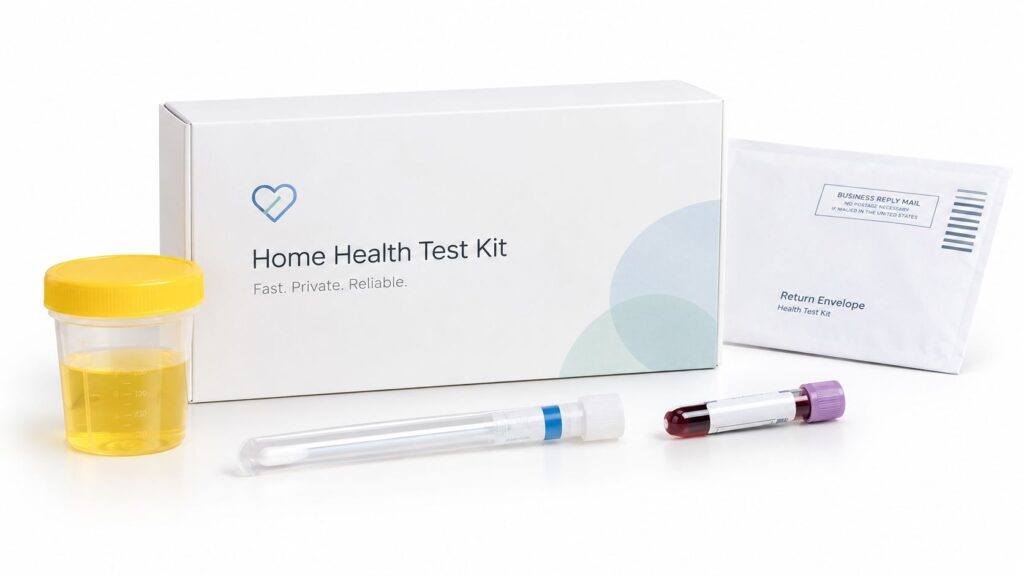
An at-home STI kit is a package that lets you collect a biological sample yourself. Depending on the service, you may order it online or obtain it through a pharmacy route. The parcel normally contains instructions, collection equipment, labels or a registration code, protective packaging, and a way to return the sample.
The phrase “home test” covers two different systems, and confusing them can lead to the wrong expectations.
Self-sampling and rapid self-testing
With a laboratory self-sampling kit, you collect the sample at home and send it to a laboratory. The laboratory processes it and reports the result later through email or a secure dashboard. This approach can combine several sample types in one screening pathway.
With a rapid self-test, you apply the sample to a device at home and read the result yourself after the time stated in the instructions. You don't mail the sample. The device and its instructions determine what the result can tell you.
Most kits are built around one or more of the following:
- A urine container for a requested urine sample.
- Sterile swabs for vaginal, throat, or rectal collection where the service includes those sites.
- A lancet and collection tube for a finger-prick blood sample.
- A barcode, code, or form that connects the sample with your registered account.
- Alcohol wipes, absorbent material, and secure packaging.
- A return envelope or sample-posting container, where the sample is laboratory processed.
The box may look simple, but each item has a purpose. The correct tube preserves the sample, the code prevents the laboratory from confusing it with another submission, and the packaging protects staff during transport.
Why the service type matters
A laboratory-processed kit can offer a broader panel because the laboratory selects a validated method for each infection and specimen. A rapid device may be useful when an immediate screening result matters, but it still has a defined scope and timing requirement. Read the product description before ordering, rather than assuming that every STI kit checks for every infection.
The NHS explains that chlamydia and gonorrhoea testing usually needs urine or a self-taken swab, while HIV testing needs a blood sample. That difference is why a full screen may arrive with several collection tools. If you have symptoms, an exposure involving the throat or rectum, or a visible lesion, a clinician may need to choose a different sample and examine you directly.
Sample Types and Which Infections They Screen
The sample type should follow the possible site and biology of the infection, not just the method that feels easiest. Urine, swabs, and blood answer different questions, so a kit containing one of them may not provide complete coverage for your situation.
A urine sample is commonly used for chlamydia and gonorrhoea. A swab can sample the vagina, throat, or rectum, depending on the kit and the sexual activity involved. Blood collected by finger prick supports screening for infections that require blood-based testing, such as HIV and syphilis.
Matching the sample to the concern
NHS sexual-health guidance recognises anal, vaginal, and throat swabs for chlamydia and gonorrhoea. The anatomical site matters. A genital sample can't reliably answer a question about an infection in the throat or rectum, so tell the provider which sites may have been exposed and check that the kit includes the appropriate swabs.
For a practical overview of male screening options, see STI screening for men. The important point is to choose a service based on the exposure, not on gender labels alone.
| Sample Type | How Collected | Infections Screened |
|---|---|---|
| Urine | Provide the requested urine sample, often using the supplied pot | Commonly chlamydia and gonorrhoea |
| Vaginal swab | Insert and rotate the sterile swab as shown in the leaflet | Chlamydia and gonorrhoea, with additional infections depending on the kit |
| Throat swab | Swab the throat without touching other surfaces | Chlamydia and gonorrhoea when the service includes throat testing |
| Rectal swab | Collect from the rectal site using the supplied swab | Chlamydia and gonorrhoea when the service includes rectal testing |
| Finger-prick blood | Use the lancet and fill the supplied tube or collection device | HIV and syphilis, with hepatitis testing depending on the panel |
Why combination kits include several items
A full screen may ask for urine or a genital swab plus a blood sample. That isn't unnecessary duplication. Bacteria on a mucosal surface are sought from that surface, while blood-based tests look for markers associated with infections circulating through the body.
Collection quality also matters. UK guidance says incorrectly collected samples won't be tested, which makes following the leaflet part of the diagnostic process rather than a minor detail. If a service asks for several specimens and you can't complete one, contact the provider or follow its instructions about returning the completed samples.
How to Use and Return an STI Test Kit
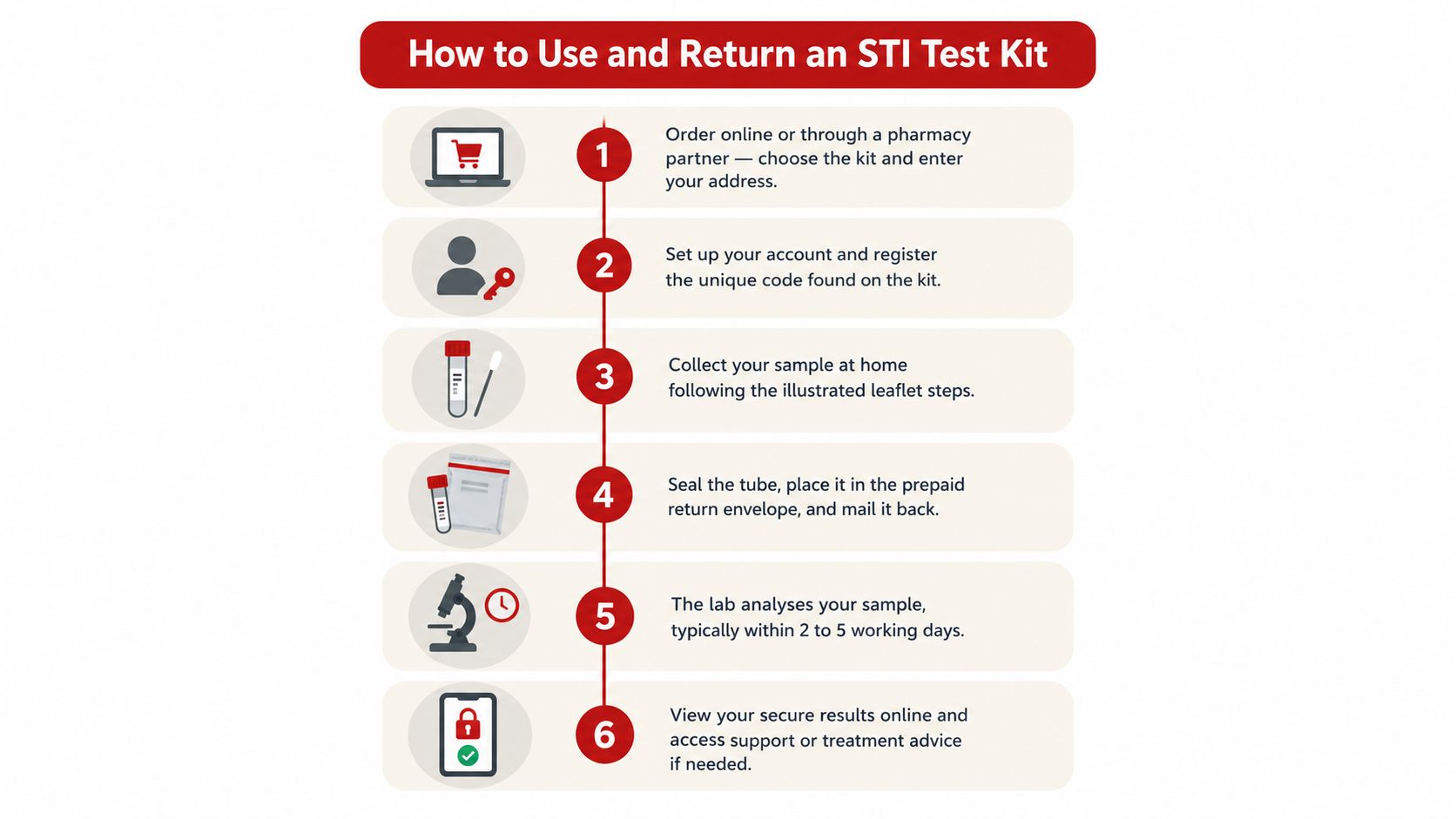
Treat the kit like a short process rather than a single test. Small errors, such as failing to register the code or leaving the sample unposted, can delay the result even when the collection itself went well.
Follow the stages in order
Order the appropriate kit. Use the product information to check the infections and anatomical sites covered. Some services allow online ordering, while others work with pharmacy partners.
Register the kit. Create the required account and enter the unique code supplied with the package. Registration links your sample to your details and helps prevent an unidentifiable result.
Check the contents. Compare the parcel with the enclosed list before collecting anything. If a tube, swab, label, or return item is missing, contact the provider before starting.
Prepare for collection. Follow the kit leaflet rather than relying on general internet advice. For urine testing, the provider may ask you not to urinate for at least an hour beforehand. For a vaginal swab, avoid lubricants that could interfere with collection if the instructions say so.
Collect carefully. Use the first part of the urine stream when requested. For a swab, rotate it for the stated time and avoid touching the tip. For blood, clean the finger, use the lancet on the side, and let the required amount enter the tube or collection device.
Seal and return the sample. Put the labelled specimen into the protective packaging and then the prepaid return envelope. NHS guidance says to post completed kits back the same day and avoid posting at the weekend because mail may take longer. A weekday morning collection followed by immediate posting is more sensible than leaving a sample until Friday evening.
For swab-specific collection equipment, compare the instructions with the swab test kit information. Don't improvise if the swab breaks, the tube spills, or the label becomes unreadable. Contact the service and ask whether a replacement is needed.
Keep the result pathway in mind
Laboratory services commonly provide results through email or a secure dashboard after processing, but the exact timing depends on the provider, transport, and sample quality. A tracked return can make delivery easier to follow, but it doesn't make an early sample accurate. Activate the kit before posting it, keep your account details private, and check the dashboard rather than relying only on a notification email.
Accuracy, Window Periods, and Real Limitations
A negative result can be reassuring, but only if the sample came from the right site, the collection worked, and enough time had passed since exposure. Timing is part of accuracy. A technically good test taken too early may not detect a recent infection.
An independent UK evidence review found that eleven self-test providers reported sensitivity and specificity estimates above 85%, while also noting that reference tests and sample sizes weren't always fully disclosed. NIHR evidence found that pooled swabs detected 98% of gonorrhoea infections in women and men who have sex with men, but pooled chlamydia testing missed infections compared with separate-site sampling, reducing detection by 3% in women and 5% in men who have sex with men. These findings support careful site selection and collection rather than blanket claims that every kit performs identically.
Use the exposure date, not the order date
UK guidance gives different testing windows for different infections. A person exposed to chlamydia 10 days ago may need to wait until day 14 or later for a more dependable result, while HIV may require a longer interval depending on the assay. NHS guidance also advises people without symptoms to wait 7 weeks after unprotected sex for broader STI testing.
| Infection | Sample Type | Window Period | Notes |
|---|---|---|---|
| Chlamydia | Urine or site-specific swab | At least 2 weeks | Earlier testing can miss a recent infection |
| Gonorrhoea | Urine or site-specific swab | At least 2 weeks | Test the exposed anatomical site |
| HIV | Blood | 45 or 90 days, depending on test type | Check the assay guidance |
| Syphilis | Blood | 12 weeks | A later test may be needed after a recent exposure |
| Hepatitis B | Blood | 12 weeks | Follow the service's specific guidance |
| Hepatitis C | Blood | 12 weeks | Follow-up may be needed after recent exposure |
The window guidance above reflects UK sexual-health testing advice. NHS general guidance also notes that an STI may take up to 7 weeks to appear on a test, particularly when someone has no symptoms. If symptoms develop, don't wait for the window to close. Seek clinical advice.
Understand what can go wrong
An insufficient sample, incorrect swab technique, a damaged container, or a collection from the wrong site can affect whether the laboratory can analyse the specimen. Recent antibiotics may also affect some bacterial results, so tell a clinician or provider about treatment when asking for advice.
For a laboratory PCR pathway, see PCR home testing. Whatever the method, repeat testing is sensible when the first test was taken too early, the exposure continued, the sample was incomplete, or symptoms appeared after a negative result.
Privacy, Confidentiality, and Data Handling
Confidentiality should be built into the service design, not added as a reassuring slogan. A well-organised home pathway separates the visible parcel from the clinical information inside the account.
NHS home-testing guidance says kits arrive in a plain envelope and include a free return process. A discreet outer package means people in a shared home don't need to see a clinical description on the delivery. A prepaid return route also avoids explaining the contents at a post office counter.
Protect the account as carefully as the parcel
The kit code connects the specimen to the registered account. That can reduce the need for personal information to appear on the outside of the package, but it doesn't make the online account unimportant. Use a password that other household members can't guess, avoid leaving the dashboard open on a shared device, and check how the service handles result notifications and password resets.
Personal information should be handled under UK data-protection requirements, including UK GDPR where applicable. Secure dashboards and controlled access help limit who can view results. Don't assume that a result is automatically added to your GP or NHS record. If you want a clinician to act on the result, you may need to share it yourself or ask the provider to help arrange follow-up.
Privacy check: Before ordering, read the provider's information about packaging, account access, result notifications, retention, and sharing. Those details tell you more than a general promise of discretion.
Confidential testing doesn't mean avoiding care. If a result is reactive or positive, privacy remains important, but so does prompt access to confirmatory testing and treatment. A sexual-health clinic can usually discuss next steps confidentially, and NHS sexual-health services remain available whether your first sample was collected at home or in a clinic.
Reading Your Results and Next Steps
Open the result when you have enough time to read the full explanation, not just the headline status. A dashboard may show separate outcomes for each infection, and one result doesn't automatically describe the others.
Match the status to the action
| Result | What It Means | Next Step |
|---|---|---|
| Negative | The test didn't detect the target infection in that sample | Check that the timing and sample site were appropriate; repeat if the test was too early or symptoms continue |
| Reactive | The screening test has detected a signal that needs clinical confirmation | Contact a sexual-health service or follow the provider's confirmation pathway |
| Positive | The result indicates that the infection was detected or requires treatment action, depending on the service | Arrange clinical follow-up, confirmation where advised, treatment, and partner advice |
| Invalid | The sample or test process didn't produce a usable result | Contact the provider or repeat with a new kit as advised |
A negative result is strongest when you tested after the relevant window, collected every requested sample correctly, and tested the anatomical sites that were exposed. If you tested soon after sex, a later negative may be needed. Don't use a negative home result to dismiss new symptoms.
A reactive result isn't a reason to panic, and it isn't a reason to ignore the result. Screening services may use “reactive” to indicate that confirmation is required. Follow the provider's instructions and avoid starting medication without clinical advice.
A positive result needs a practical response. Contact a sexual-health clinic, GP, or the service's clinical team to discuss confirmation and treatment. Avoid sex or use condoms until you've received appropriate advice, and ask about informing recent partners without disclosing more personal information than necessary.
An invalid result usually means the test or sample couldn't be interpreted. It doesn't mean negative. A missing control signal, an incomplete specimen, or a handling problem can cause an invalid outcome, so repeat the process or request guidance.
When a Kit Is the Right Choice and When to See a Clinician
An at-home kit suits someone who has no symptoms, can wait for the relevant window period, and can collect and return the requested samples. It can support routine screening, a check after a new partner, or a private first step when attending a clinic feels difficult. Check the included sites and infections before ordering.
A clinic is the better route if you have pelvic or testicular pain, fever, painful urination, unusual discharge, genital sores, a spreading rash, or symptoms that are getting worse. You may also need a clinic if the exposure involved the throat or rectum and your chosen kit doesn't include those swabs, or if you need urgent treatment rather than a result later.
NHS sexual-health services offer free and confidential testing and treatment, while private services can provide a postal pathway for people who value convenience. For broader, plain-language information to discuss sexual wellbeing alongside general health, sexual health resources can provide useful background, but a symptom or positive result still needs an appropriate UK clinical service.
A sensible plan is straightforward: record the exposure date, identify the affected areas, select a suitable kit, and verify the window period before collecting samples. If timing is unclear or symptoms develop, reach out to a sexual-health clinic rather than depending on a single home test result.
Repose Healthcare offers private at-home STI screening, including full screening and targeted PCR kits using the sample types specified for each test, with return packaging and online results. Visit Repose Healthcare to choose a suitable kit and start a confidential testing pathway from home.
You Might Also Like
STI Test Kit at Home: How It Works and What to Expect
You've had condomless sex with a new partner, feel completely well, and are now deciding [...]
Fertility Blood Test Day 3: What to Expect
You've booked your first fertility appointment, but one phrase on the instructions keeps bothering you: [...]
Home Liver Function Test: What Results Mean
You've opened the results from a home liver function test and found a mildly raised [...]
Glucose Tolerance Test at Home: What You Need to Know
A true diagnostic oral glucose tolerance test in the UK is usually a supervised clinic [...]
At Home PSA Test: Accuracy, Process, and UK Guidelines
You notice that you're urinating more often, your stream seems weaker, or you want a [...]
A1C Blood Test UK: What It Measures and How to Get One
You've just opened a private or at-home A1C blood test UK result and found two [...]
STI Screening for Men: What to Test and When
You've recently ended a relationship, ordered an STI test kit online, and now you're staring [...]
Fertility Testing Before Trying to Get Pregnant: Key Info
You and your partner may have chosen a rough timeline, checked your finances and started [...]
Nutrition Testing Kit: What It Measures and Why It Matters
You're doing the sensible thing, eating reasonably, trying to sleep, and still feeling flat. That's [...]
Private Coeliac Testing UK: A Practical Patient Guide
You've been bloated after pasta for months. You've searched “coeliac symptoms”, noticed the fatigue and [...]
STI Test Kit Price Guide for UK Home Testing
Private STI test kits in the UK usually start at about £29 to £30 for [...]
Sexual Health Screening: Your Guide to 2026
You're often here for a very ordinary reason that suddenly feels loaded. A new partner. [...]
Pregnancy Screening Tests Private: Your UK Guide
You've had a positive pregnancy test, the NHS booking appointment is still ahead, and your [...]
What Is Glucose Tolerance Test and How It Works
A glucose tolerance test is a two-hour challenge test: after an overnight fast, your fasting [...]
Blood Test for Night Sweats What to Check and When
You wake in the early hours with damp nightwear, wet sheets and a racing mind. [...]
The 2026 Cost of Hepatitis Vaccination in the UK
You're usually looking up the cost of hepatitis vaccination for a practical reason. A trip [...]
Hormone Blood Test London: Find Your Perfect Test
Some London health questions start subtly. Your cycle changes a little. You feel wired at [...]
Peanut Allergy Test Kit: A Practical UK User’s Guide
A peanut reaction often starts with uncertainty, not clarity. You eat a biscuit, satay sauce, [...]
NIPT Test Edinburgh: Your 2026 Guide
If you're searching nipt test edinburgh, you're probably already in that familiar stage of pregnancy [...]
Peripheral Artery Disease UK: Peripheral Artery Disease UK:
You might be reading this because walking has started to feel different. Perhaps your calf [...]
NIPT Test Cardiff: Clinic, Home & NHS Pathways 2026
If you're in Cardiff, newly pregnant, and staring at screening options that all seem to [...]
Gender Scan Difference UK: Accuracy, Timing & Cost Compared
You've probably already done the same search most parents do. One tab shows the NHS [...]
NIPT Test Cambridge: Guide to Options & Booking 2026
You're in Cambridge, you've had the first rush of finding out you're pregnant, and then [...]
Home COVID Test Results: A Practical UK & Ireland Guide
You've done the swab, mixed the sample, added the drops, and now you're staring at [...]
DVT Test Squeeze Calf: Homan’s Sign & Beyond
You notice one calf is sore, a little swollen, and not behaving like an ordinary [...]
Your Guide to Every Travel Clinic Leicester Offers in 2026
Flights are booked. The hotel is sorted. Your passport is still in date. Then one [...]
13 Week Gender Scan: Accuracy, NIPT & What to Expect
By the time you reach 13 weeks, pregnancy often starts to feel more real in [...]
Your Pregnancy Scan London: Guide to Options & Costs
A positive test can make London feel suddenly very small and very complicated. You might [...]
Your Nuchal Dating Scan Explained: A 2026 UK Guide
That appointment message has landed in your phone or come through the post, and suddenly [...]
Normal Cortisol Levels UK: Get Clarity
Some people search for normal cortisol levels uk after weeks of feeling unlike themselves. They’re [...]