
NIPT Test Cardiff: Clinic, Home & NHS Pathways 2026
If you're in Cardiff, newly pregnant, and staring at screening options that all seem to come with unfamiliar terms, you're not alone. Many people reach the point where they want clearer answers than "wait and see", but they also don't want to rush into anything invasive.
A nipt test cardiff search usually starts with one practical question. What is the simplest, safest way to get early screening information? From there, the next questions follow quickly: can you get it through the NHS, do you need a private clinic, and is an at-home route realistic?
NIPT has become one of the most useful modern screening options in pregnancy because it offers early information from a blood sample rather than a procedure inside the womb. For many Cardiff families, that changes the whole decision-making process. It can turn a stressful few weeks into a more informed, manageable plan.
Your Guide to NIPT in Cardiff
In real life, choosing a screening pathway isn't just a medical decision. It's also about timing, travel, work, childcare, privacy, and how much uncertainty you feel able to sit with.
Some readers arrive here after an NHS appointment and want to understand what happens next. Others want direct private access because they don't meet NHS criteria, or they prefer to organise testing on their own timeline. Both situations are common, and neither means you're being overcautious.
Why this test matters early in pregnancy
NIPT stands for Non-Invasive Prenatal Testing. It looks at small fragments of placental DNA circulating in the pregnant person's blood and screens for certain chromosomal conditions. The appeal is straightforward. It offers meaningful screening insight early in pregnancy without the miscarriage risk associated with invasive diagnostic procedures.
For many people, the value isn't only in the result itself. It's in having a clearer next step.
Practical rule: The right pathway is usually the one that fits both your clinical situation and your real life. A free NHS route may suit one family perfectly. Another may prioritise direct access and home sampling.
What usually shapes the decision
Most Cardiff patients weigh the same handful of factors:
- Access: Can you have the test routinely, or only if another screening result places you in a higher-chance group?
- Setting: Do you want a hospital or clinic appointment, or would you rather manage the process from home?
- Pace: Are you comfortable waiting for standard appointments, or do you want to arrange testing as soon as you're eligible?
- Support: Do you know what happens if the result is low chance, high chance, or no result?
Those trade-offs matter more than glossy marketing language. A good NIPT pathway should be clear, well organised, and honest about what the test can and can't tell you.
What a NIPT Test Actually Screens For
A common point of confusion in Cardiff appointments is this: NIPT gives targeted screening information, not a full genetic overview of the pregnancy. It looks for a small number of specific chromosomal conditions that are well studied and commonly included in standard screening pathways.
For most standard NHS and private NIPT options, the core focus is the same. The test screens for Down's syndrome, Edwards' syndrome, and Patau's syndrome. Some providers also offer optional screening for sex chromosome differences or fetal sex, but those extras should be treated as separate add-ons rather than the starting point.

The three conditions included in standard NIPT screening
The three main conditions are:
- Down's syndrome (Trisomy 21): caused by an extra copy of chromosome 21.
- Edwards' syndrome (Trisomy 18): caused by an extra copy of chromosome 18.
- Patau's syndrome (Trisomy 13): caused by an extra copy of chromosome 13.
Those names often appear quickly in brochures and booking pages, but the practical point is simpler. Standard NIPT is designed to estimate the chance of these trisomies. It does not screen for every developmental condition, every inherited disorder, or every structural concern that may appear on a scan.
Screening and diagnosis are different
This distinction matters in real decision-making. A low chance result can be very reassuring, but it is not the same as a diagnosis that rules a condition out with certainty. A high chance result does not confirm a condition either. It means the pregnancy needs diagnostic follow-up.
The evidence base for NIPT is strong for the three main trisomies. A UK evidence review from Cardiff University reported very high sensitivity and specificity for Trisomy 21, 18, and 13 in singleton pregnancies, which is why NIPT is widely used as a screening step before any invasive test is considered, as set out in the Cardiff University evidence review PDF.
Why this matters when choosing your next step
In practice, NIPT often helps families avoid going straight to an invasive procedure. If the result is low chance, many patients feel able to continue routine care with more confidence. If the result is high chance, the next discussion is usually about diagnostic testing such as CVS or amniocentesis and what that may involve.
That trade-off is one of the main reasons NIPT has become so widely used. It offers early, focused screening from a blood sample, whether that sample is taken in a clinic or arranged through an at-home pathway, while keeping diagnostic procedures for the smaller group of pregnancies where a definite answer is needed.
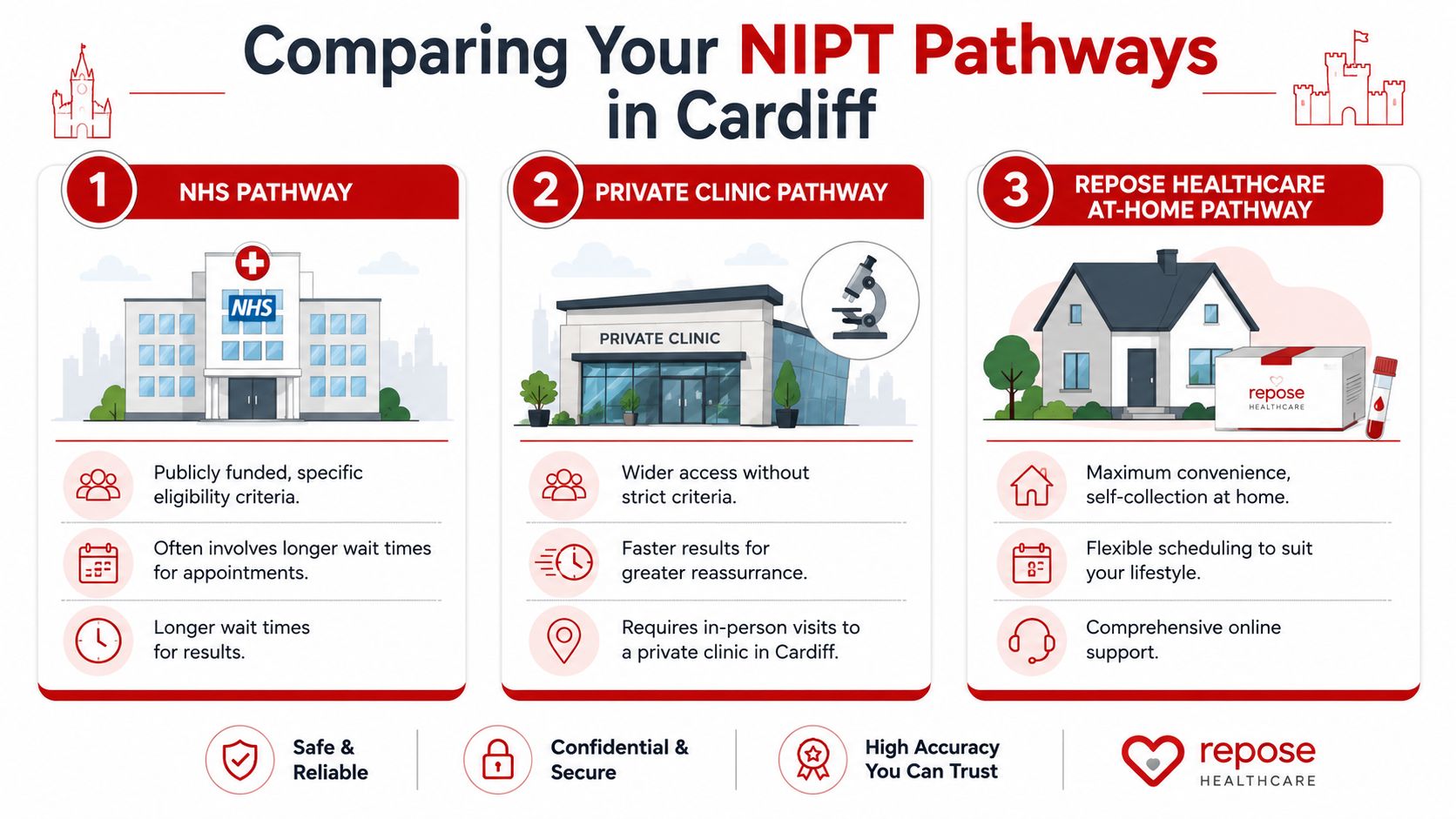
Comparing Your NIPT Pathways in Cardiff
You may be sitting with a normal 12 week scan, a screening result you are unsure how to interpret, and one practical question. Do you wait and follow the NHS pathway, book a private clinic, or choose an at-home test that fits around life in Cardiff?
That choice is rarely about one factor alone. Cost matters. So do timing, travel, privacy, and what kind of support you want if the result raises further questions.
The NHS route in Cardiff
In Wales, NIPT is generally used within the NHS as a contingent screening test after a pregnancy has already been identified as higher chance on standard screening, as outlined in the European NIPT policy review on PubMed. For many Cardiff families, that means NHS NIPT is available only if earlier screening places them in that group.
The advantages are practical. There is no direct fee when you meet the criteria. Your notes, counselling, and follow-up sit within one maternity system. If a result suggests a higher chance, the referral route for diagnostic testing is already in place.
The limitation is access. This is not usually an open-book, self-referred screening option for someone who wants extra reassurance early in pregnancy.
Private in-clinic testing
Private clinic testing gives direct access without waiting to meet NHS criteria. You book with the provider, attend in person, have the blood sample taken by a clinician, and receive the result through that clinic's process.
Some Cardiff patients prefer this route because the sample collection is handled for them. That can matter if needle anxiety is manageable in a clinical setting, or if you want the chance to ask final questions face to face before the sample is taken. Local private clinic pricing commonly sits in the mid hundreds of pounds, although packages and what is included can vary between providers.
That variation matters more than many people expect. One clinic may include a dating scan, another may not. One may build result counselling into the fee, another may charge separately. Before booking, check what happens if the sample is inconclusive and whether a redraw is included.
Private at-home testing
At-home NIPT has become a serious first-choice option, not just a backup for people who cannot get to clinic. For many pregnant women in Cardiff, it is the most workable route because it removes travel, waiting rooms, parking, and the need to fit another appointment into an already crowded schedule.
That convenience comes with responsibility. You need to be comfortable following instructions carefully, checking the correct timing for testing, and returning the sample exactly as directed. If you like having control over when and how things happen, this can be a very good fit. If you know you feel calmer with a clinician doing everything in front of you, a clinic may suit you better.
Repose Healthcare offers this kind of at-home pathway. It can be a practical choice for patients who want modern access to screening without losing sight of the bigger picture. If you are comparing screening routes with the possibility of later diagnostic testing, it also helps to read about amniocentesis costs and what the procedure involves, because that is often the next discussion after a high chance result.
Side-by-side decision view
| Pathway | Who it suits | Main advantage | Main trade-off |
|---|---|---|---|
| NHS | People who meet screening criteria through routine maternity care | No direct cost and built-in follow-up | Limited eligibility and less personal control over timing |
| Private clinic | People who want direct access and staff-led blood collection | Face-to-face support on the day | Travel, appointment scheduling, and higher overall time commitment |
| Private at home | People who want privacy, flexibility, and home-based access | Testing can fit around work, family life, and travel constraints | You must manage the steps carefully and follow the kit instructions closely |
In practice, the best pathway is the one that matches both your medical situation and your real life. NHS care makes sense if you are eligible and comfortable with that timetable. A private clinic suits patients who value in-person support. An at-home service is often the strongest option for women who want private access with more control over when the test happens.
The At-Home NIPT Process with Repose Healthcare
At-home NIPT only feels convenient if the process is straightforward. If the instructions are vague or the sample journey is clumsy, the convenience disappears quickly. That's why the details matter more than the marketing.
How the pathway usually works
With an at-home service, the order starts online. You choose the NIPT product, receive the kit, read through the instructions, complete the collection steps, package the sample correctly, and send it back using the return method provided. Results are then released through a secure online account.
What makes this route practical is control. You aren't trying to line up a clinic slot with work, school runs, or transport. You can prepare properly and take the sample pathway seriously rather than squeezing it into a stressful day.
A well-run process usually includes these stages:
Order and review
Read every instruction before opening anything. Most avoidable problems happen because people start first and read later.Check pregnancy timing
Don't collect too early. Timing has a direct effect on whether there's enough fetal DNA in the sample for analysis.Complete the sample carefully
Follow each handling and packaging step in order. Don't improvise if something seems optional.Label and return correctly
Identification errors create delays that have nothing to do with your pregnancy and everything to do with paperwork.
What reduces avoidable delays
This is the part patients often underestimate. NIPT isn't difficult, but it does depend on sample quality and proper handling.
In one NHS high-throughput NIPT service, about 4.3% of results were inconclusive and around 5.4% of samples were not tested because of sample issues. Welsh guidance also notes the importance of collecting the sample at or after 9 to 10 weeks, following instructions carefully, and ensuring correct labelling, as described in the Public Health Wales information for women offered further tests.
That translates into a few very practical rules:
- Wait until the correct gestation: Taking the sample too early increases the chance of trouble.
- Read before collecting: Don't rely on guesswork, especially around packaging and return steps.
- Label immediately: Complete identification exactly as instructed before anything is sealed.
- Post promptly: Avoid leaving the sample sitting around longer than necessary.
When home testing works well and when it doesn't
At-home NIPT suits people who are comfortable following a structured process and want minimal disruption. It can be a very sensible option for Cardiff patients who'd rather not attend a private clinic just to have the screening sample arranged.
It may be less suitable if you feel very anxious about every step, want same-room reassurance from a clinician, or know you'll struggle to follow collection instructions carefully. In those cases, a clinic-based appointment may be the better fit even if it's less convenient.
The strongest reason to choose home testing isn't that it's trendy. It's that for many families, it removes friction without removing clinical seriousness.
Understanding Your NIPT Results
You might be sitting at your kitchen table in Cardiff, phone in hand, opening a result you have been thinking about for days. This is often the point where screening starts to feel very real.
The first thing to keep hold of is what NIPT can and cannot tell you. It is a screening test. Results are usually reported as low chance or high chance, and those terms guide next steps rather than give a final diagnosis.

If your result is low chance
A low-chance result is reassuring. For the chromosome conditions the test is designed to screen for, it means the chance of the baby having that condition is very low, though no screening test can reduce risk to zero.
In practice, that usually means you continue with standard pregnancy care. Extra testing is not usually recommended on the basis of a low-chance NIPT result alone, unless there is another reason such as an ultrasound finding or a separate clinical concern.
Read the full report, not just the headline. Check which conditions were screened, and ask for clarification if any wording is unclear.
If your result is high chance
A high-chance result needs prompt follow-up, but it is still not a diagnosis. That distinction matters, especially in the first hours after seeing the result.
The next step is usually a conversation with your maternity team or private provider about diagnostic testing, such as CVS or amniocentesis. Those tests can confirm whether the condition is present. If you want a clearer explanation of why screening and diagnosis are different, this guide to NIPT accuracy and result interpretation sets that out well.
I often advise patients to focus on sequence rather than fear. First, confirm what the report says. Second, find out who is arranging follow-up. Third, ask how quickly diagnostic testing can be offered and what support is available while you wait.
A high-chance result means the pregnancy needs diagnostic confirmation before any final conclusions are made.
If there is no result
Sometimes the lab cannot issue a result. This is usually described as a failed sample, inconclusive result, or no-call result.
That can happen for several reasons, including too little placental DNA in the sample or a technical issue during processing. It does not, by itself, mean everything is fine, and it does not, by itself, mean there is a problem. It means the next step needs to be clear.
Ask two direct questions. Can the test be repeated, and if so, when? If a repeat is not suitable, what diagnostic or ultrasound follow-up is recommended instead?
For Cardiff patients using an at-home pathway, provider communication is crucial. A convenient home test is only useful if the plan after a high-chance or no-result report is straightforward and clinically sensible.
Making Your Choice Costs Timelines and Final Steps
By the time most Cardiff patients decide on NIPT, they aren't comparing science. They're comparing logistics.
If you're eligible through the NHS, the financial side is easiest because the pathway is part of public care. The trade-off is that access is conditional, not open to everyone from the outset. If you want direct private access in Cardiff, local clinic pricing has been listed at £395 to £495 in the earlier NHS-linked summary, while an at-home private route is usually best checked on the provider's own product page because package structure varies.
A simple decision framework
Use these questions to make the choice clearer:
- Do you qualify for NHS access? If yes, that may be the simplest route.
- Do you want direct access regardless of NHS criteria? Private testing is the practical answer.
- Would travel add stress? If yes, home sampling may suit you better.
- Do you want staff to handle collection in person? A clinic appointment may feel more comfortable.
- Do you already know what you'd do after each possible result? If not, pause and map that out first.
What to do before you book
Before choosing any nipt test cardiff option, check three things:
| Question | Why it matters |
|---|---|
| When can I collect the sample? | Timing affects whether the test can be processed properly |
| What happens if the result is high chance or no result? | You need a clear follow-up plan before you start |
| What is included in the price? | It avoids surprises around processing, returns, or result access |
If you're comparing private options, review the current pricing and package details directly on the Repose Healthcare NIPT cost page. That gives you the practical detail you need to compare a home route against local clinic visits and the NHS pathway.
The best choice is the one that fits your pregnancy, your timeline, and your tolerance for uncertainty. A test is only helpful when the pathway around it is clear.
If you want a private home-based route with clear ordering, return packaging, and secure online results, Repose Healthcare offers an at-home NIPT pathway designed for people who want early screening access without arranging a clinic visit.
You Might Also Like
Home Liver Function Test: What Results Mean
You've opened the results from a home liver function test and found a mildly raised [...]
Glucose Tolerance Test at Home: What You Need to Know
A true diagnostic oral glucose tolerance test in the UK is usually a supervised clinic [...]
At Home PSA Test: Accuracy, Process, and UK Guidelines
You notice that you're urinating more often, your stream seems weaker, or you want a [...]
A1C Blood Test UK: What It Measures and How to Get One
You've just opened a private or at-home A1C blood test UK result and found two [...]
STI Screening for Men: What to Test and When
You've recently ended a relationship, ordered an STI test kit online, and now you're staring [...]
Fertility Testing Before Trying to Get Pregnant: Key Info
You and your partner may have chosen a rough timeline, checked your finances and started [...]
Nutrition Testing Kit: What It Measures and Why It Matters
You're doing the sensible thing, eating reasonably, trying to sleep, and still feeling flat. That's [...]
Private Coeliac Testing UK: A Practical Patient Guide
You've been bloated after pasta for months. You've searched “coeliac symptoms”, noticed the fatigue and [...]
STI Test Kit Price Guide for UK Home Testing
Private STI test kits in the UK usually start at about £29 to £30 for [...]
Sexual Health Screening: Your Guide to 2026
You're often here for a very ordinary reason that suddenly feels loaded. A new partner. [...]
Pregnancy Screening Tests Private: Your UK Guide
You've had a positive pregnancy test, the NHS booking appointment is still ahead, and your [...]
What Is Glucose Tolerance Test and How It Works
A glucose tolerance test is a two-hour challenge test: after an overnight fast, your fasting [...]
Blood Test for Night Sweats What to Check and When
You wake in the early hours with damp nightwear, wet sheets and a racing mind. [...]
The 2026 Cost of Hepatitis Vaccination in the UK
You're usually looking up the cost of hepatitis vaccination for a practical reason. A trip [...]
Hormone Blood Test London: Find Your Perfect Test
Some London health questions start subtly. Your cycle changes a little. You feel wired at [...]
Peanut Allergy Test Kit: A Practical UK User’s Guide
A peanut reaction often starts with uncertainty, not clarity. You eat a biscuit, satay sauce, [...]
NIPT Test Edinburgh: Your 2026 Guide
If you're searching nipt test edinburgh, you're probably already in that familiar stage of pregnancy [...]
Peripheral Artery Disease UK: Peripheral Artery Disease UK:
You might be reading this because walking has started to feel different. Perhaps your calf [...]
NIPT Test Cardiff: Clinic, Home & NHS Pathways 2026
If you're in Cardiff, newly pregnant, and staring at screening options that all seem to [...]
Gender Scan Difference UK: Accuracy, Timing & Cost Compared
You've probably already done the same search most parents do. One tab shows the NHS [...]
NIPT Test Cambridge: Guide to Options & Booking 2026
You're in Cambridge, you've had the first rush of finding out you're pregnant, and then [...]
Home COVID Test Results: A Practical UK & Ireland Guide
You've done the swab, mixed the sample, added the drops, and now you're staring at [...]
DVT Test Squeeze Calf: Homan’s Sign & Beyond
You notice one calf is sore, a little swollen, and not behaving like an ordinary [...]
Your Guide to Every Travel Clinic Leicester Offers in 2026
Flights are booked. The hotel is sorted. Your passport is still in date. Then one [...]
13 Week Gender Scan: Accuracy, NIPT & What to Expect
By the time you reach 13 weeks, pregnancy often starts to feel more real in [...]
Your Pregnancy Scan London: Guide to Options & Costs
A positive test can make London feel suddenly very small and very complicated. You might [...]
Your Nuchal Dating Scan Explained: A 2026 UK Guide
That appointment message has landed in your phone or come through the post, and suddenly [...]
Normal Cortisol Levels UK: Get Clarity
Some people search for normal cortisol levels uk after weeks of feeling unlike themselves. They’re [...]
How to Test Iron Levels in Blood: A Complete UK Guide
You’re probably not searching how to test iron levels in blood out of curiosity. More [...]
Growth Scan Pregnancy: UK Guide & What to Expect
You’re at an antenatal appointment, everything seems routine, and then your midwife says, “We’d like [...]