 Skip to content
Cortisol Levels Test: Your Comprehensive UK Guide
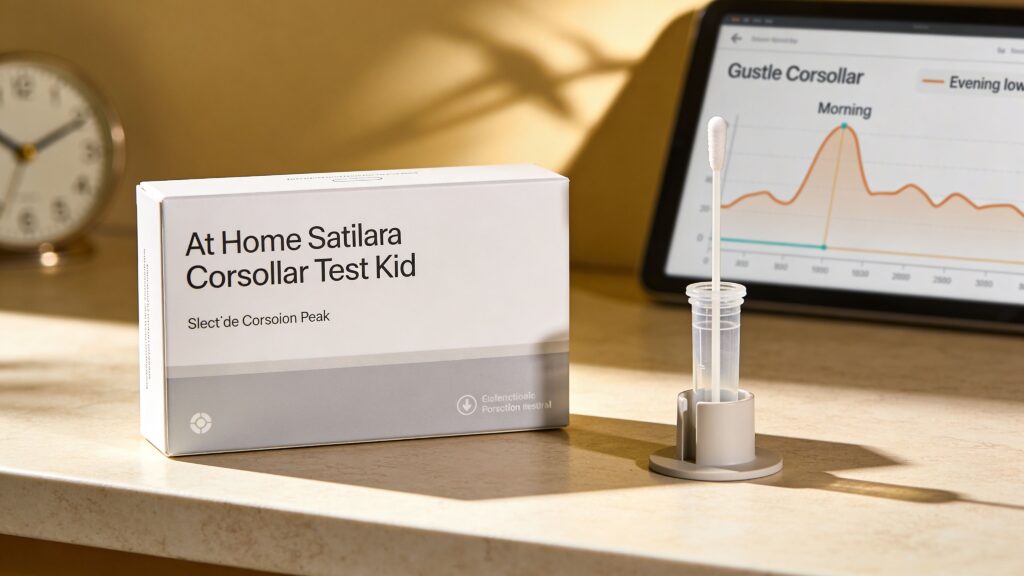
You wake up tired, push through the morning on caffeine, feel oddly tense by midday, then find yourself wide awake when you should be winding down. Or the opposite happens. You feel washed out, light-headed, and unable to recover properly even after a quiet weekend. If that sounds familiar, you’re not overthinking it. Cortisol can be part of the picture.
Cortisol is often reduced to “the stress hormone”, but that shorthand misses why testing can matter. When cortisol is out of step, people often notice broad, frustrating symptoms rather than one obvious sign. Sleep changes. Energy becomes unreliable. Weight shifts without a clear reason. Mood feels less steady. Blood pressure can run low or high. None of those symptoms prove a cortisol problem, but they do justify looking more closely when the pattern keeps repeating.
A cortisol levels test gives you something more useful than guesswork. It shows whether your cortisol is broadly behaving as expected for the time of day and whether further medical follow-up may be sensible. For many people in the UK, that first step is easier to take at home than through a clinic appointment that takes weeks to arrange.
That’s where home testing can be practical rather than gimmicky. You collect your sample in your own time, follow the instructions carefully, and get a lab-based result you can review privately. Alongside testing, it’s also worth improving the basics that influence stress biology day to day. If stress is a major part of your current picture, this guide on managing stress and anxiety is a sensible companion read.
Introduction Is Stress Taking Its Toll on Your Health
People rarely search for a cortisol levels test because life feels perfectly balanced. Usually, they search because something feels off and hasn’t settled. They’re tired but restless. Their sleep is light, broken, or unrefreshing. They feel puffy, drained, wired, or flat. Often, they’ve already tried the obvious fixes.
In practice, cortisol testing is most useful when symptoms have become a pattern rather than a bad week. One poor night’s sleep can throw almost anyone off. Ongoing symptoms are different. That’s when a structured test can help separate temporary stress from a result that deserves a conversation with a GP.
A cortisol result is most helpful when it answers a specific question, not when it’s used as a random wellness score.
Home testing suits this kind of decision well. It removes the friction of travel, waiting rooms, and trying to fit a timed sample into a busy day. It also helps people who’d rather start privately before deciding whether they need a clinical follow-up.
What Is Cortisol and Why Should You Test It
Cortisol works like the body’s day manager. It helps decide when you feel alert, how you respond to pressure, how your body mobilises energy, and how inflammation is regulated. It isn’t a “bad” hormone. You need it. Problems start when levels are too low, too high, or poorly timed.

What cortisol actually does
Think of cortisol as the hormone that helps your body prioritise. In the morning, it should help you get going. During illness or pressure, it helps you respond. Across the day, it interacts with appetite, blood pressure, immune activity, and sleep timing.
When that system drifts, the symptoms can look messy rather than neat. You might notice:
- Energy problems that don’t match your routine
- Sleep disruption such as waking early, waking often, or feeling tired at bedtime but alert late at night
- Weight or appetite changes without a clear explanation
- Mood changes including feeling more anxious, flat, or irritable
- Physical signs such as dizziness, low blood pressure, or feeling unusually run down
When testing makes sense
A cortisol levels test is worth considering when symptoms keep circling back and other simple explanations don’t fit. It can also be relevant when a clinician suspects conditions linked to cortisol imbalance, including adrenal insufficiency or Cushing’s syndrome.
That doesn’t mean every stressed person needs a cortisol test. It means testing becomes practical when the result could change what you do next. If low cortisol is a concern, the pattern of fatigue, dizziness, and poor resilience to illness deserves proper assessment. If high cortisol is a concern, late-night testing can be more informative than a random morning snapshot because rhythm matters.
For people dealing with prolonged stress and exhaustion, biology is only part of the recovery picture. Behaviour, pacing, sleep, and nervous system load matter as well. This neuroscience guide to recovering from burnout is useful because it explains that side of the equation in plain language.
Practical rule: Test when you have a clear reason. Ongoing symptoms, a GP’s suggestion, or a need to document a pattern are all good reasons. Curiosity alone usually isn’t.
Choosing Your Cortisol Levels Test Saliva Urine or Blood
The right test depends on the question you’re trying to answer. That’s where people often go wrong. They ask for “a cortisol test” as if all methods measure the same thing. They don’t.
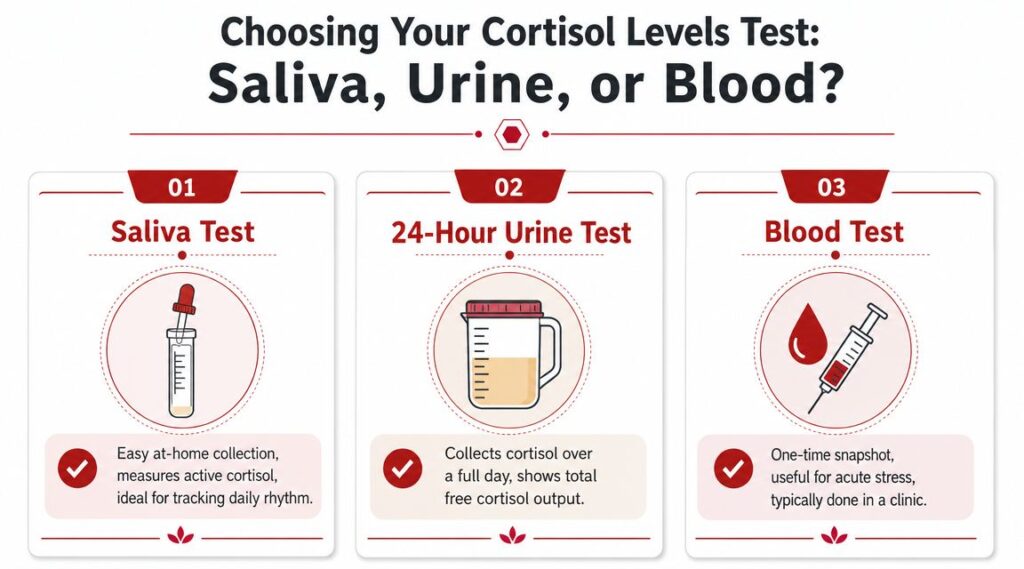
Saliva testing
Saliva testing is often the most practical choice when the goal is to assess daily rhythm or to screen for excess cortisol late at night. It measures free cortisol, which is the biologically active fraction rather than the protein-bound total seen in standard blood tests.
For screening for conditions like Cushing’s syndrome, late-night salivary cortisol testing offers 100% sensitivity and over 96% specificity at certain cutoffs, making it a strong first-line option for home collection according to this clinical review of late-night salivary cortisol.
Why that matters in real life is simple. If a clinician wants to know whether cortisol is staying abnormally high when it should be low, saliva collected late at night can answer that better than a convenient daytime sample.
Urine testing
A 24-hour urine test looks at cortisol output over a full day. That can be useful in endocrine workups, especially when total free cortisol output is the main question. The downside is practical. Collection is awkward, timing errors are common, and it’s much less convenient for routine home use than saliva.
Urine testing also doesn’t show the shape of your daily cortisol rhythm. It gives a day-total rather than a time-specific pattern.
Blood testing
Blood tests remain important, especially when adrenal insufficiency is being investigated. A morning blood sample can be a useful screening tool because cortisol should normally be higher early in the day. It’s a good option when the question is “is morning cortisol unexpectedly low?” rather than “what does the whole day’s rhythm look like?”
Blood has trade-offs. It’s a snapshot. It can also be influenced by factors that affect total cortisol measurements, including pregnancy and oral contraceptive use.
A practical comparison
| Test Type | What It Measures | Collection Method | Best For | Repose Option |
|---|---|---|---|---|
| Saliva | Free cortisol at specific times | Home saliva samples | Daily rhythm and late-night screening | At-home hormone testing options |
| 24-hour urine | Total free cortisol output across a full day | All urine collected over 24 hours | Broader endocrine assessment when a clinician requests day-total output | No routine home convenience advantage |
| Blood | Total serum cortisol at one time point | Finger-prick or venous sample | Morning screening, especially when low cortisol is a concern | Blood-based cortisol testing may be used depending on the service selected |
What tends to work best
If your symptoms suggest rhythm disruption, saliva usually gives the clearest practical picture. If a doctor is worried about Addison’s disease or another form of adrenal insufficiency, morning blood testing often becomes the first move. If there’s concern about Cushing’s syndrome, late-night saliva is particularly useful.
One sensible option people use is the Repose Healthcare Cortisol Saliva Test, which is designed for home sample collection and lab analysis. That suits people who need timed samples without the hassle of arranging repeated clinic visits.
If timing is central to the question, saliva often beats convenience-led blood testing because cortisol is a rhythm hormone, not just a single number.
How to Prepare for an Accurate Cortisol Test at Home
Preparation matters because cortisol is easily influenced by timing and circumstances. A sloppy collection can create a misleading result. Most problems don’t come from the lab. They come from a sample taken at the wrong time or under the wrong conditions.
Understand the daily rhythm
Cortisol follows a diurnal rhythm. It should rise early, then fall across the day, reaching its lowest point late at night. That’s why a well-timed sample matters more than a convenient sample.
If you collect too late in the morning, too close to exercise, or during an unusually stressful event, the result may reflect the moment rather than your underlying pattern.
The home collection checklist
Before collecting a sample, keep the basics tight:
- Read the instructions first so you know the exact collection times and the return process.
- Keep the day ordinary if you can. Don’t choose a day with extreme exercise, travel, or disrupted sleep unless your clinician specifically wants to see that pattern.
- Be honest about medication on any forms provided. Steroids, hormone treatments, and some other medicines can alter interpretation.
- Handle timings carefully. Set alarms if your kit requires more than one sample.
- Package and return promptly using the kit materials, especially if your instructions specify same-day or next-day posting.
What the process usually looks like
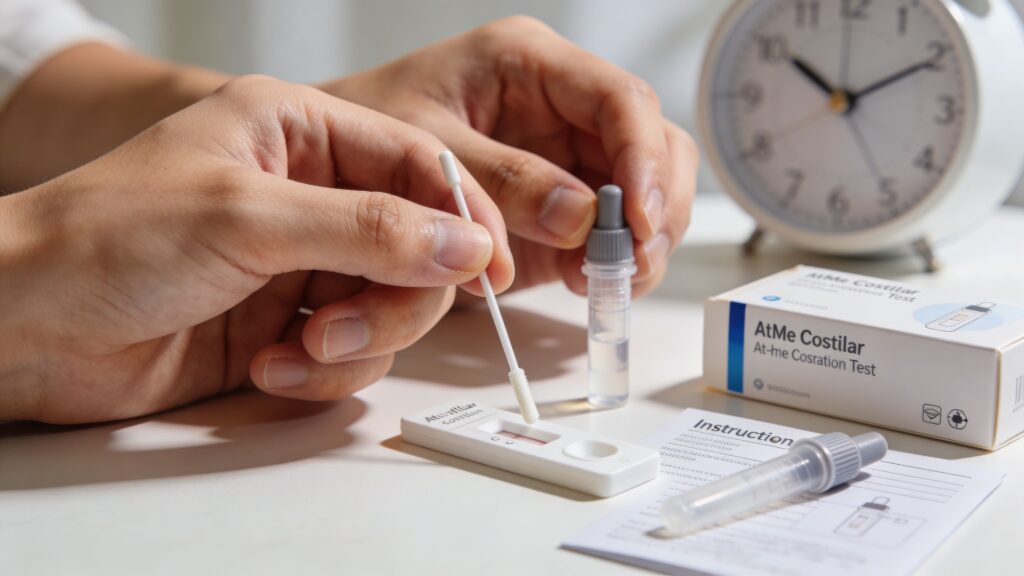
The process is straightforward when not overcomplicated. Open the kit. Label the sample tubes as directed. Wash your hands if instructed. Collect the sample at the exact time shown in the guide. Seal everything properly, complete any paperwork, and post it back in the prepaid packaging.
If you’re comparing options that involve finger-prick or other home collection methods, Repose also explains the wider process for private blood testing at home, which helps if you’re deciding between saliva and blood-based routes.
Small timing errors matter more in cortisol testing than in many other home tests. Set reminders and treat the schedule seriously.
Common mistakes to avoid
People most often run into trouble when they guess the timing, forget a sample, or collect on a chaotic day and then assume the result represents their normal baseline. Another common issue is failing to note medicines or hormone use.
If you want a result that’s useful in a GP conversation, precision matters from the moment you open the box.
Interpreting Your Cortisol Test Results from Repose
The first thing to remember is that a report gives clinical information, not a self-diagnosis. A cortisol result needs context. Time of collection, symptoms, current medication, and the type of test all matter.
What the numbers mean in UK practice
In UK clinical use, cortisol blood results are commonly reported in nmol/L. According to North Bristol NHS Trust guidance, a morning cortisol above 300 nmol/L is often used to help exclude adrenal insufficiency in initial screening, while a morning cortisol below 100 nmol/L strongly suggests adrenal insufficiency and needs further investigation, as outlined in this NHS cortisol testing guidance.
That same guidance also notes that the normal morning range is approximately 170 to 540 nmol/L when cortisol is measured at the right time. Timing isn’t a technical footnote. It’s central to interpretation.
How to read your report sensibly
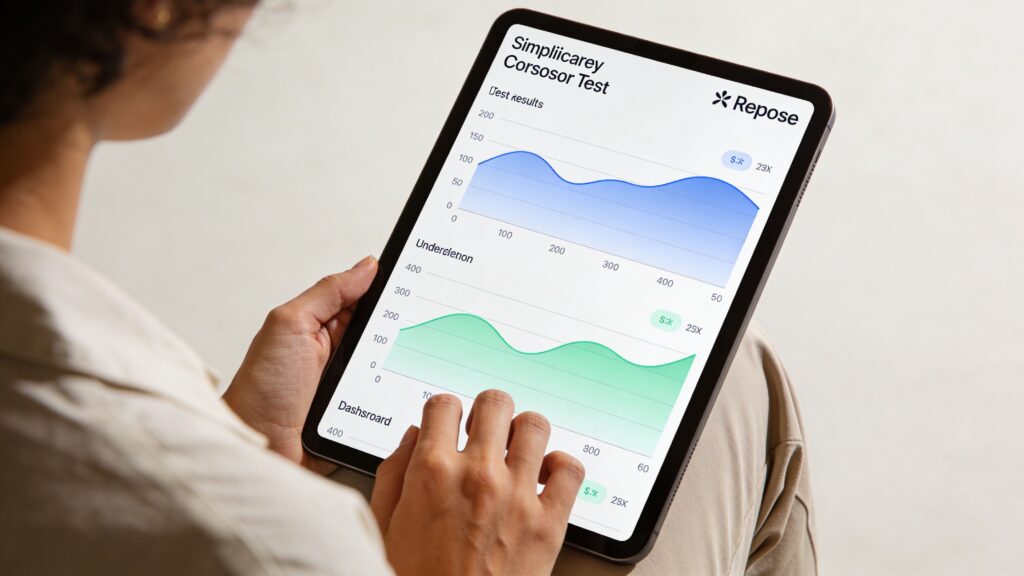
When you log into your dashboard, start with three questions:
-
Was the sample taken at the correct time?
A technically normal number at the wrong time can still be unhelpful. -
Was this saliva, blood, or another method?
Don’t compare one method with another as if they are interchangeable. -
Does the result fit the symptoms?
A result that seems off-pattern should be reviewed with a clinician, not interpreted in isolation.
If you’re waiting for your report, this guide on how long blood test results take helps set expectations around turnaround and reporting.
What high or low results might suggest
Low results in the right clinical setting can raise concern for adrenal insufficiency. High results, especially if they are high late at night, can point towards loss of the usual daily rhythm and may prompt investigation for cortisol excess.
That still doesn’t mean the result is diagnostic on its own. A clinician may decide the next step is repeat testing, a dynamic endocrine test, or no further action if the sample conditions were poor.
The most useful interpretation is practical. Does this result reduce uncertainty, or does it tell you that proper follow-up is needed?
Factors Affecting Cortisol and Your Next Steps
Cortisol is sensitive to real life. That’s both useful and inconvenient. It means the test can pick up meaningful physiological changes, but it also means context can distort the picture if you ignore it.
Factors that can skew interpretation
The obvious influences are poor sleep, acute illness, and a highly stressful day. Those don’t automatically invalidate a result, but they do change how confidently you can treat it as representative.
The most important medication issue is glucocorticoids such as prednisolone. Patients on long-term glucocorticoid medication can develop secondary adrenal insufficiency, and home tests may show falsely low cortisol. In those cases, medication history must be part of the interpretation, and a GP may need to arrange specialist follow-up, as explained in this guidance on cortisol testing and steroid medication.
When to speak to your GP
Bring your result to your GP if:
- Your level is clearly outside the lab range and your symptoms fit
- You take steroid medication, including repeated or long-term courses
- You have symptoms of low cortisol such as marked fatigue, dizziness, low blood pressure, or feeling unusually unwell after illness
- You have signs of excess cortisol and especially if night-time results are abnormal
- Your result is indeterminate and you need help deciding whether further testing is appropriate
What a GP may do next
A good home test doesn’t replace endocrine medicine. It improves the starting point. Your GP may review your symptoms, medications, and sample timing first. After that, they may repeat a blood test, refer you, or order a confirmatory dynamic test.
For suspected adrenal insufficiency, one of the key follow-up tests is the ACTH stimulation test. That’s the kind of next step a home result can help trigger at the right time.
What doesn’t work well is trying to “correct” an abnormal result with supplements or internet advice before you’ve clarified what the result means. If cortisol is too low or too high, self-treatment can delay proper diagnosis.
Frequently Asked Questions
Can I do a cortisol levels test at home in the UK?
Yes, depending on the method. Home saliva collection is often the most practical for rhythm assessment and late-night testing. Some blood-based options can also be done at home, depending on the sampling method offered.
Is a home cortisol test enough to diagnose Addison’s disease or Cushing’s syndrome?
No. It can provide a useful clue, but diagnosis usually needs clinical review and sometimes confirmatory endocrine testing. Home testing is best treated as a first step, not the final word.
What if my cortisol result comes back abnormal?
Take the result seriously, but don’t panic. If an at-home test is abnormal, a GP may order an ACTH stimulation test for confirmation. This involves giving cosyntropin and checking whether cortisol rises appropriately, with a peak above about 413 nmol/L typically considered a normal response according to Mayocliniclabs ACTH stimulation test guidance.
Can stress alone change my result?
Yes. Cortisol responds to psychological and physical stress. That’s why timing and test-day conditions matter. A result collected during a chaotic or unusually demanding day may not reflect your usual baseline.
Do oral contraceptives or pregnancy affect cortisol tests?
They can affect interpretation, especially with blood tests that measure total cortisol. That’s one reason the test method matters. Always disclose hormone use and pregnancy status when relevant.
Is “adrenal fatigue” a diagnosis?
It’s a popular term, but it isn’t the same thing as diagnosed adrenal insufficiency. People often use it to describe feeling exhausted, overstretched, and out of rhythm. Those symptoms are real, but the label can blur important distinctions. If you’re worried about clinically low cortisol, use proper testing and clinical follow-up rather than relying on a catch-all term.
If you want a practical starting point, Repose Healthcare offers UK-based at-home testing with clear instructions, prepaid return packaging, accredited lab processing, and secure online results. Used properly, a cortisol test can give you a clearer next step, whether that’s reassurance, better symptom tracking, or a more informed conversation with your GP.

You Might Also Like
STI Test Kit at Home: How It Works and What to Expect
You've had condomless sex with a new partner, feel completely well, and are now deciding [...]
Fertility Blood Test Day 3: What to Expect
You've booked your first fertility appointment, but one phrase on the instructions keeps bothering you: [...]
Home Liver Function Test: What Results Mean
You've opened the results from a home liver function test and found a mildly raised [...]
Glucose Tolerance Test at Home: What You Need to Know
A true diagnostic oral glucose tolerance test in the UK is usually a supervised clinic [...]
At Home PSA Test: Accuracy, Process, and UK Guidelines
You notice that you're urinating more often, your stream seems weaker, or you want a [...]
A1C Blood Test UK: What It Measures and How to Get One
You've just opened a private or at-home A1C blood test UK result and found two [...]
STI Screening for Men: What to Test and When
You've recently ended a relationship, ordered an STI test kit online, and now you're staring [...]
Fertility Testing Before Trying to Get Pregnant: Key Info
You and your partner may have chosen a rough timeline, checked your finances and started [...]
Nutrition Testing Kit: What It Measures and Why It Matters
You're doing the sensible thing, eating reasonably, trying to sleep, and still feeling flat. That's [...]
Private Coeliac Testing UK: A Practical Patient Guide
You've been bloated after pasta for months. You've searched “coeliac symptoms”, noticed the fatigue and [...]
STI Test Kit Price Guide for UK Home Testing
Private STI test kits in the UK usually start at about £29 to £30 for [...]
Sexual Health Screening: Your Guide to 2026
You're often here for a very ordinary reason that suddenly feels loaded. A new partner. [...]
Pregnancy Screening Tests Private: Your UK Guide
You've had a positive pregnancy test, the NHS booking appointment is still ahead, and your [...]
What Is Glucose Tolerance Test and How It Works
A glucose tolerance test is a two-hour challenge test: after an overnight fast, your fasting [...]
Blood Test for Night Sweats What to Check and When
You wake in the early hours with damp nightwear, wet sheets and a racing mind. [...]
The 2026 Cost of Hepatitis Vaccination in the UK
You're usually looking up the cost of hepatitis vaccination for a practical reason. A trip [...]
Hormone Blood Test London: Find Your Perfect Test
Some London health questions start subtly. Your cycle changes a little. You feel wired at [...]
Peanut Allergy Test Kit: A Practical UK User’s Guide
A peanut reaction often starts with uncertainty, not clarity. You eat a biscuit, satay sauce, [...]
NIPT Test Edinburgh: Your 2026 Guide
If you're searching nipt test edinburgh, you're probably already in that familiar stage of pregnancy [...]
Peripheral Artery Disease UK: Peripheral Artery Disease UK:
You might be reading this because walking has started to feel different. Perhaps your calf [...]
NIPT Test Cardiff: Clinic, Home & NHS Pathways 2026
If you're in Cardiff, newly pregnant, and staring at screening options that all seem to [...]
Gender Scan Difference UK: Accuracy, Timing & Cost Compared
You've probably already done the same search most parents do. One tab shows the NHS [...]
NIPT Test Cambridge: Guide to Options & Booking 2026
You're in Cambridge, you've had the first rush of finding out you're pregnant, and then [...]
Home COVID Test Results: A Practical UK & Ireland Guide
You've done the swab, mixed the sample, added the drops, and now you're staring at [...]
DVT Test Squeeze Calf: Homan’s Sign & Beyond
You notice one calf is sore, a little swollen, and not behaving like an ordinary [...]
Your Guide to Every Travel Clinic Leicester Offers in 2026
Flights are booked. The hotel is sorted. Your passport is still in date. Then one [...]
13 Week Gender Scan: Accuracy, NIPT & What to Expect
By the time you reach 13 weeks, pregnancy often starts to feel more real in [...]
Your Pregnancy Scan London: Guide to Options & Costs
A positive test can make London feel suddenly very small and very complicated. You might [...]
Your Nuchal Dating Scan Explained: A 2026 UK Guide
That appointment message has landed in your phone or come through the post, and suddenly [...]
Normal Cortisol Levels UK: Get Clarity
Some people search for normal cortisol levels uk after weeks of feeling unlike themselves. They’re [...]