
Hormone Blood Test London: Find Your Perfect Test
Some London health questions start subtly. Your cycle changes a little. You feel wired at night and flat in the morning. Your skin, sleep, libido, energy, or mood seem different, but nothing is dramatic enough to make life stop. It's the kind of issue many people try to push through while commuting, working late, and fitting appointments around everything else.
Then you search hormone blood test london and end up with a long list of clinics, panels, and medical terms. One page talks about fertility. Another talks about menopause. Another lists biomarkers with no real explanation of when to test or why timing matters. That's usually where confusion starts.
Navigating Your Health Journey in London
A typical London situation looks like this. Someone feels “off” for months, books a GP appointment when they can, then wonders whether they should also look privately because they want answers sooner or they want more privacy. They're not trying to over-medicalise normal life. They just want a sensible next step.

London gives you options, but options aren't the same as clarity. Some people need a fertility-style baseline panel. Others need a broader look because fatigue, mood change, weight change, poor sleep, and cycle disruption can overlap. A list of clinic names doesn't solve that problem.
What usually helps is thinking in order. Start with the reason you want testing. Then decide which hormones fit that concern. Then choose the route that works for your schedule, privacy needs, and budget. If you're comparing home kits with in-person services, this overview of online lab tests you can do at home in the UK is useful because it shows how the process works in practice rather than just naming providers.
Practical rule: The most useful hormone test isn't the biggest panel. It's the panel taken at the right time, for the right reason.
That's where many London guides fall short. They tell you where to go, but not how to make the result meaningful. Timing, sample method, and follow-up matter just as much as the booking itself.
Deciding Which Hormones You Need to Test
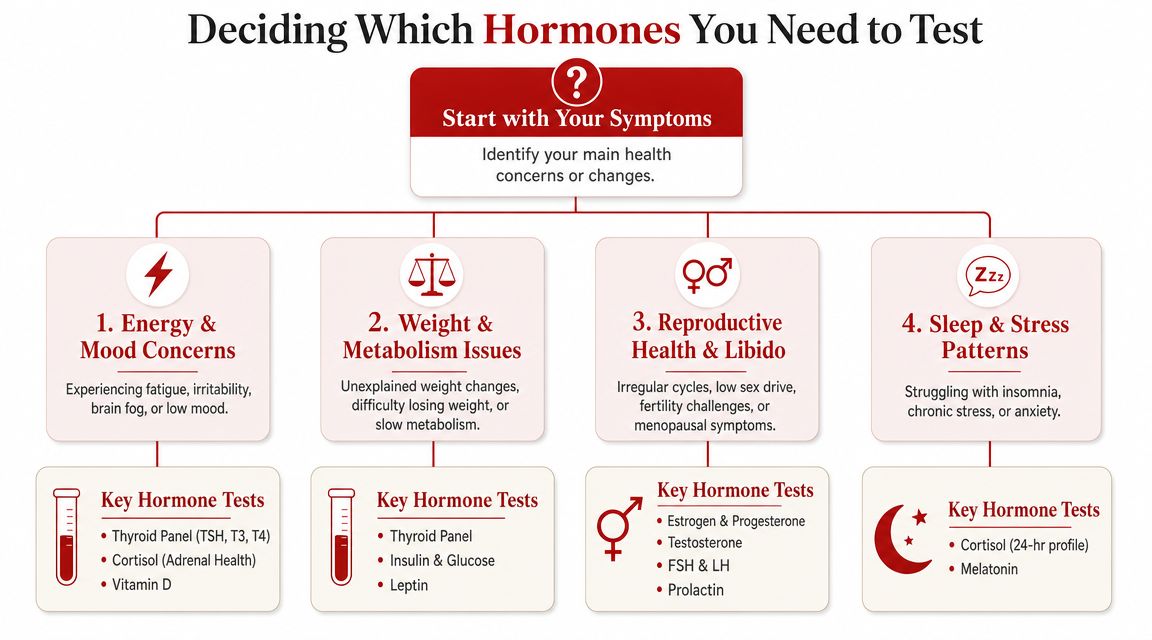
The right panel depends on the question you're trying to answer. That sounds obvious, but many people book too broadly and still don't get clarity. A hormone panel should match your symptoms, your life stage, and, for some tests, your cycle timing.
If your main concern is energy and feeling run down
Hormones are only one part of the picture when someone feels exhausted, but they can be relevant. If fatigue comes with poor concentration, low mood, or disrupted sleep, people often look at thyroid hormones and stress-related markers alongside more general wellness testing.
A broad fatigue-focused panel can be more practical than ordering a reproductive hormone test by default. If that's your starting point, a Tiredness and Fatigue Blood Test can make more sense than jumping straight into a fertility-style workup, because it keeps the question aligned with the symptom.
If you're thinking about fertility or cycle changes
Timing is a crucial factor. London clinics commonly position baseline female hormone testing as a day-3 or early-cycle assessment. Superdrug Health Clinic says its Female Hormone Blood Test should be taken on day 3 of the menstrual cycle, or as close as possible, and that it measures FSH, LH and oestradiol. Chelsea Blood Testing Clinic uses the same core trio, which shows how established that baseline approach is in London practice, as outlined by Superdrug's female fertility hormone screen information.
That same practical issue is often missed on clinic pages. Many answer “where can I get a test?” but not “when should I do it?” Hormones like FSH, LH and oestradiol are commonly interpreted on day 2 to 5 of the cycle for fertility assessment, while progesterone is typically checked 7 days before the next period, according to guidance on blood test timing from The Gender Hormone Clinic. Test at the wrong point and the numbers may be harder to interpret properly.
A targeted Female Hormone Test is usually the better fit when your questions relate to irregular periods, ovulation, fertility planning, or possible perimenopausal change.
If perimenopause is the question
Perimenopause often blurs into everyday life. Some months look normal. Others don't. Symptoms can include cycle shifts, sleep disruption, hot flushes, irritability, lower resilience, and changes in libido or concentration. A blood test can add useful context, but it works best when paired with a symptom history and, if you still have periods, correct timing.
Some women also want practical lifestyle support while they're sorting out what testing to do. This article on support for perimenopausal women is a helpful read because it focuses on the lived side of cycle change rather than just lab markers.
If you're not sure and need a simple filter
Use this quick decision guide:
- Cycle irregularity or fertility planning: start with a Female Hormone Test and check the required cycle day before ordering.
- Low energy with broad, non-specific symptoms: begin with a Tiredness and Fatigue Blood Test or wider wellness panel.
- Menopausal or perimenopausal questions: choose a hormone panel only if you're also prepared to note symptoms and test timing.
- Persistent uncertainty: speak to a clinician before picking a panel, especially if you're taking hormonal contraception or HRT.
The same result can mean different things depending on cycle day, medication, and the reason you tested in the first place.
Choosing Your Testing Path NHS vs Private Clinic vs At-Home
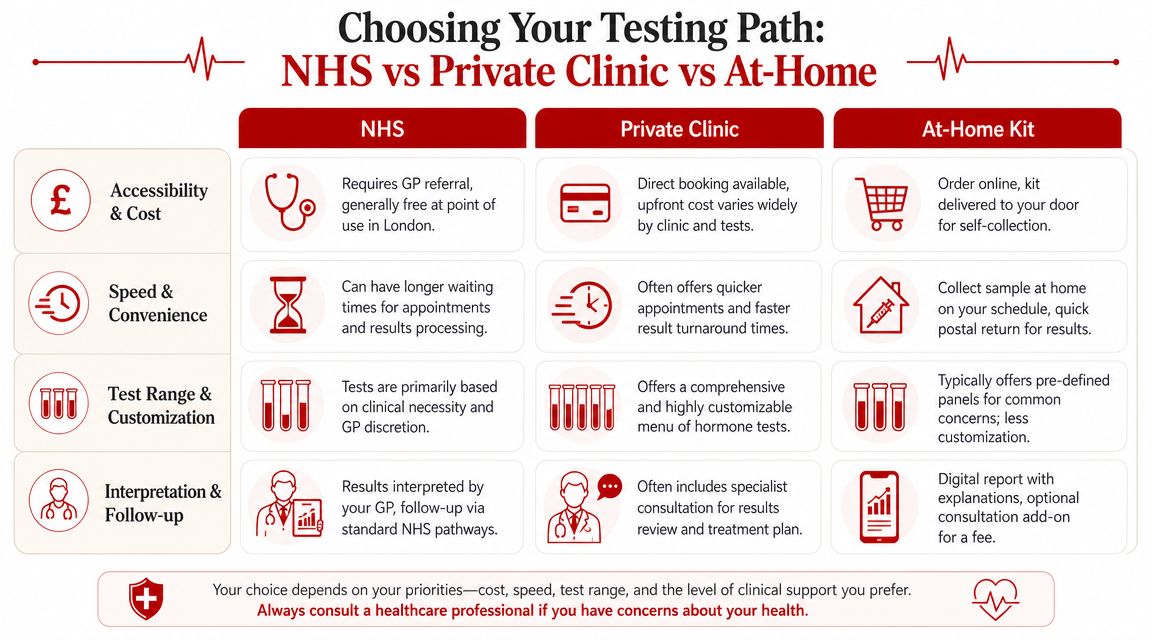
Once you know what you want to test, the next decision is how to get it done. In London, the choice often comes down to three routes: NHS, private clinic, or at-home testing. Each has real strengths. Each also has trade-offs that matter in day-to-day life.
The NHS route
The NHS is often the right first step if your symptoms are significant, persistent, or linked to a wider health concern. Your GP can decide whether testing is clinically indicated and can place results in the context of your overall history, prescriptions, and ongoing care.
The trade-off is less control over pace and scope. The panel you get is based on clinical need, not personal preference, and appointment timing may not line up neatly with cycle timing or a busy London workweek. If you need repeat tests for comparison, you may also find the process less flexible.
Private clinics in London
Private services appeal to people who want direct access and shorter waits. London's private market has clearly moved towards speed. The Online GP in Marylebone says it offers same-day blood test appointments with results typically returned within 24 to 48 hours, while Spire London East Hospital says results are usually available within a week after samples are sent to the laboratory and reviewed, as described in The Online GP's overview of hormone testing in London.
That speed is useful, but convenience still depends on where you live and work. A clinic in Marylebone may be easy for one person and awkward for another. Travel time, parking, appointment slots, and needing a venous draw during office hours are all practical factors, not minor details.
At-home testing
At-home testing works well for people who value privacy, schedule control, and the ability to collect a sample without travelling across the city. It can be especially helpful when timing matters and you don't want to coordinate a clinic visit around a specific cycle day.
This route does require you to follow instructions carefully. Finger-prick sampling is convenient, but it isn't “do anything whenever you like” testing. You still need to check timing, packaging, return instructions, and whether the panel suits your actual concern. If you want to compare that route with other options, this guide to an at-home hormone test in the UK is useful for understanding the practical steps.
A side-by-side view
| Path | What works well | What tends to frustrate people | Best suited to |
|---|---|---|---|
| NHS | Integrated follow-up through your GP, no direct test shopping | Less control over timing and panel choice | Symptoms needing broader medical assessment |
| Private clinic | Faster access, broad panel choice, in-person blood draw | Travel, appointment logistics, upfront cost | People who want quick clinician-led testing in London |
| At-home kit | Privacy, timing control, no clinic visit | You must collect and return the sample correctly | People who want convenience and repeatable testing at home |
What works in real life
A lot depends on the reason for testing.
- Choose NHS first if you have worrying symptoms, multiple health issues, or you already know you'll need medical follow-up.
- Choose private clinic if you want fast access to a broader menu and prefer venous sampling done for you.
- Choose at-home testing if privacy, timing, and convenience are your main priorities.
One practical option in the at-home category is Repose Healthcare, which offers UK home testing kits including hormone panels. That route suits people who want to collect their sample on their own schedule and review results securely online rather than fitting a clinic visit into a London workday.
Convenience only helps if the panel is appropriate and the sample is taken properly.
How to Prepare for Your Hormone Test
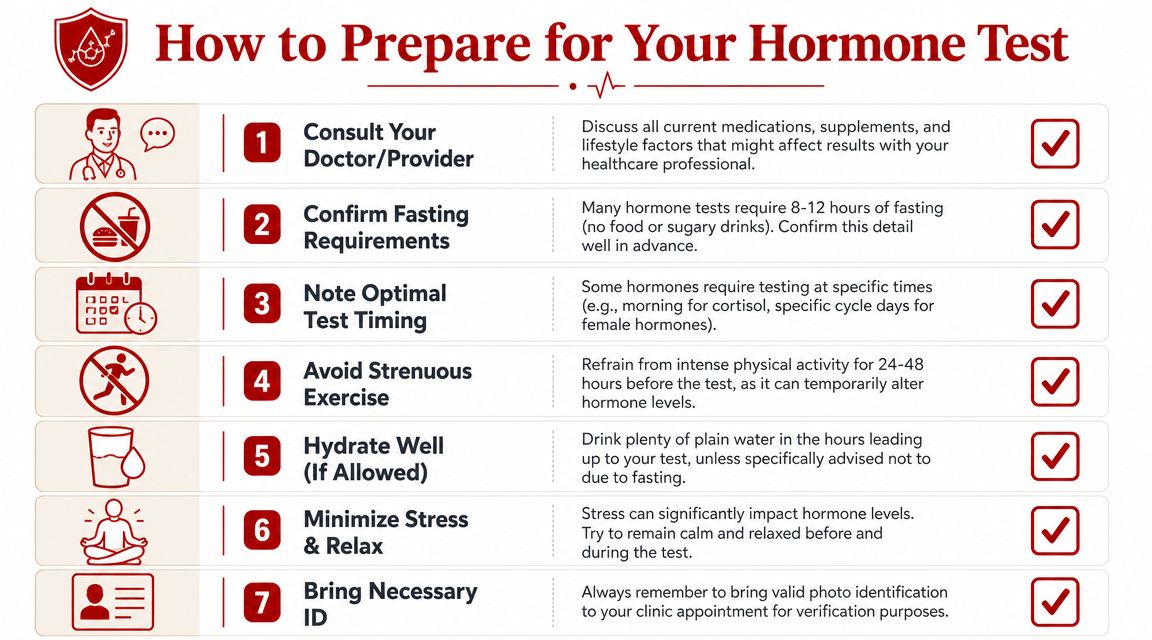
Good preparation makes the result more useful. Poor preparation can leave you with numbers that are technically correct but hard to interpret in context. That's particularly true for hormones, because timing, daily variation, and menstrual cycle phase can all matter.
Get the timing right first
This is the step people most often underestimate. London clinics have established timing practices for a reason. Superdrug Health Clinic and Chelsea Blood Testing Clinic specify that a baseline female hormone blood test measuring FSH, LH and oestradiol should be taken on day 3 of the menstrual cycle, which shows that the date of testing is part of the interpretation, as reflected in Superdrug's day-3 female fertility testing guidance.
If your panel includes progesterone, the timing may be different. If you still have periods, write down the first day of your last period before you book anything. If your cycles are irregular, note that too, because it affects how the result is read.
Check instructions before collection
Not every test has the same preparation requirements. Some can be taken more flexibly. Others need morning sampling or specific handling. Don't assume your previous blood test routine applies here.
Use a short checklist:
- Read the kit or clinic instructions fully: don't skim. Small details affect sample quality.
- Review medication and supplements: if you take hormonal medication, contraception, or HRT, that can affect interpretation. Ask your clinician what to do before changing anything.
- Confirm whether fasting applies: some panels do, some don't.
- Choose a calm collection window: don't leave an at-home finger-prick sample until the moment you're rushing out the door.
Clinic draw versus home collection
A clinic blood draw is usually simpler from the patient side. You attend, a phlebotomist takes the sample, and the laboratory process begins. Your job is mainly to arrive on the correct day and follow any pre-test instructions.
At-home collection gives you more control, but you have to create the right setup yourself. Warm hands, a steady surface, enough time, and careful packaging all help. If you're using a finger-prick kit, don't start late in the evening if the return instructions require prompt posting.
Bring context with the sample
The result means more when it's attached to a clear note of why you tested. Keep a simple record of:
Your symptoms
Fatigue, irregular periods, low mood, poor sleep, acne, hot flushes, low libido, or fertility concerns.Your timing
Cycle day, time of day, and whether the sample was taken at home or in clinic.Your current hormones or medication
Contraception, HRT, testosterone therapy, or any recent changes.
Preparation insight: A hormone result without timing information is much less useful than most people expect.
Understanding Your Results and Planning Next Steps
When results arrive, the initial focus is often on the highlighted flags. That's understandable, but it's not the best place to start. First check which hormones were tested, when the sample was taken, and whether that timing matched the purpose of the test.
What your report usually shows
Most reports present each biomarker with a measured value and a laboratory reference range. Some platforms also mark results as in range or out of range. That layout is helpful, but it's still only part of the story.
Hormone interpretation always depends on context. A result can't be read properly without your symptoms, age, cycle status, medication, and the reason you tested. If you're looking at your report for the first time, this guide on how to read blood test results in the UK can help you understand the format before you decide what to do next.
What to do if a result looks off
Don't self-diagnose from one line on a report. A single abnormal-looking marker can reflect timing, expected variation, or something that needs proper follow-up. The next step depends on the pattern, not just the flag.
A sensible approach is:
- Compare the result with your original question: did this panel test what you needed?
- Check the timing details: cycle day and time of sampling matter.
- Book follow-up with a GP or appropriate clinician: especially if symptoms are ongoing or the pattern looks unclear.
- Keep the report for trend tracking: repeat testing over time can be more informative than a one-off snapshot in some situations.
Men and male hormone questions
Men often approach hormone testing with a single question about testosterone, but the surrounding context matters just as much. Symptoms like low libido, reduced energy, poor recovery, or mood change can overlap with sleep, stress, weight, medication, and other health issues. If you're trying to understand what a testosterone result might mean in practical terms, XO Medical's male health advice is a useful explainer.
Privacy and follow-up
A private report can be convenient, but it shouldn't sit in your inbox without a plan. Use it as a tool for action. That may mean discussing it with your GP, using it to prepare for a fertility consultation, or repeating the same panel later under the same conditions to compare like with like.
Results are most useful when they change a decision. That decision might be medical follow-up, symptom tracking, or simply ruling out one line of concern.
Take Control of Your Hormonal Health Today
Getting a hormone blood test in London doesn't need to become a full-time research project. The practical route is usually the right one. Start with the question you're trying to answer. Choose a panel that matches that question. Take timing seriously. Then make sure you know what you'll do with the result once it arrives.
For some people, that means going through the NHS because the issue needs broad medical assessment. For others, a private London clinic makes sense because speed and in-person support matter. And for plenty of people, at-home testing is the most realistic option because privacy, control, and convenience fit better around work, family, and day-to-day life.
Hormone data is useful, but it isn't magic. It works best when paired with symptoms, timing, and sensible follow-up. That's also why lifestyle still matters. Sleep, food, stress, alcohol, exercise, and cycle awareness can all shape how you feel while you're investigating. If you want a practical starting point on nutrition, this guide to foods for hormonal health is worth keeping alongside your test results.
The main thing is not to stay stuck in guesswork. If you've been putting off testing because the London options feel confusing, simplify the decision. Pick the route you're likely to complete properly. A well-timed home test is often more useful than a clinic appointment you keep postponing.
If you're searching for hormone blood test london, your ultimate goal usually isn't the test itself. It's reassurance, clarity, and a next step that makes sense for your body and your life.
If you're ready to move from uncertainty to action, Repose Healthcare offers a practical place to start. You can explore at-home hormone and wellness testing options, choose a panel that fits your concern, and complete the process with clear instructions and secure online results.
You Might Also Like
STI Test Kit at Home: How It Works and What to Expect
You've had condomless sex with a new partner, feel completely well, and are now deciding [...]
Fertility Blood Test Day 3: What to Expect
You've booked your first fertility appointment, but one phrase on the instructions keeps bothering you: [...]
Home Liver Function Test: What Results Mean
You've opened the results from a home liver function test and found a mildly raised [...]
Glucose Tolerance Test at Home: What You Need to Know
A true diagnostic oral glucose tolerance test in the UK is usually a supervised clinic [...]
At Home PSA Test: Accuracy, Process, and UK Guidelines
You notice that you're urinating more often, your stream seems weaker, or you want a [...]
A1C Blood Test UK: What It Measures and How to Get One
You've just opened a private or at-home A1C blood test UK result and found two [...]
STI Screening for Men: What to Test and When
You've recently ended a relationship, ordered an STI test kit online, and now you're staring [...]
Fertility Testing Before Trying to Get Pregnant: Key Info
You and your partner may have chosen a rough timeline, checked your finances and started [...]
Nutrition Testing Kit: What It Measures and Why It Matters
You're doing the sensible thing, eating reasonably, trying to sleep, and still feeling flat. That's [...]
Private Coeliac Testing UK: A Practical Patient Guide
You've been bloated after pasta for months. You've searched “coeliac symptoms”, noticed the fatigue and [...]
STI Test Kit Price Guide for UK Home Testing
Private STI test kits in the UK usually start at about £29 to £30 for [...]
Sexual Health Screening: Your Guide to 2026
You're often here for a very ordinary reason that suddenly feels loaded. A new partner. [...]
Pregnancy Screening Tests Private: Your UK Guide
You've had a positive pregnancy test, the NHS booking appointment is still ahead, and your [...]
What Is Glucose Tolerance Test and How It Works
A glucose tolerance test is a two-hour challenge test: after an overnight fast, your fasting [...]
Blood Test for Night Sweats What to Check and When
You wake in the early hours with damp nightwear, wet sheets and a racing mind. [...]
The 2026 Cost of Hepatitis Vaccination in the UK
You're usually looking up the cost of hepatitis vaccination for a practical reason. A trip [...]
Hormone Blood Test London: Find Your Perfect Test
Some London health questions start subtly. Your cycle changes a little. You feel wired at [...]
Peanut Allergy Test Kit: A Practical UK User’s Guide
A peanut reaction often starts with uncertainty, not clarity. You eat a biscuit, satay sauce, [...]
NIPT Test Edinburgh: Your 2026 Guide
If you're searching nipt test edinburgh, you're probably already in that familiar stage of pregnancy [...]
Peripheral Artery Disease UK: Peripheral Artery Disease UK:
You might be reading this because walking has started to feel different. Perhaps your calf [...]
NIPT Test Cardiff: Clinic, Home & NHS Pathways 2026
If you're in Cardiff, newly pregnant, and staring at screening options that all seem to [...]
Gender Scan Difference UK: Accuracy, Timing & Cost Compared
You've probably already done the same search most parents do. One tab shows the NHS [...]
NIPT Test Cambridge: Guide to Options & Booking 2026
You're in Cambridge, you've had the first rush of finding out you're pregnant, and then [...]
Home COVID Test Results: A Practical UK & Ireland Guide
You've done the swab, mixed the sample, added the drops, and now you're staring at [...]
DVT Test Squeeze Calf: Homan’s Sign & Beyond
You notice one calf is sore, a little swollen, and not behaving like an ordinary [...]
Your Guide to Every Travel Clinic Leicester Offers in 2026
Flights are booked. The hotel is sorted. Your passport is still in date. Then one [...]
13 Week Gender Scan: Accuracy, NIPT & What to Expect
By the time you reach 13 weeks, pregnancy often starts to feel more real in [...]
Your Pregnancy Scan London: Guide to Options & Costs
A positive test can make London feel suddenly very small and very complicated. You might [...]
Your Nuchal Dating Scan Explained: A 2026 UK Guide
That appointment message has landed in your phone or come through the post, and suddenly [...]
Normal Cortisol Levels UK: Get Clarity
Some people search for normal cortisol levels uk after weeks of feeling unlike themselves. They’re [...]