
Peanut Allergy Test Kit: A Practical UK User’s Guide
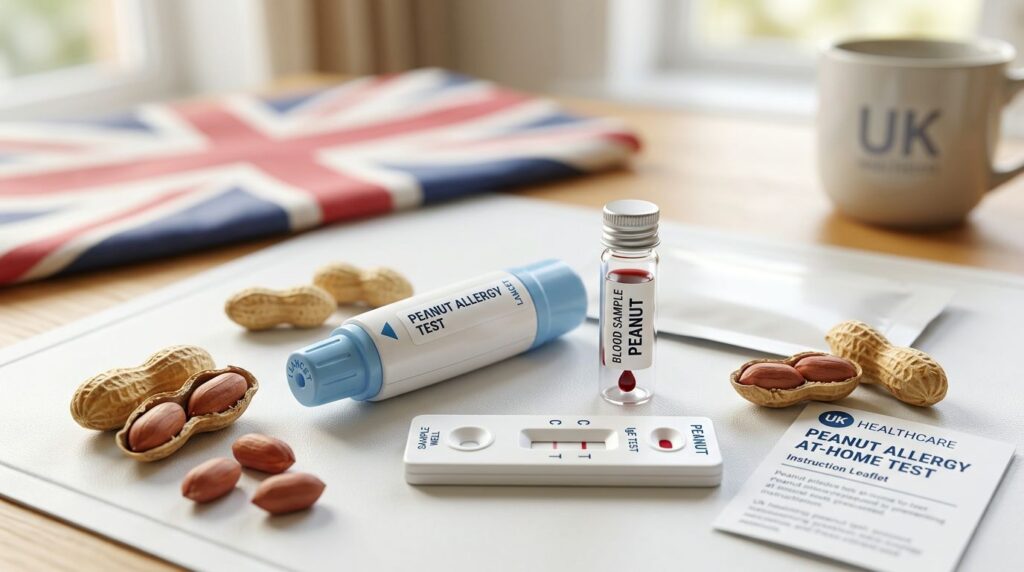
A peanut reaction often starts with uncertainty, not clarity. You eat a biscuit, satay sauce, or takeaway you've had before, then notice an itchy mouth, stomach discomfort, hives, or a feeling that something wasn't right. If you're a parent, the worry can be sharper because you're trying to decide whether this was a one-off event, a sensitivity, or something that needs proper medical follow-up.
That's where a peanut allergy test kit can help. For UK and Irish users, an at-home blood test can be a practical first step when you want clinically useful information without waiting for a clinic appointment. It gives you data you can take forward, rather than relying on guesswork or internet forums.
Equally, this guide is about clinical testing for your body, not the peanut test strips used in food factories or commercial kitchens to check surfaces and rinse water for contamination. Those kits answer a different question. They tell you whether peanut protein is present in an environment, not whether your immune system is reacting to peanut in a way that suggests allergy. That confusion is common, and many product pages still don't address the household decision-making questions people genuinely have, as shown in Hygiena's overview of peanut allergen detection.
Anxiety and Answers Finding Your Starting Point
The hardest part is often not the test. It's the period before it, when you're replaying symptoms and wondering whether you're overreacting or missing something important.

A lot of people search for a peanut allergy test kit because they want one simple answer. Am I allergic or not? In real clinical practice, it's usually a bit more nuanced than that. A blood test can show whether your immune system has made IgE antibodies to peanut, but that result has to be interpreted alongside your symptoms and timing.
Two very different kinds of peanut testing
When people look online, they often find two categories mixed together:
- Clinical allergy blood tests that look for immune markers in your sample
- Food or surface detection kits that look for peanut protein in a product, on a worktop, or in rinse water
Those aren't interchangeable. One is about your immune response. The other is about environmental contamination.
A positive food-detection strip doesn't diagnose allergy, and a blood test doesn't prove a particular kitchen surface is safe.
Why starting with a home blood test can be useful
For many people, home testing feels more manageable than waiting and worrying. You can collect the sample privately, from your own home, then use the result as part of a proper conversation with your GP or allergy specialist.
That matters because fear tends to push people toward extremes. Some avoid large groups of foods without evidence. Others test themselves informally by eating peanut again, which can be risky if previous symptoms were significant.
A better approach is calm and structured:
- Look at the reaction history. What did you eat, how quickly did symptoms start, and what happened?
- Use a clinically relevant test if you need an initial answer.
- Take the result forward for professional interpretation, especially if symptoms were immediate or concerning.
If you're in that uncertain middle ground, you're not being dramatic by wanting answers. You're being sensible.
Different Types of Peanut Allergy Tests Explained
Not all peanut tests do the same job. That's one of the biggest reasons people get confused.
Your immune system uses antibodies as a defence system. In peanut allergy, IgE antibodies can behave like over-alert security guards. They spot peanut proteins and trigger an alarm. The challenge is that the alarm system can sometimes be present without causing real-world symptoms every time peanut is eaten.
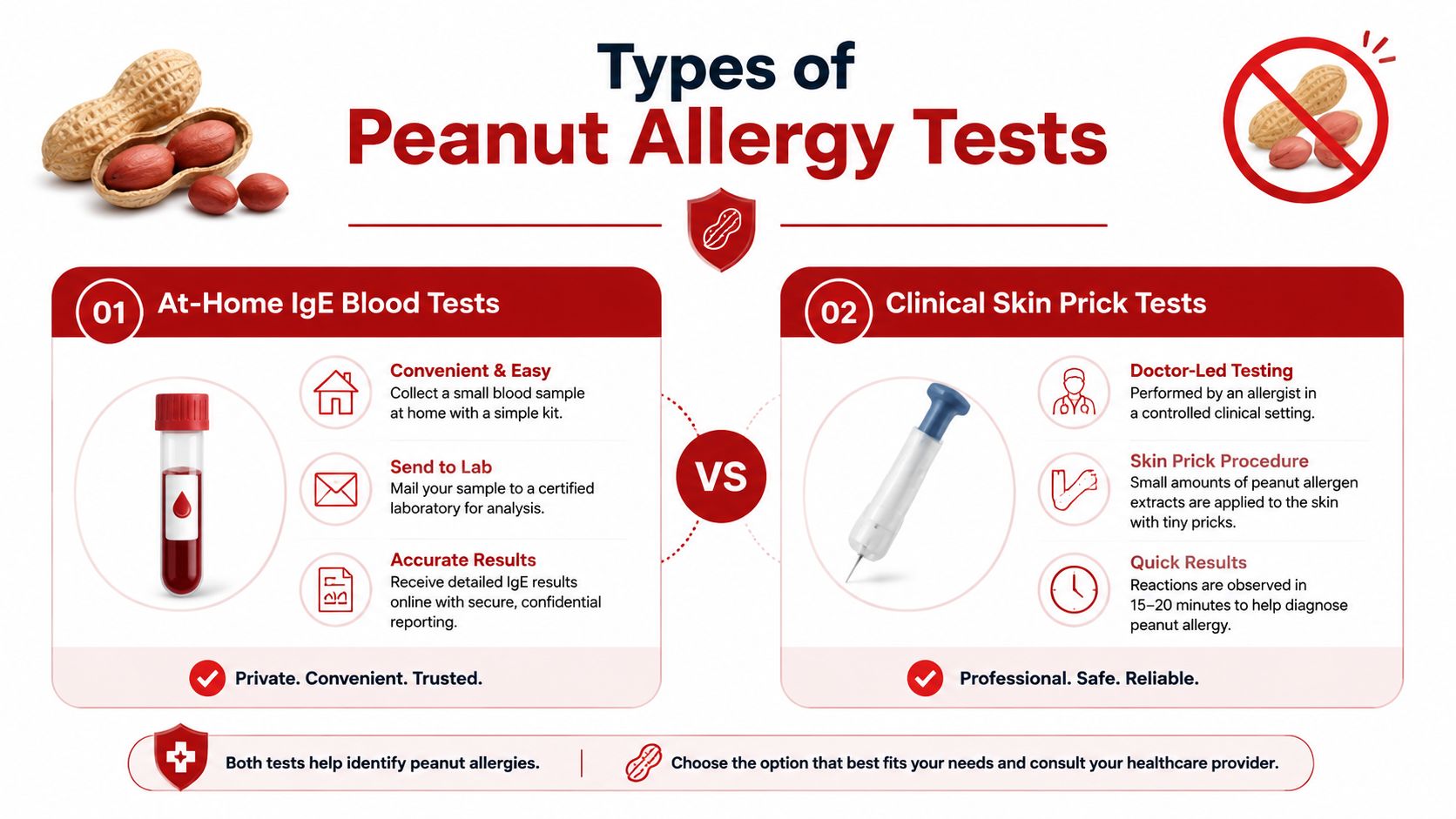
The main testing methods
In practice, peanut allergy is usually investigated with a mix of history-taking and one or more formal tests.
| Test Type | What It Measures | Performed By | Primary Purpose |
|---|---|---|---|
| At-home IgE blood test | Peanut-specific IgE antibodies in blood | Individual at home, then laboratory analysis | Identifies sensitisation and helps guide next steps |
| Clinical skin prick test | Skin response to peanut extract | Clinician | Assesses immediate allergic sensitisation in a supervised setting |
| Oral food challenge | Real-world reaction during controlled exposure | Allergy specialist team | Helps confirm whether clinical allergy is present |
Where an at-home blood test fits
An at-home blood test is often the most practical starting point if you want to investigate a possible peanut allergy without arranging a first clinic visit straight away. It doesn't replace specialist assessment, but it can provide useful evidence.
A strong reason this matters comes from UK evidence. A landmark UK study found that a peanut-specific IgE level of at least 6 kU/L gave a 95% positive predictive value for a clinical reaction, which shows that result thresholds matter rather than every positive being equal, as detailed in this UK peanut allergy study in a paediatric cohort.
That doesn't mean a home result should be read in isolation. It means numbers can carry different weight depending on the context.
Why skin prick tests and food challenges are still used
Skin prick testing can be helpful because it gives a fast, doctor-led measure of whether the skin reacts to peanut extract. But again, a positive result doesn't automatically tell you how someone will react when eating peanut.
An oral food challenge is often treated as the most definitive way to clarify a true allergy, because it observes what happens when peanut is introduced in a controlled setting. It's not something to try yourself at home.
Practical rule: Think of a home blood test as an evidence-gathering step, not a final verdict.
If you want a broader overview of how food allergy testing works in day-to-day practice, this guide on how to test for food allergies is a useful starting point.
How to Use Your Repose At-Home Test Kit
The process is usually much simpler than people expect. Most of the anxiety comes from not knowing what arrives, how much blood is needed, or what happens after you post it back.
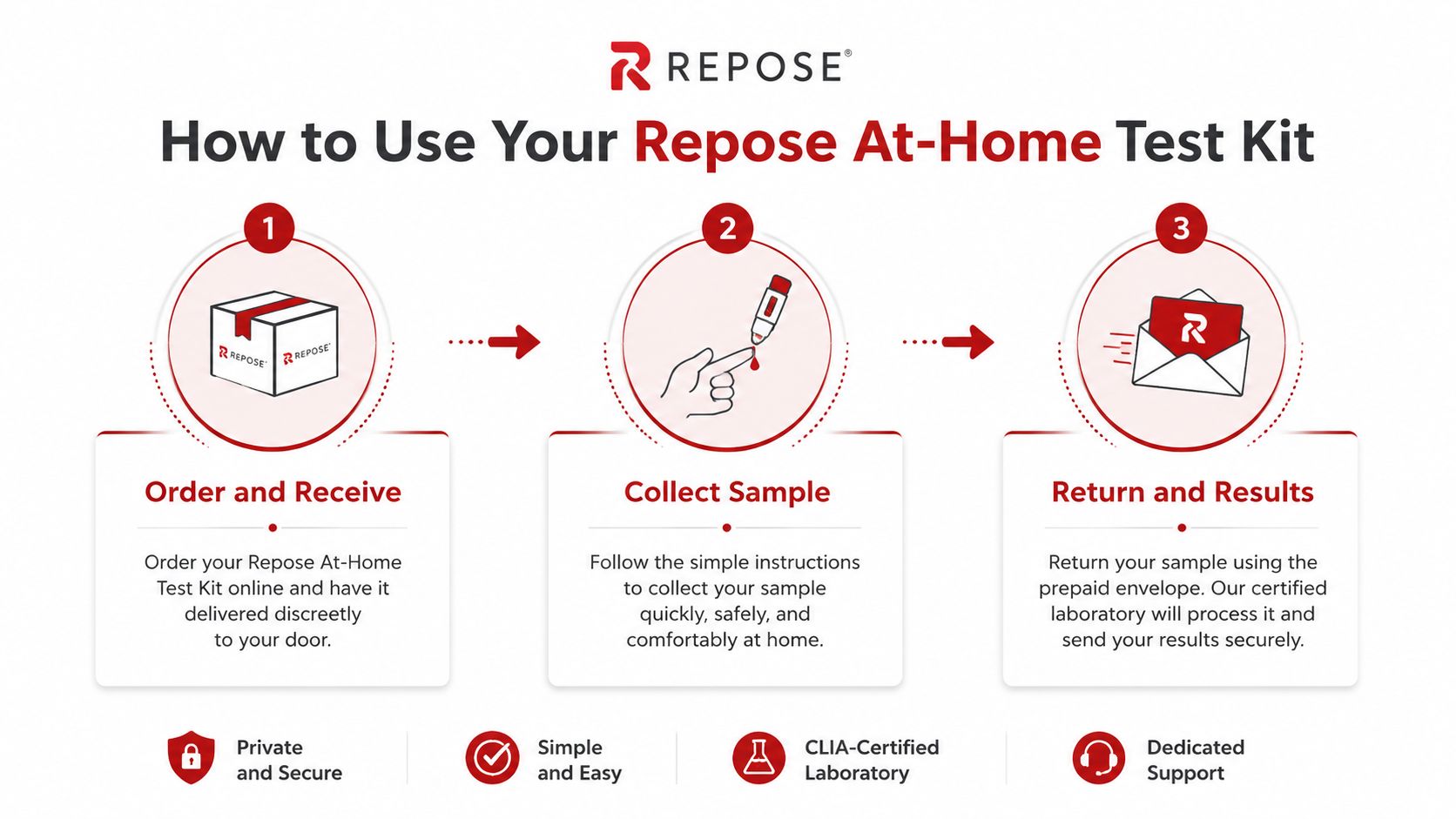
What the journey usually looks like
If you order an at-home allergy blood test, you can expect a straightforward sequence.
Choose the right test
If peanut is your main concern, a targeted test is usually the clearest place to start. If symptoms seem broader or you're unsure what the trigger is, a larger allergy panel may be more appropriate.Read the instructions before collecting the sample
Don't open the lancet and start improvising. Set everything out first, wash and warm your hands, and check the sample card or collection tube so you know exactly what you're aiming to do.Take the finger-prick sample carefully
A finger-prick blood sample is designed for home use. The key is preparation. Warm hands and a calm setup usually make collection easier than rushing.
What happens after collection
Once the sample is taken, it goes back to the laboratory using the return packaging included with the kit. The laboratory analyses the blood sample, and the result is then shared through a secure online account.
The reason many people choose this route is convenience. There's no need to sit in a waiting room just to begin the process.
One practical option if you need wider screening
If peanut may not be the only trigger, one option is the Alex Allergy Test for 300 allergens, which is designed for broader allergy investigation rather than a single allergen question. That can be useful when symptoms don't clearly point to one food.
Before you post the sample, double-check labels and packaging. Most home testing errors happen before the laboratory ever sees the blood.
Small details that make the process smoother
A few habits help avoid avoidable problems:
- Pick a calm time: Don't do the sample when you're rushing out the door.
- Warm your hands first: Blood flow is usually better.
- Follow the return instructions exactly: Packaging and identification details matter.
- Keep your expectations realistic: The result is useful clinical information, but it still needs interpretation in context.
If you're worried about the finger-prick itself, often, the anticipation is worse than the collection.
Interpreting Results Sensitisation Versus True Allergy
This is the point often overlooked, and it's the reason peanut allergy testing can feel confusing.
A blood test can show sensitisation. That means your immune system has made IgE antibodies to peanut. But sensitisation is not the same thing as a true clinical allergy, where eating peanut causes actual symptoms.
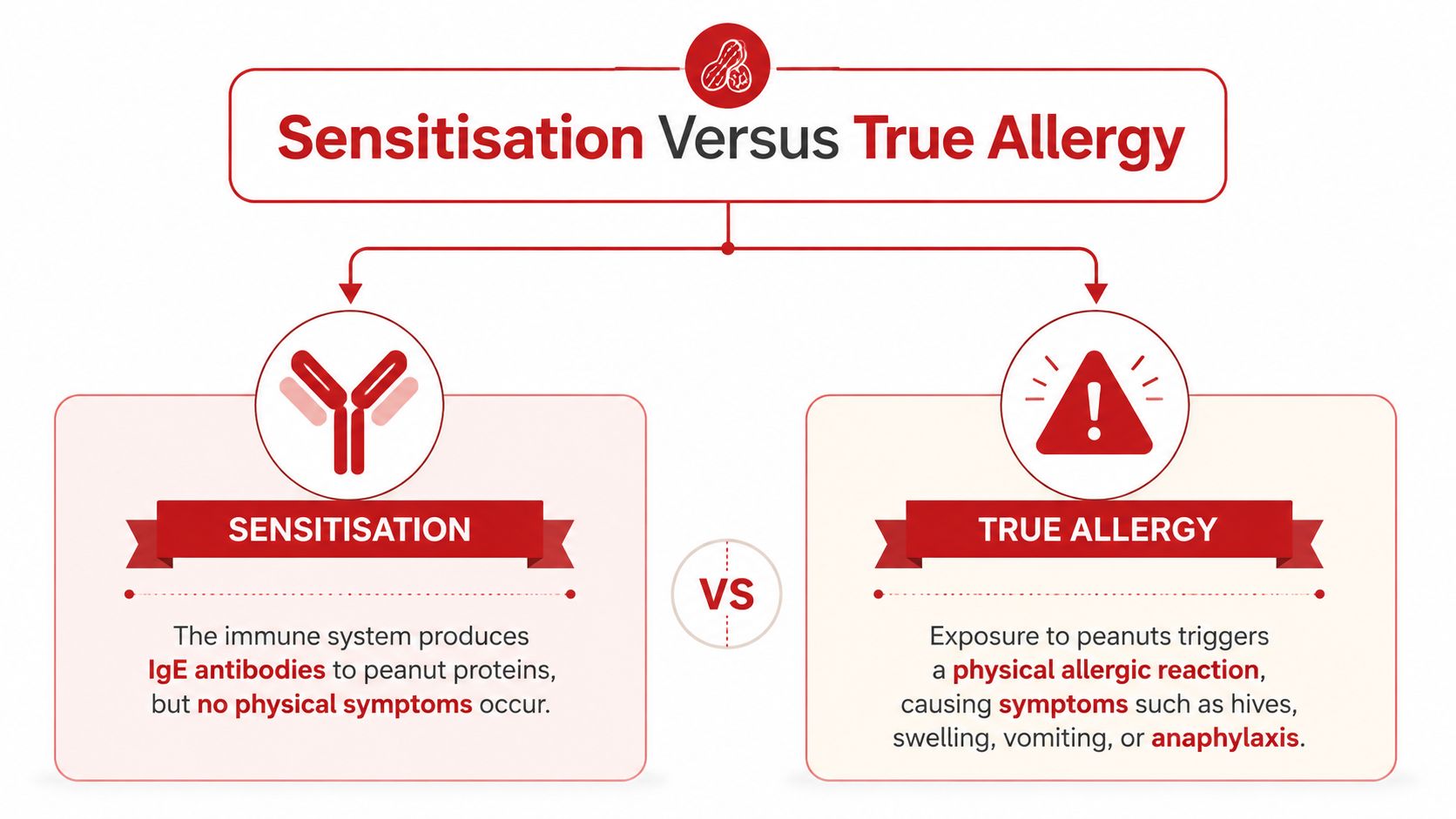
A simple way to think about it
A useful analogy is a smoke alarm. A smoke alarm can be installed, powered, and sensitive enough to go off. That doesn't always mean there's a house fire. Sometimes it reacts to burnt toast. In allergy testing, sensitisation is the presence of the alarm system. Clinical allergy is the fire that produces symptoms when peanut is eaten.
That's why test interpretation needs two pieces of information:
- What the blood test shows
- What your body has done in real life
If someone has a positive result but has eaten peanut without symptoms, that means something different from a positive result in someone who develops hives, vomiting, wheeze, or swelling shortly after exposure.
Why test results alone can mislead
UK clinical guidance has recognised this for years. NICE has treated food allergy diagnosis as a risk-based clinical decision rather than a simple self-test issue. The original CG116 guideline was published in February 2011 and set out that suspected food allergy in children and young people should be assessed with a careful history plus appropriate testing, because test results alone can be misleading, as discussed in this review of peanut allergy diagnosis and component testing.
That matters because a positive result can create unnecessary fear if it's over-read. It can also create false reassurance if a result is read too casually.
A laboratory result is one piece of the puzzle. Your symptoms, timing, and exposure history still matter.
Why component testing changed the picture
Older approaches often focused on whole-peanut testing. Modern specialist practice increasingly uses component-resolved diagnostics, which look at specific peanut proteins rather than treating peanut as one single thing.
The component most often discussed is Ara h 2. In the review above, Ara h 2 was described as the most important predictor of clinical allergy. One cited study found that Ara h 2 correctly identified 60% of children with true peanut allergy, compared with 26% for whole-peanut specific IgE, and another analysis found it could reduce the need for oral food challenges by 50% when used appropriately in assessment.
That gives patients a more useful question than “is anything peanut-related showing up?” The better question is “does this pattern look more consistent with a true allergic reaction risk?”
What a positive result should mean to you
A positive peanut allergy test kit result should prompt careful interpretation, not panic.
Think in these terms:
Positive with clear symptoms after eating peanut
This combination is more clinically meaningful and deserves prompt GP or specialist follow-up.Positive without convincing symptoms
This may reflect sensitisation rather than true allergy. It still matters, but it doesn't answer everything on its own.Negative but symptoms continue
That can still need medical review. Not every food-related reaction follows the same pathway.
The most useful mindset is to treat the result as evidence for a clinical conversation, not as a stand-alone diagnosis.
You Have Your Results What Happens Next
The next step depends on the result, but one rule applies to everyone. Don't use home testing as a reason to experiment on yourself.
If your result is negative, that usually makes an IgE-mediated peanut allergy less likely. But “less likely” doesn't mean “nothing is wrong”. If symptoms continue after eating peanut or foods that may contain peanut, book a GP appointment and bring a record of what happened.
If the result is positive
A positive result is a reason to pause, not to self-test by eating peanuts again. If previous symptoms were immediate or worrying, deliberate exposure at home isn't a safe way to “check”.
Bring the report to your GP or allergy specialist. It gives them something concrete to work with alongside your history.
Your appointment will usually focus on questions such as:
- What exactly was eaten
- How quickly symptoms started
- What the symptoms were
- Whether peanut has ever been eaten without symptoms
- Whether other nuts or foods may have been involved
Depending on that picture, the clinician may decide the blood result is enough to support advice on avoidance, or they may recommend further specialist assessment.
If symptoms were severe
If a reaction involved breathing difficulty, throat tightness, collapse, or rapidly worsening symptoms, seek urgent medical help. That's more important than waiting to interpret paperwork.
Take photos of visible symptoms if it's safe to do so. A picture of hives or swelling can help a clinician understand what happened later.
Using the result constructively
A home result is most helpful when you use it as part of a proper medical chain:
- Keep the report
- Write down your reaction history
- Avoid informal self-challenges
- Arrange clinical follow-up
If you're comparing options for more focused testing, individual allergen tests can be helpful when you already have a strong suspicion about one trigger and want clearer initial data before that appointment.
Living Safely with a Potential Peanut Allergy
Even before you have a final diagnosis, a few habits can make daily life calmer and safer. The goal isn't to live nervously. It's to become organised.
Everyday precautions that actually help
Read labels every time
Don't rely on memory or packaging colour. Recipes and manufacturing processes can change.Ask direct questions when eating out
Be specific. Say you're concerned about peanut and possible cross-contact. General phrases like “I've got a food issue” are easier to misunderstand.Keep a written record of reactions
Note the food, timing, and symptoms. Patterns often become clearer when they're written down.Know your action plan
If a clinician confirms allergy, make sure you understand what to do if symptoms happen again.
Households and children
If the concern involves a child, routine matters. Make sure everyone who cares for them understands the difference between preference and medical risk. Grandparents, schools, clubs, and babysitters need simple, clear instructions.
Parents often find it useful to read practical resources written in plain language. If that's your situation, this guide to childhood nut allergies offers a helpful family-focused overview.
Confidence comes from systems
People cope better when they stop relying on memory alone. A simple routine is often enough:
- check the label
- ask the question
- keep the medication plan clear
- avoid guessing
Suspected peanut allergy can feel intimidating at first. In everyday life, though, good systems usually reduce stress far more effectively than constant worry.
Frequently Asked Questions About Peanut Allergy Testing
Can a peanut allergy test kit tell me how severe my reaction would be?
No. A home blood test can help show whether peanut-specific IgE is present, but it doesn't predict exactly how severe a future reaction would be. Severity depends on the wider clinical picture, not just one laboratory result.
Is a positive result the same as a diagnosis?
No. A positive result can show sensitisation. Diagnosis depends on how that result fits with your symptom history and medical assessment.
Are these tests suitable for children?
That depends on the child's age, symptoms, and the specific kit. If a child has had a significant or immediate reaction, it's sensible to involve a GP or allergy specialist early rather than relying only on home interpretation.
If my result is negative, can I stop worrying?
A negative result can be reassuring, but it doesn't explain every food-related symptom. If reactions continue, you still need clinical advice.
Should I eat peanut again to confirm the result?
No. If there's any realistic concern about allergy, self-challenging at home isn't a safe way to settle the question.
Will my data stay private?
Home health testing providers typically use secure online reporting systems and confidentiality processes. Before ordering, check how your data is stored, who can access it, and how results are delivered.
Should I choose a single peanut test or a larger allergy panel?
If peanut is the clear suspect, a targeted test may be easier to interpret. If symptoms are broader or the trigger is uncertain, a wider panel may be more useful as a starting point.
If you want a private starting point for investigating symptoms, Repose Healthcare offers at-home health testing for people in the UK and Republic of Ireland, including allergy testing that can help you gather clinically useful information before speaking with your GP or specialist.
You Might Also Like
STI Test Kit at Home: How It Works and What to Expect
You've had condomless sex with a new partner, feel completely well, and are now deciding [...]
Fertility Blood Test Day 3: What to Expect
You've booked your first fertility appointment, but one phrase on the instructions keeps bothering you: [...]
Home Liver Function Test: What Results Mean
You've opened the results from a home liver function test and found a mildly raised [...]
Glucose Tolerance Test at Home: What You Need to Know
A true diagnostic oral glucose tolerance test in the UK is usually a supervised clinic [...]
At Home PSA Test: Accuracy, Process, and UK Guidelines
You notice that you're urinating more often, your stream seems weaker, or you want a [...]
A1C Blood Test UK: What It Measures and How to Get One
You've just opened a private or at-home A1C blood test UK result and found two [...]
STI Screening for Men: What to Test and When
You've recently ended a relationship, ordered an STI test kit online, and now you're staring [...]
Fertility Testing Before Trying to Get Pregnant: Key Info
You and your partner may have chosen a rough timeline, checked your finances and started [...]
Nutrition Testing Kit: What It Measures and Why It Matters
You're doing the sensible thing, eating reasonably, trying to sleep, and still feeling flat. That's [...]
Private Coeliac Testing UK: A Practical Patient Guide
You've been bloated after pasta for months. You've searched “coeliac symptoms”, noticed the fatigue and [...]
STI Test Kit Price Guide for UK Home Testing
Private STI test kits in the UK usually start at about £29 to £30 for [...]
Sexual Health Screening: Your Guide to 2026
You're often here for a very ordinary reason that suddenly feels loaded. A new partner. [...]
Pregnancy Screening Tests Private: Your UK Guide
You've had a positive pregnancy test, the NHS booking appointment is still ahead, and your [...]
What Is Glucose Tolerance Test and How It Works
A glucose tolerance test is a two-hour challenge test: after an overnight fast, your fasting [...]
Blood Test for Night Sweats What to Check and When
You wake in the early hours with damp nightwear, wet sheets and a racing mind. [...]
The 2026 Cost of Hepatitis Vaccination in the UK
You're usually looking up the cost of hepatitis vaccination for a practical reason. A trip [...]
Hormone Blood Test London: Find Your Perfect Test
Some London health questions start subtly. Your cycle changes a little. You feel wired at [...]
Peanut Allergy Test Kit: A Practical UK User’s Guide
A peanut reaction often starts with uncertainty, not clarity. You eat a biscuit, satay sauce, [...]
NIPT Test Edinburgh: Your 2026 Guide
If you're searching nipt test edinburgh, you're probably already in that familiar stage of pregnancy [...]
Peripheral Artery Disease UK: Peripheral Artery Disease UK:
You might be reading this because walking has started to feel different. Perhaps your calf [...]
NIPT Test Cardiff: Clinic, Home & NHS Pathways 2026
If you're in Cardiff, newly pregnant, and staring at screening options that all seem to [...]
Gender Scan Difference UK: Accuracy, Timing & Cost Compared
You've probably already done the same search most parents do. One tab shows the NHS [...]
NIPT Test Cambridge: Guide to Options & Booking 2026
You're in Cambridge, you've had the first rush of finding out you're pregnant, and then [...]
Home COVID Test Results: A Practical UK & Ireland Guide
You've done the swab, mixed the sample, added the drops, and now you're staring at [...]
DVT Test Squeeze Calf: Homan’s Sign & Beyond
You notice one calf is sore, a little swollen, and not behaving like an ordinary [...]
Your Guide to Every Travel Clinic Leicester Offers in 2026
Flights are booked. The hotel is sorted. Your passport is still in date. Then one [...]
13 Week Gender Scan: Accuracy, NIPT & What to Expect
By the time you reach 13 weeks, pregnancy often starts to feel more real in [...]
Your Pregnancy Scan London: Guide to Options & Costs
A positive test can make London feel suddenly very small and very complicated. You might [...]
Your Nuchal Dating Scan Explained: A 2026 UK Guide
That appointment message has landed in your phone or come through the post, and suddenly [...]
Normal Cortisol Levels UK: Get Clarity
Some people search for normal cortisol levels uk after weeks of feeling unlike themselves. They’re [...]