
Fertility Blood Test Day 3: What to Expect
You've booked your first fertility appointment, but one phrase on the instructions keeps bothering you: “Please attend on day 3 of your cycle.” Does that mean three days after spotting starts? What if day 3 falls on a Sunday? And what does the blood test reveal?
A fertility blood test on day 3 is usually a baseline assessment of reproductive hormones, particularly FSH, LH and oestradiol. The timing gives your clinician an early-cycle snapshot, but it isn't a pass-or-fail test and it can't define your fertility on its own.
What Day 3 Fertility Blood Testing Involves
Suppose your period starts with a little brown spotting on Monday, then becomes proper bleeding on Tuesday. Which day counts as day 1? Usually, day 1 is the first day of genuine menstrual flow, not light spotting. That makes Wednesday day 3, although your clinic may use its own definition, so ask if your periods build gradually or remain difficult to date.
The test is timed early in the cycle, while the ovaries and pituitary gland are setting the next group of follicles in motion. This gives your clinician a baseline picture before a dominant follicle develops and changes hormone levels. It is similar to checking a timetable before a journey has properly begun. The timing helps make results easier to interpret.
UK NHS fertility services commonly request these blood tests during the first few days of the cycle. University Hospitals Birmingham's fertility blood test guidance asks patients to attend on day 3, while some services accept a wider early-cycle window.
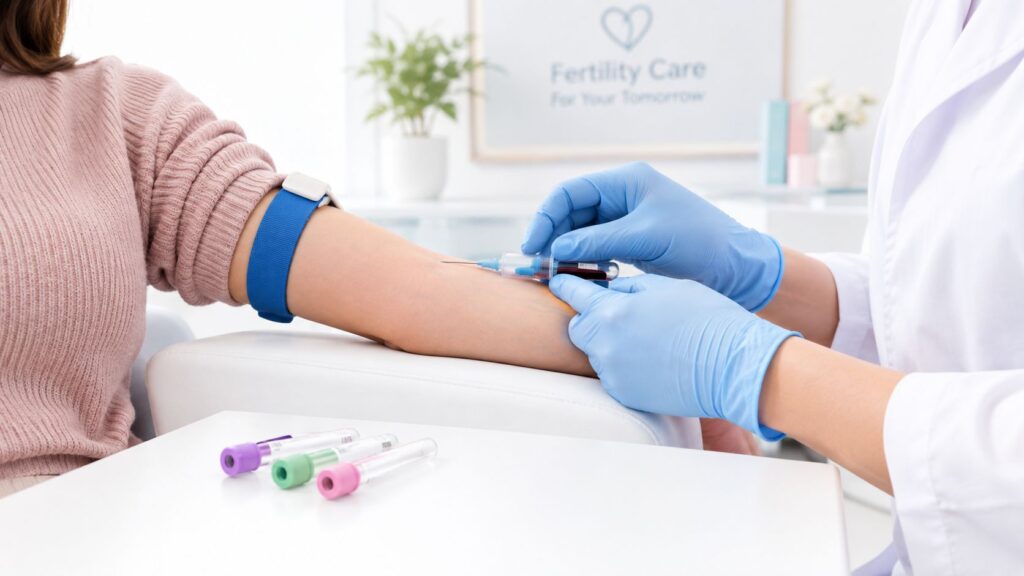
A GP, NHS fertility service or private clinic takes the sample from a vein in your arm. The panel commonly includes:
- FSH, which shows how strongly the pituitary is stimulating the ovaries. A result that appears reassuring still needs to be read with oestradiol, because raised oestradiol can make FSH look lower than it otherwise would.
- LH, which rises before ovulation. On day 3, an LH level out of proportion to FSH can prompt further investigation, particularly when cycle patterns or other symptoms also raise questions.
- Oestradiol, which reflects early follicle activity and helps your clinician judge whether the FSH result gives a reliable picture.
Irregular cycles do not automatically make the test useless, but they can make the date harder to choose. If bleeding is unusually light, prolonged or unpredictable, contact the clinic rather than guessing.
A day 3 result is a snapshot, not a permanent verdict. Levels may vary between cycles, and clinicians interpret them alongside your history and other investigations.
Practical rule: Record when proper bleeding began, when any spotting started and whether the flow changed. This small note can prevent a timing error.
Your appointment may be described as “day 2 to 5 bloods”. That usually means the service accepts a broader early-cycle window, with day 3 as a common reference point.
The Hormones Measured on Day 3 and What Each One Tells You
You may see three hormone results on your day 3 report and wonder which one gives the answer. Fertility bloods work more like a conversation between the brain and ovaries: FSH, LH and oestradiol each provide part of the picture. Reading one result alone can cause unnecessary worry or reassurance.
FSH
Follicle-stimulating hormone, or FSH, shows how strongly the pituitary gland is stimulating the ovaries to support follicle development. Clinicians use it as one indicator when assessing ovarian reserve, which relates to the remaining supply of eggs.
A UK fertility reference describes day 3 FSH below 10 IU/L as generally normal, above 15 IU/L as potentially indicating diminishing ovarian reserve, and above 40 IU/L as usually suggesting menopause. The FSH guidance from Fertility Plus explains why oestradiol should be checked at the same time. A raised oestradiol result can suppress FSH, making the FSH value look more reassuring than it is.
LH
Luteinising hormone, or LH, helps coordinate the hormonal changes that lead to ovulation. On day 3, your clinician normally reads LH alongside FSH and your cycle history, rather than treating it as a standalone fertility score.
An unusual relationship between LH and FSH may lead to further assessment, particularly if your cycles or symptoms also suggest disrupted ovulation. LH alone does not diagnose polycystic ovary syndrome. Your symptoms, cycle pattern, examination and other tests remain part of the assessment.
Oestradiol
Oestradiol is an early-cycle form of oestrogen produced as follicles begin developing. If it is higher than expected on day 3, it can feed back to the pituitary and make FSH appear lower.
That creates a practical interpretation trap. A “normal” FSH is not automatically reassuring when oestradiol is high, so the two results should be considered together using your laboratory's units and reference interval.
| Hormone | Reassuring range or finding | Borderline | High or concerning |
|---|---|---|---|
| FSH | Below 10 IU/L | Around 10 to 15 IU/L may need context | Above 15 IU/L may indicate diminishing ovarian reserve; above 40 IU/L usually suggests menopause |
| LH | Interpreted alongside FSH and cycle history | An unusual relationship with FSH may need review | An isolated result does not establish a diagnosis |
| Oestradiol | Interpreted with FSH and the laboratory range | A result near the upper end needs context | Higher oestradiol can suppress FSH and mask a less reassuring result |
Laboratories may display these results differently, and reference intervals can vary. If you are also working on broader health goals such as body composition, Lila's AI calculator review covers that separately. Hormone interpretation belongs with your clinician.
How to Prepare and Time Your Day 3 Blood Test
Start by identifying the first day of full menstrual bleeding. Don't automatically count light spotting as day 1. If your bleeding begins overnight or changes from spotting to proper flow during the day, ask the testing service which date they want recorded.
Book early if you can. A clinic may accept day 2 to 5, and that flexibility can help when day 3 falls on a weekend, you're working away or you're travelling. Don't assume every provider uses the same window. The appointment request should tell you whether the test must be exactly on day 3 or can take place during the wider early-cycle period.
A simple scheduling checklist
- Record the start of proper bleeding. Note the date and whether spotting came first.
- Check the accepted cycle window. Ask whether day 2, day 3 or another early-cycle day is suitable.
- Confirm the request form. Find out whether the clinic arranges it or whether your GP needs to provide it.
- Ask about medicines. Some treatments can affect hormone interpretation, so disclose everything you take.
- Tell the provider about irregular cycles. Strict day counting may not work when periods are unpredictable or absent.
For irregular or absent periods, don't keep waiting indefinitely for a textbook day 3. Leeds Teaching Hospitals' fertility service information notes that baseline bloods may be taken without waiting when periods are more than six weeks apart. The clinical context then changes, so write down when you last bled and explain your cycle pattern.
Fasting requirements vary by panel and provider. Ask the service before attending rather than assuming. It's also sensible to contact the clinic if you have an acute illness or your appointment clashes with travel, because the clinician may prefer to interpret the sample differently or rearrange it.
The most useful preparation is accurate information. Bring your cycle dates, medication list and any previous hormone results, and ask how the laboratory reports units. That makes the follow-up conversation much clearer.
What Happens During the Blood Draw and Lab Processing
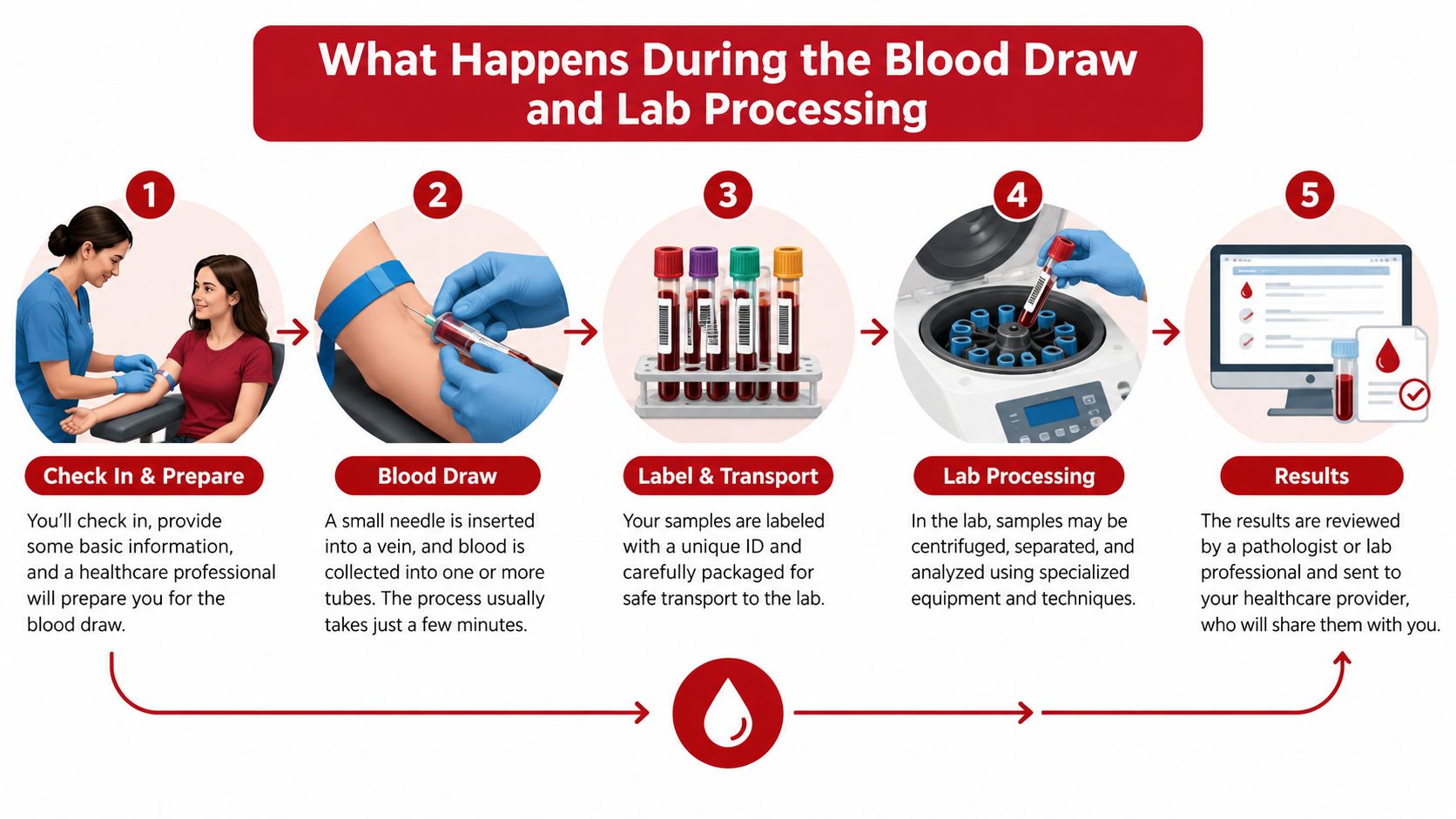
You'll usually check in, confirm your cycle day and have a standard venous blood sample taken by a trained phlebotomist. The appointment is generally straightforward, although the number of tubes depends on which hormones and additional tests have been requested.
The phlebotomist may ask when your bleeding started and whether the sample is being taken for FSH, LH and oestradiol alone or as part of a broader fertility panel. The laboratory then analyses the sample and sends the report to the requesting service or provider.
Clinic testing and home collection
A clinic draw allows staff to verify your identity, cycle day and request form before the sample is collected. It also gives you an immediate opportunity to ask what the panel includes and how results will be communicated.
At-home finger-prick testing follows a different process. You collect capillary blood using the kit's instructions, package the sample and return it to the laboratory. Before ordering, check that the test is designed for the correct cycle day, that the laboratory explains its quality controls and that a clinician will review the result.
Turnaround times depend on the provider, the panel and the delivery method. A report should show the measured value, unit, laboratory reference interval and any comments. Don't rely on a text message or summary label alone, because “normal” can mean different things across different tests.
If the result arrives without a clear cycle-day field, contact the provider and ask how the laboratory interpreted your timing. A technically accurate measurement can still be clinically difficult to use if the cycle day is missing or recorded incorrectly.
How to Read Your Day 3 Fertility Results
You open your results and see a “normal” FSH, then notice that your oestradiol is higher than expected. It is natural to feel reassured by the first number, but day 3 fertility bloods need to be read as a pattern. Start with the laboratory's reference range, then consider cycle day, symptoms, age, medical history and other test results.
FSH is often the result people check first. A lower result may be reassuring, while a result above the laboratory's expected range may lead to repeat testing or further assessment. UK guidance states that FSH and oestradiol shouldn't be used alone to predict fertility treatment outcomes. NICE fertility guidance and recommendations support interpreting these results alongside the wider clinical picture.
The FSH and oestradiol combination
Suppose your FSH appears reassuring, but your oestradiol is higher than expected for an early-cycle baseline. Oestradiol can suppress FSH, making the FSH look lower than it might otherwise be. A “normal” FSH can therefore hide part of the picture. Clinicians read these hormones together rather than treating a low FSH as proof that ovarian reserve is normal.
LH adds another layer. Your clinician may compare it with FSH and consider whether your cycle history suggests an ovulation-related condition. A ratio or isolated result cannot diagnose PCOS, ovarian insufficiency or another disorder.
| Hormone | Clinical note | Unit guidance |
|---|---|---|
| FSH | Read with oestradiol, your history and other fertility findings. Refer to the earlier table for the numerical ranges. | Check the report's stated unit and reference interval. |
| LH | Consider the result alongside FSH and your cycle pattern. An isolated high or low value is not diagnostic. | Use the laboratory's own unit and range. |
| Oestradiol | A raised early-cycle result may suppress FSH, so interpret both results together. | Confirm whether the report uses the unit expected by your provider. |
Check whether your report uses IU/L, pmol/L or pg/mL. The same hormone can have a different numerical value when the unit changes. Repose Healthcare's guide to female hormone blood test results can help explain report terminology, while your GP or fertility specialist should interpret what the findings mean for you.
Progesterone belongs elsewhere in the cycle. It is generally measured in the mid-luteal phase to help confirm ovulation, so a day 3 panel cannot show whether ovulation occurred.
Next Steps After Your Day 3 Fertility Blood Test
Your next step depends on the whole result pattern, not just whether one value is marked high or low.
If the results look reassuring, continue the plan agreed with your clinician. If you're trying to conceive, the appropriate point for further investigation depends on factors such as age, cycle regularity, medical history and how long you've been trying. Don't treat a “normal” panel as a guarantee, and don't treat a borderline result as a diagnosis of infertility.
Three common result pathways
Reassuring results: Keep the full report and discuss whether any additional assessment is appropriate. Fertility bloods don't assess every factor involved in conception, so your clinician may consider your partner's health, ovulation pattern, tubes and other relevant history.
Borderline results: Ask whether the test should be repeated in a future cycle. FSH can vary, and a second early-cycle result may provide more useful context than a single reading. Make sure the repeat sample is taken at the cycle stage requested by the service.
High or unusual results: Arrange a clinical review rather than trying to interpret the result alone. A fertility specialist may recommend further assessment, such as an ultrasound antral follicle count or AMH, depending on your history and the initial findings.
A result can be important without being a final answer. The useful question is, “What should we check next?”
If you used an at-home kit, take the complete report to your GP or fertility specialist. Include the cycle day, units, laboratory ranges and any notes, rather than showing only the headline number. A clinician can then judge whether the collection method and timing fit the question being asked.
This guide to fertility testing before trying to get pregnant may help you organise the wider discussion, particularly if you're planning ahead rather than investigating a current delay in conception.
Before your appointment, write down your bleeding dates and prepare a short list of questions. Ask what each test measures, whether the timing was suitable and whether you need repeat bloods or an ultrasound. That turns a worrying set of numbers into a practical conversation about your next decision.
Repose Healthcare offers at-home hormone and fertility testing with clear collection instructions, prepaid return packaging and results delivered through a secure online dashboard. If you're arranging early-cycle testing and want to understand the available options, visit Repose Healthcare and review the relevant test information before ordering.
You Might Also Like
STI Test Kit at Home: How It Works and What to Expect
You've had condomless sex with a new partner, feel completely well, and are now deciding [...]
Fertility Blood Test Day 3: What to Expect
You've booked your first fertility appointment, but one phrase on the instructions keeps bothering you: [...]
Home Liver Function Test: What Results Mean
You've opened the results from a home liver function test and found a mildly raised [...]
Glucose Tolerance Test at Home: What You Need to Know
A true diagnostic oral glucose tolerance test in the UK is usually a supervised clinic [...]
At Home PSA Test: Accuracy, Process, and UK Guidelines
You notice that you're urinating more often, your stream seems weaker, or you want a [...]
A1C Blood Test UK: What It Measures and How to Get One
You've just opened a private or at-home A1C blood test UK result and found two [...]
STI Screening for Men: What to Test and When
You've recently ended a relationship, ordered an STI test kit online, and now you're staring [...]
Fertility Testing Before Trying to Get Pregnant: Key Info
You and your partner may have chosen a rough timeline, checked your finances and started [...]
Nutrition Testing Kit: What It Measures and Why It Matters
You're doing the sensible thing, eating reasonably, trying to sleep, and still feeling flat. That's [...]
Private Coeliac Testing UK: A Practical Patient Guide
You've been bloated after pasta for months. You've searched “coeliac symptoms”, noticed the fatigue and [...]
STI Test Kit Price Guide for UK Home Testing
Private STI test kits in the UK usually start at about £29 to £30 for [...]
Sexual Health Screening: Your Guide to 2026
You're often here for a very ordinary reason that suddenly feels loaded. A new partner. [...]
Pregnancy Screening Tests Private: Your UK Guide
You've had a positive pregnancy test, the NHS booking appointment is still ahead, and your [...]
What Is Glucose Tolerance Test and How It Works
A glucose tolerance test is a two-hour challenge test: after an overnight fast, your fasting [...]
Blood Test for Night Sweats What to Check and When
You wake in the early hours with damp nightwear, wet sheets and a racing mind. [...]
The 2026 Cost of Hepatitis Vaccination in the UK
You're usually looking up the cost of hepatitis vaccination for a practical reason. A trip [...]
Hormone Blood Test London: Find Your Perfect Test
Some London health questions start subtly. Your cycle changes a little. You feel wired at [...]
Peanut Allergy Test Kit: A Practical UK User’s Guide
A peanut reaction often starts with uncertainty, not clarity. You eat a biscuit, satay sauce, [...]
NIPT Test Edinburgh: Your 2026 Guide
If you're searching nipt test edinburgh, you're probably already in that familiar stage of pregnancy [...]
Peripheral Artery Disease UK: Peripheral Artery Disease UK:
You might be reading this because walking has started to feel different. Perhaps your calf [...]
NIPT Test Cardiff: Clinic, Home & NHS Pathways 2026
If you're in Cardiff, newly pregnant, and staring at screening options that all seem to [...]
Gender Scan Difference UK: Accuracy, Timing & Cost Compared
You've probably already done the same search most parents do. One tab shows the NHS [...]
NIPT Test Cambridge: Guide to Options & Booking 2026
You're in Cambridge, you've had the first rush of finding out you're pregnant, and then [...]
Home COVID Test Results: A Practical UK & Ireland Guide
You've done the swab, mixed the sample, added the drops, and now you're staring at [...]
DVT Test Squeeze Calf: Homan’s Sign & Beyond
You notice one calf is sore, a little swollen, and not behaving like an ordinary [...]
Your Guide to Every Travel Clinic Leicester Offers in 2026
Flights are booked. The hotel is sorted. Your passport is still in date. Then one [...]
13 Week Gender Scan: Accuracy, NIPT & What to Expect
By the time you reach 13 weeks, pregnancy often starts to feel more real in [...]
Your Pregnancy Scan London: Guide to Options & Costs
A positive test can make London feel suddenly very small and very complicated. You might [...]
Your Nuchal Dating Scan Explained: A 2026 UK Guide
That appointment message has landed in your phone or come through the post, and suddenly [...]
Normal Cortisol Levels UK: Get Clarity
Some people search for normal cortisol levels uk after weeks of feeling unlike themselves. They’re [...]