
Progesterone Test for Fertility: Your 2026 UK Guide
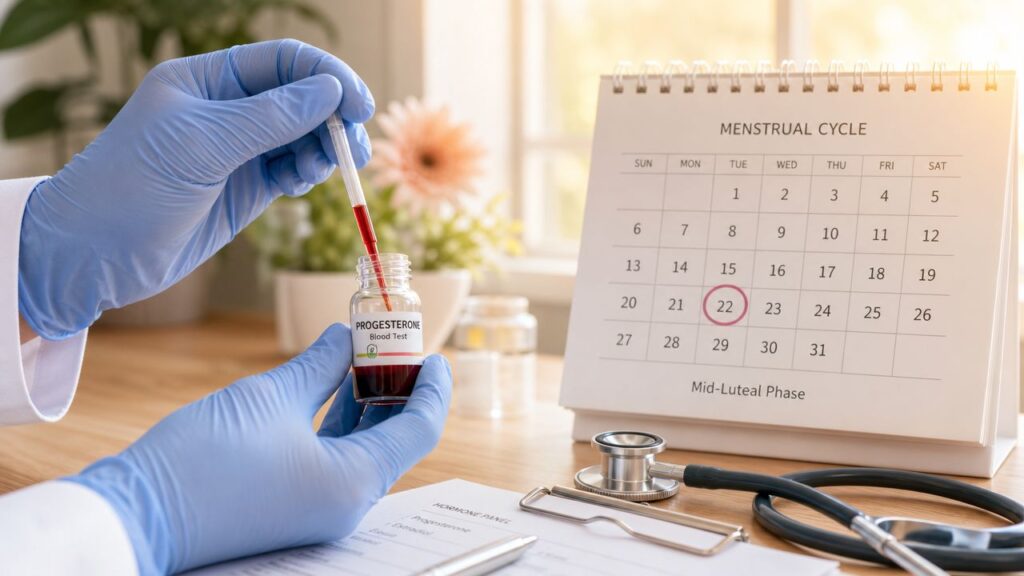
If you're trying to conceive, you've probably already taken the usual first steps. You've watched your cycle app, used ovulation sticks, noticed changes in cervical mucus, and tried to time sex carefully. But one question often lingers after all that effort. Did ovulation happen, and did it happen strongly enough to support a possible pregnancy?
That's where a progesterone test for fertility becomes useful. It doesn't tell you everything about fertility, and it won't diagnose every reason pregnancy hasn't happened. What it can do is give you one very practical piece of information that changes what you do next. It can confirm whether your body has ovulated when the test is taken at the right time.
For many people in the UK, that clarity matters as much as the number itself. A result can help you stop guessing, avoid mistimed testing, and decide whether to keep tracking, repeat the test next cycle, or bring the result to your GP or fertility clinic.
Why a Progesterone Test Is a Key Step on Your Fertility Journey
A very common scenario goes like this. Your ovulation strips look promising one month, less clear the next. Your app says one thing, your body seems to say another, and you start wondering whether you're missing your fertile window or whether ovulation isn't happening consistently.
A progesterone test often becomes the first clarifying step because it answers a narrower question than people expect. It doesn't ask, “Am I fertile overall?” It asks, “Did I ovulate in this cycle?” That sounds simple, but it matters. If ovulation isn't confirmed, the next step is different from the plan you'd follow if ovulation clearly did occur.
In practice, I find that many people feel relief. Not because the answer is always perfect, but because the uncertainty becomes more manageable. Instead of trying to interpret symptoms, apps, and internet advice all at once, you get an objective blood result to work with.
Why this test helps when home tracking feels unclear
Ovulation predictor kits can be useful. So can cycle charts. But they don't all answer the same question.
- LH tests predict a surge: They suggest your body is preparing to ovulate.
- Cycle apps estimate timing: They rely on previous cycle patterns and aren't the same as hormone confirmation.
- Progesterone testing confirms after the event: It helps show whether ovulation has taken place.
Practical rule: If you've had a positive ovulation test but still aren't sure whether ovulation truly happened, progesterone is often the next sensible check.
That's also why a progesterone result is rarely the end of the story. It's a fork in the road. A reassuring result may shift attention toward timing intercourse, sperm factors, tubal issues, or egg reserve. A low or unclear result may point you back to timing, repeat testing, or a fuller hormone review.
What a Progesterone Test Measures
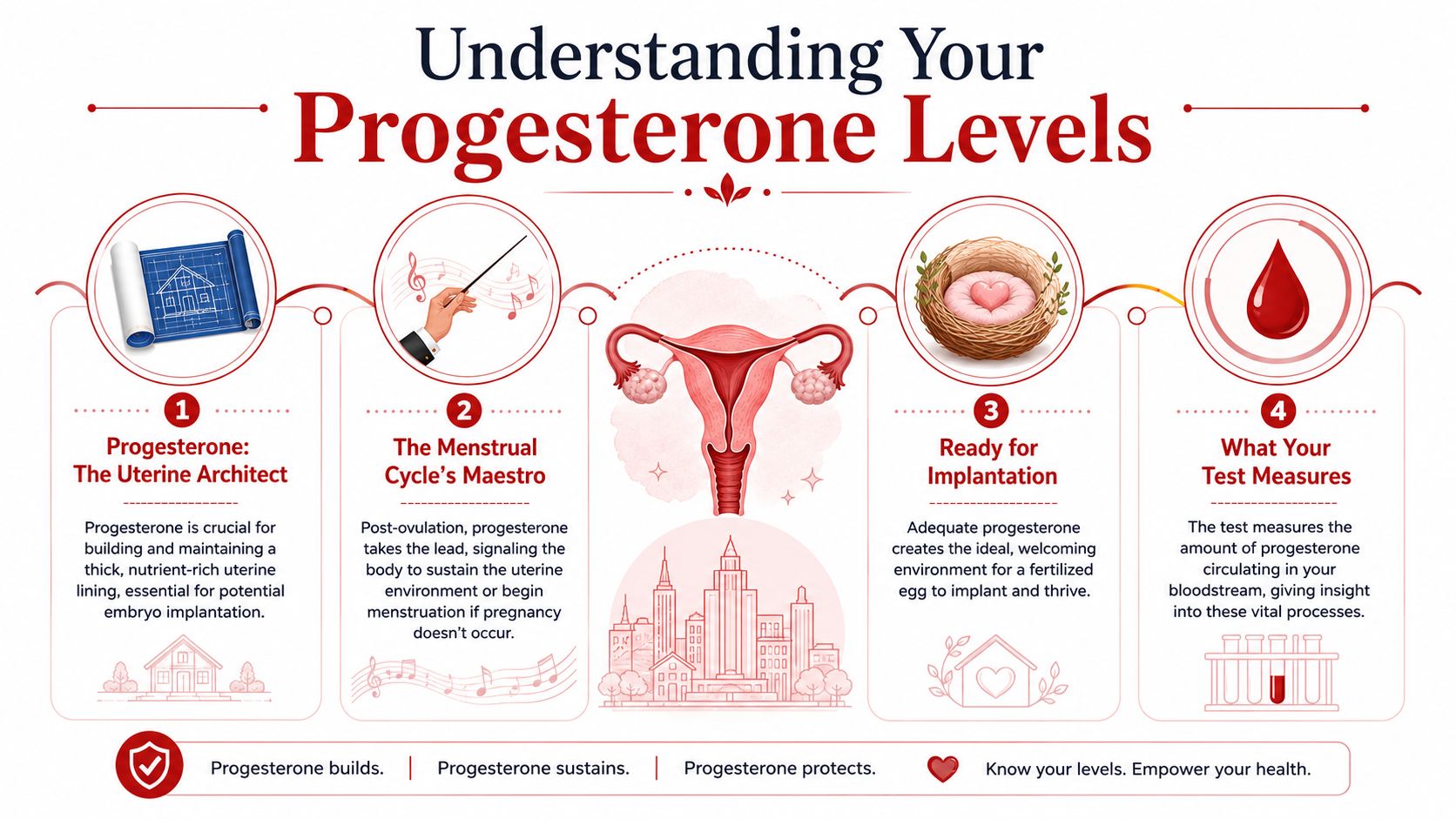
Progesterone is the hormone your body produces after an egg has been released. Its job is to support the lining of the womb during the second half of the cycle, which is why clinicians use it as a marker of whether ovulation has taken place.
That makes it a confirmation test, not a prediction test.
It measures what happened after ovulation, rather than what might be about to happen. That is the key difference from LH urine strips, which look for the surge that comes before egg release. If you are comparing test options, this guide to ovulation blood tests explains where progesterone fits in a fertility workup.
What the blood test is checking
A progesterone blood test checks whether your level has risen in the luteal phase, which is the part of the cycle after ovulation. In UK practice, that rise is used to support one main question. Did this cycle include ovulation?
The lab is not trying to catch the egg being released in real time. It is looking for the hormonal pattern that should follow. If the sample is taken at the right point in the cycle, the result helps your GP or fertility clinic decide whether ovulation is likely, uncertain, or less likely and whether the next step should be repeat timing, further hormone tests, or a broader fertility review.
A simple way to read the pattern is this:
- Before ovulation: progesterone stays low.
- After ovulation: progesterone rises.
- In the mid-luteal phase: the level is high enough to assess properly.
- If pregnancy does not occur: progesterone falls before the period starts.
What the result can and cannot tell you
A progesterone result is useful, but it answers a narrow clinical question.
- It can support ovulation confirmation: if the timing was right, a raised level suggests ovulation has happened.
- It can help explain an unclear cycle: this matters if periods are irregular, ovulation tests are confusing, or symptoms do not match your app.
- It cannot explain every reason for delayed conception: normal progesterone does not rule out sperm problems, blocked tubes, endometriosis, or issues with egg reserve.
- It can be misleading if the timing is off: a low result on the wrong day may reflect the test date, not a problem with ovulation.
This is the part many patients find most helpful once the result comes back. A progesterone number is not a verdict on your fertility overall. It is one piece of evidence that helps shape the next decision. In practice, that usually means either confirming that ovulation is happening and looking elsewhere, or recognising that ovulation still needs a closer look.
When to Take a Progesterone Test for Accurate Results
You book a progesterone blood test for day 21 because that is what you have heard for years. Then your result comes back low, and you are left wondering whether you missed ovulation or whether the test was done on the wrong day. In clinic, that mix-up is very common.
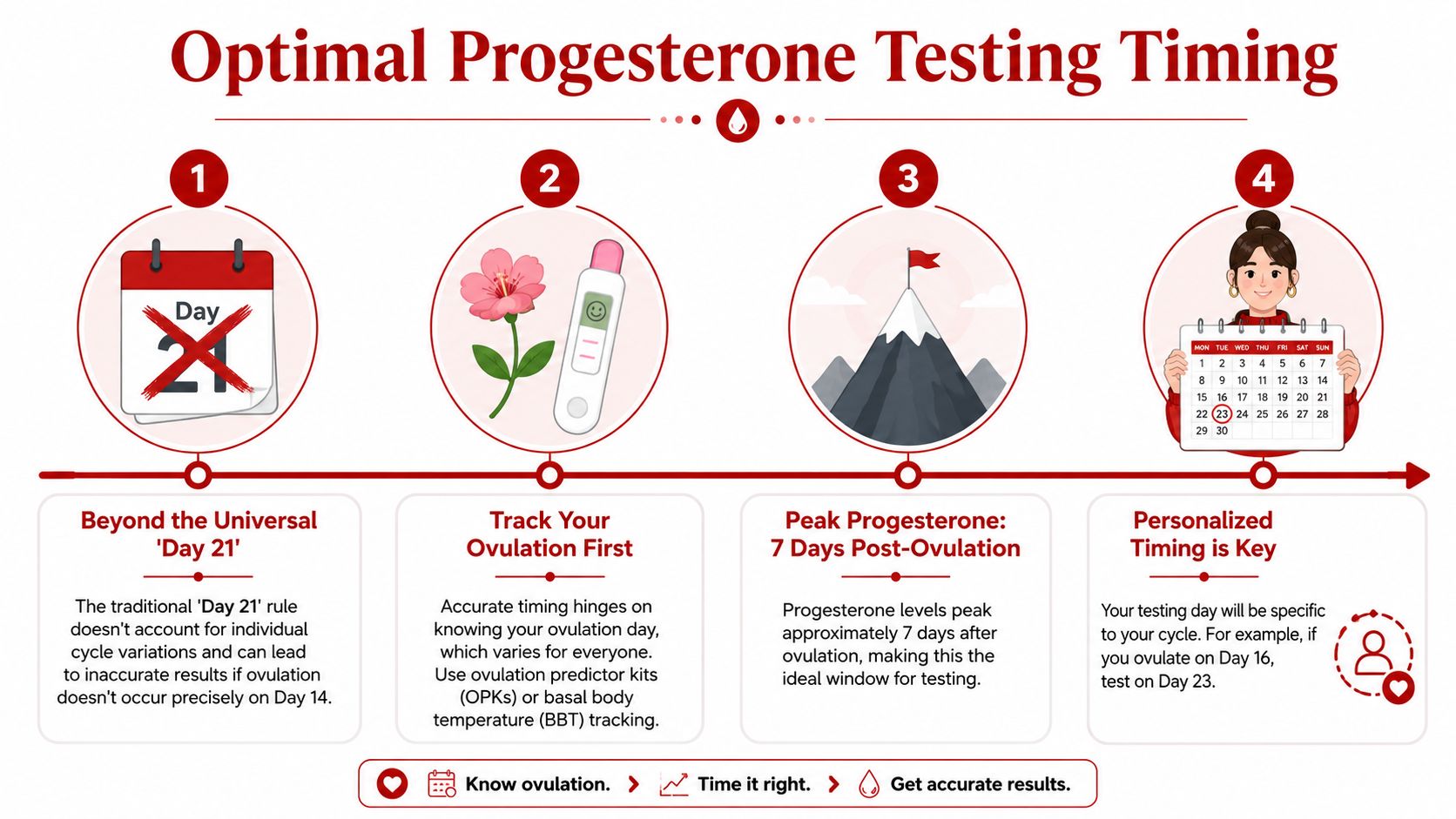
The best timing is usually simple. Take the test about 7 days before your next period is due. Day 21 only fits if your cycle is close to 28 days and ovulation happens at the expected point in that cycle.
The timing rule that works in real life
Use your own cycle pattern, not a fixed calendar date.
Test 7 days before you expect your next period.
For regular cycles, that usually gives the clearest mid-luteal result:
- 28-day cycle: test on day 21
- 30-day cycle: test on day 23
- 32-day cycle: test on day 25
- 35-day cycle: test on day 28
Progesterone rises after ovulation and then changes quickly across the second half of the cycle. A result taken too early can look falsely low. A result taken too late can miss the window that is most helpful for confirming ovulation.
If your cycles are irregular
Irregular periods need a different plan. The test can still be useful, but it often has to be matched to suspected ovulation rather than a cycle day.
A practical approach is to use ovulation predictor kits, cervical mucus changes, or basal body temperature to estimate when ovulation happened, then arrange the blood test roughly 7 days later. If you are organising testing yourself, a service built around ovulation blood tests can fit more easily around cycle tracking.
If cycles are very unpredictable, I usually advise keeping a clear note of three things: the first day of bleeding, any positive LH tests, and the exact day the blood sample was taken. That record often explains a confusing result better than the number alone.
Common timing mistakes that change the result
A few patterns cause repeat confusion in fertility workups:
- Using day 21 for every cycle, even when cycles are longer or shorter
- Testing without a rough idea of when the next period is due
- Relying on one isolated blood result when the cycle itself is unclear
- Ignoring factors affecting progesterone in women, which can sometimes affect how a result is interpreted in context, as outlined here: factors affecting progesterone in women
The practical takeaway is straightforward. If the timing was off, the next step is often to repeat the test in a better-timed cycle rather than assume there is a hormone problem. That saves a lot of unnecessary worry, and in UK fertility care it often helps decide whether you need repeat ovulation testing or a broader review instead.
Understanding Your Progesterone Test Results
You have the result in front of you. The useful question now is what to do with it.
In practice, I read a progesterone result alongside the timing, cycle pattern, and the reason the test was done in the first place. In UK fertility care, a mid-luteal serum progesterone of 30 nmol/L or greater is commonly used as good evidence that ovulation took place, provided the sample was taken at the right point in the cycle, as outlined by Gloucestershire Hospitals NHS progesterone testing guidance.
A practical way to read the result
Use the table below as a guide to the next step, not as a diagnosis on its own.
| Progesterone Level (nmol/L) | What it usually means | What to do next |
|---|---|---|
| Lower than expected for the luteal phase | The sample may have been taken on the wrong day, or ovulation may not have been confirmed in that cycle | Check cycle dates, LH results, and expected period date. Repeat in a better-timed cycle if needed |
| 30 nmol/L or greater | Good evidence that ovulation occurred if timing was correct | Shift attention to other parts of the fertility picture if pregnancy is not happening |
| Clearly raised mid-luteal result | Supports active progesterone production after ovulation | Usually reassuring. Discuss whether any further hormone testing is actually necessary |
You may also see progesterone reported in ng/mL rather than nmol/L. In general clinical use, lower thresholds can suggest ovulation has happened, while higher mid-luteal values give stronger reassurance about that cycle. In the UK, though, most laboratory reports use nmol/L, so that is usually the number patients are working with.
If your result is in the ovulatory range
A clearly ovulatory result often answers one question and raises the next one. If ovulation looks likely and the blood was taken on the correct day, repeating the same test month after month is often less helpful than widening the review.
That next step may be as simple as checking whether intercourse timing is realistic, or as formal as arranging semen analysis, tubal assessment, or ovarian reserve testing through your GP or fertility clinic. This is often the point where people stop asking, “Am I ovulating?” and start asking, “What else could be slowing things down?”
If you are still building a clearer hormone picture at home, a broader at-home hormone test in the UK may be more useful than another isolated luteal progesterone result.
If your result is low or unclear
A low progesterone result does not automatically mean there is a hormone disorder.
The first check is timing. Progesterone rises and falls across the luteal phase, so a result can look disappointing if the blood sample was taken too early or too late. That is one of the commonest reasons for confusion in fertility workups.
A sensible plan usually looks like this:
- Confirm the test date against your cycle. Check the first day of the last period, any positive LH test, and when the next period arrived.
- Match the result to ovulation signs. If your LH surge or symptoms suggest ovulation happened later than expected, the blood result may still fit the cycle.
- Repeat once if the timing was uncertain. One poorly timed result is weak evidence.
- Ask for review if the pattern repeats. Repeated low or non-confirmatory results deserve proper clinical interpretation, especially if cycles are irregular or pregnancy has not happened after several months of trying.
If lower results keep showing up, it can help to review the wider factors affecting progesterone in women, because progesterone sits inside a bigger picture that includes cycle regularity, ovulation timing, stress on the body, and other hormone patterns.
When an at-home blood test can be useful
Convenience matters. Access matters too.
For someone who knows their likely testing window and wants a laboratory result without attending a clinic, an at-home blood test can be a practical option. The main trade-off is the same one seen in clinic testing. If the day is wrong, the number is much less useful.
The Repose Healthcare at-home progesterone blood test is one example of a home kit processed by a UK-accredited laboratory. That can be helpful if you want a result to discuss with a GP or fertility specialist and already have a clear plan for when to take the sample.
One progesterone result gives a clue. A correctly timed result, repeated pattern, and clear next step are what make it clinically useful.
Serum Blood Tests vs At-Home Urine Kits
A common point of confusion in fertility tracking is the difference between a serum progesterone blood test and an at-home urine kit. They are not interchangeable.
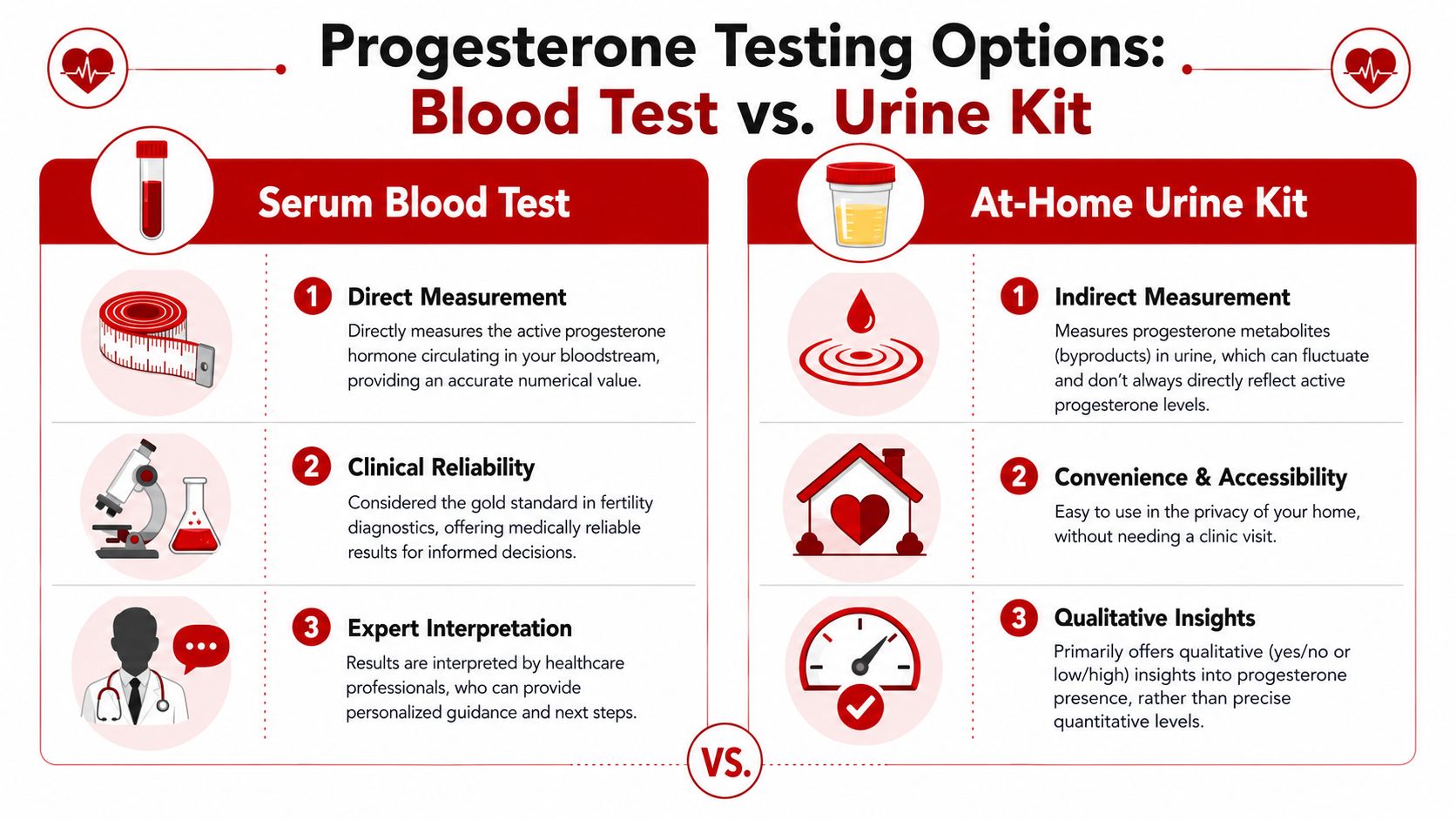
A serum blood test measures progesterone in the bloodstream at that point in your cycle. A home urine kit usually measures PdG, which is a breakdown product of progesterone passed in urine. Both can add useful information, but they answer slightly different questions, and that matters when you are deciding what to do next.
What a blood test does better
If the goal is a result you can take to a GP, fertility clinic, or private specialist and discuss in a UK fertility workup, a serum blood test is usually the stronger option.
It gives a lab value rather than a pattern on strips. That makes it easier to interpret alongside cycle dates, symptoms, ultrasound findings, or other hormone tests. It is also the format clinicians are used to using when they need to decide whether ovulation looks likely, whether timing may have been off, or whether repeat testing is sensible.
Blood testing is usually the better fit when you need:
- A specific number: Useful for clinical review rather than self-tracking alone.
- A result that can sit in your medical record: Helpful if you are speaking to your GP or moving into fertility investigations.
- A cycle-specific answer: It helps assess what happened in that particular cycle.
Where urine kits fit in
Urine PdG kits are often more useful for home monitoring over several days after suspected ovulation. They can show whether progesterone metabolites rise and stay present across the post-ovulation phase. For someone with regular cycles who wants more visibility at home, that can be practical.
The trade-off is clarity. A urine kit does not give the same direct serum measurement as a blood test, so it is usually less useful when the question is, "Do I have a result a clinician can act on?" In practice, I see urine kits help with tracking habits and timing awareness, while blood tests are better for formal interpretation.
The difference is similar to the gap between a home trend and a lab result in other areas of health. If you've ever looked into understanding your A1c home test results, the same principle applies. Home tests can be useful, but the format affects how confidently you and your clinician can use the result.
Choosing based on the question you're asking
Start with the decision you need to make.
| Test type | Usually better for |
|---|---|
| Serum progesterone blood test | Confirming ovulation with a lab value at a specific cycle point |
| Home urine PdG kit | Watching a post-ovulation trend at home over several days |
If you want one clinically interpretable result, a laboratory-processed option is usually more useful than strip-based testing alone. These at-home hormone test options in the UK can suit someone who wants the convenience of home sampling but still needs a result that can be discussed in a proper fertility appointment.
Your Action Plan After Getting Your Progesterone Results
The most helpful thing you can do after a progesterone result is avoid two extremes. Don't dismiss it. And don't let a single number convince you that your whole fertility journey is already mapped out.
A progesterone result is useful because it tells you what to do next. That next step depends on whether the result strongly supports ovulation, looks borderline, or doesn't confirm ovulation at all.

If your result supports ovulation
If your sample was timed properly and the result supports ovulation, that's a meaningful checkpoint. It suggests your body likely released an egg in that cycle.
At that stage, your energy is usually better spent on the rest of the fertility picture:
- Review timing: Were you having intercourse in the fertile window leading up to ovulation?
- Think beyond ovulation: If pregnancy still isn't happening, other factors may need attention.
- Consider broader testing: Ovarian reserve, semen analysis, or structural assessment may become more relevant.
For some people, that broader next step includes learning about ovarian reserve. If that's the question in front of you, an AMH Plus test may be more informative than repeating progesterone again and again.
If your result is borderline or confusing
This is the category that creates the most stress. The answer usually isn't panic. It's troubleshooting.
Start with the basics:
- Recheck timing. Was the sample taken 7 days before the period you got?
- Look at your cycle notes. Did ovulation signs suggest a different luteal timing day?
- Repeat next cycle if needed. One uncertain cycle doesn't prove a long-term problem.
If the timing was off, the number may be answering the wrong question.
This is also where a more complete view of hormone health helps. A broader clinical guide to women's hormone health can be useful background if you're trying to understand how progesterone fits into the wider endocrine picture.
If your result doesn't confirm ovulation
If the sample timing was good and the result still doesn't support ovulation, don't try to self-diagnose from one test alone. But do take it seriously enough to follow up.
A sensible next plan is:
- Repeat once if there's any doubt about timing
- Book a GP or fertility appointment if the pattern repeats
- Bring your cycle dates and result with you
- Ask what other tests are needed rather than focusing only on progesterone
That last part matters. Fertility workups often move faster when you bring organised information instead of only saying, “My test was low.”
A clear note of period dates, suspected ovulation date, test date, and result gives your clinician something they can use.
If you want a practical next step, Repose Healthcare offers at-home health testing through UK-accredited laboratories, including hormone and fertility testing that can help you gather clear data before speaking with your GP or fertility specialist. The value isn't just in getting a number. It's in getting a result you can time properly, understand clearly, and use to make a better decision about what to do next.
You Might Also Like
Progesterone Test for Fertility: Your 2026 UK Guide
If you're trying to conceive, you've probably already taken the usual first steps. You've watched [...]
7 Week Scan Pictures: See Early Development
You get a positive test at home, then wait days for a scan appointment, and [...]
Home Allergy Test Kit Reviews: A UK Expert Guide 2026
You've got symptoms that don't fit neatly into one box. Maybe it's a rash after [...]
NIPT Test Sheffield: Your 2026 Guide to Options & Costs
You've had the booking confirmation for your early pregnancy appointment. You're checking dates, comparing clinics, [...]
Private Scan London: 2026 Guide to Costs & Booking
You wake up with the same worry you had last week. The pelvic pain is [...]
The 2026 Cost of Hepatitis Vaccination in the UK
You're usually looking up the cost of hepatitis vaccination for a practical reason. A trip [...]
Hormone Blood Test London: Find Your Perfect Test
Some London health questions start subtly. Your cycle changes a little. You feel wired at [...]
Peanut Allergy Test Kit: A Practical UK User’s Guide
A peanut reaction often starts with uncertainty, not clarity. You eat a biscuit, satay sauce, [...]
NIPT Test Edinburgh: Your 2026 Guide
If you're searching nipt test edinburgh, you're probably already in that familiar stage of pregnancy [...]
Peripheral Artery Disease UK: Peripheral Artery Disease UK:
You might be reading this because walking has started to feel different. Perhaps your calf [...]
NIPT Test Cardiff: Clinic, Home & NHS Pathways 2026
If you're in Cardiff, newly pregnant, and staring at screening options that all seem to [...]
Gender Scan Difference UK: Accuracy, Timing & Cost Compared
You've probably already done the same search most parents do. One tab shows the NHS [...]
NIPT Test Cambridge: Guide to Options & Booking 2026
You're in Cambridge, you've had the first rush of finding out you're pregnant, and then [...]
Home COVID Test Results: A Practical UK & Ireland Guide
You've done the swab, mixed the sample, added the drops, and now you're staring at [...]
DVT Test Squeeze Calf: Homan’s Sign & Beyond
You notice one calf is sore, a little swollen, and not behaving like an ordinary [...]
Your Guide to Every Travel Clinic Leicester Offers in 2026
Flights are booked. The hotel is sorted. Your passport is still in date. Then one [...]
13 Week Gender Scan: Accuracy, NIPT & What to Expect
By the time you reach 13 weeks, pregnancy often starts to feel more real in [...]
Your Pregnancy Scan London: Guide to Options & Costs
A positive test can make London feel suddenly very small and very complicated. You might [...]
Your Nuchal Dating Scan Explained: A 2026 UK Guide
That appointment message has landed in your phone or come through the post, and suddenly [...]
Normal Cortisol Levels UK: Get Clarity
Some people search for normal cortisol levels uk after weeks of feeling unlike themselves. They’re [...]
How to Test Iron Levels in Blood: A Complete UK Guide
You’re probably not searching how to test iron levels in blood out of curiosity. More [...]
Growth Scan Pregnancy: UK Guide & What to Expect
You’re at an antenatal appointment, everything seems routine, and then your midwife says, “We’d like [...]
Gender Scan Near Me: Your 2026 Guide to Options
You’re probably here because the question has stopped feeling abstract. Maybe you’ve had your booking [...]
Progesterone Test For Pregnancy: Viability & Home Kit
The positive test is there, but relief doesn’t always follow. For many women, early pregnancy [...]
Ovulation Blood Tests: Confirm Your Ovulation
You’ve probably already done some version of this. You’ve checked an app, watched for a [...]
How to Test Testosterone Levels: A UK Guide
You wake up tired, despite a full night in bed. Your training feels flat. Your [...]
UK Vitamin D Test: A Complete At-Home Guide for 2026
You wake up tired, even after a full night’s sleep. By mid-afternoon you’re reaching for [...]
Blood Iron Level Test: A Complete UK Guide for 2026
Some days it isn’t dramatic. You’re just slower than usual. You wake up after a [...]
Cortisol Levels Test: Your Comprehensive UK Guide
You wake up tired, push through the morning on caffeine, feel oddly tense by midday, [...]
Travel Clinic Leeds: Compare 7 Top Options For 2026
You book the flights first. Then the practical questions start. Is a tetanus booster enough [...]