
Home Allergy Test Kit Reviews: A UK Expert Guide 2026
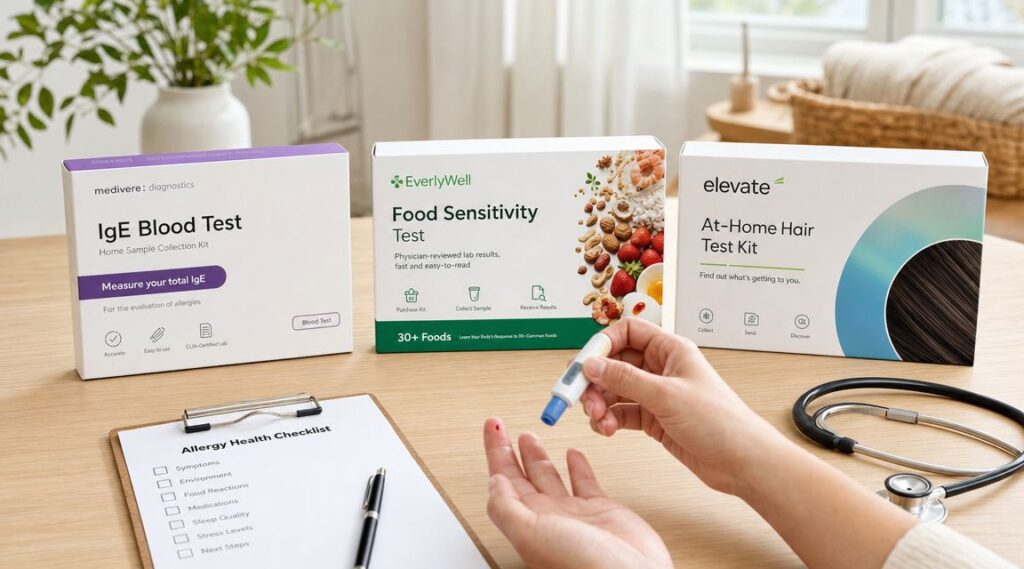
You've got symptoms that don't fit neatly into one box. Maybe it's a rash after certain meals, a blocked nose that never quite settles, or bloating that seems to appear at random. You search for answers, and suddenly your screen is full of home test kits promising fast, private clarity.
That's where misinterpretations frequently occur.
Many home allergy test kit reviews treat every kit as if it belongs in the same category. It doesn't. A finger-prick blood test that measures IgE, the antibody used in standard allergy workups, is not the same as a “food sensitivity” panel based on IgG, and neither is remotely comparable to hair analysis or bioresonance. If you lump them together, the whole market looks more credible than it is.
For UK and Ireland consumers, that distinction matters more than the branding, the packaging, or how long the online questionnaire looks. The key question isn't “Which kit has the most allergens?” It's what the test measures, whether the lab process is clinically defensible, and whether the result will help you make a safe next decision.
Are Home Allergy Test Kits a Reliable First Step
You have recurring symptoms, no clear pattern, and an NHS appointment that may take time. A home test can look like a sensible way to narrow the field before you change your diet or start avoiding half the house.
That can be reasonable, but only if the kit measures something clinically meaningful.
The main problem with many home allergy test kit reviews is that they blur together very different products. A targeted home IgE blood test can sometimes help identify whether a suspected allergen deserves proper follow-up. A broad “sensitivity” panel, especially one that tests dozens of foods without a clear clinical question, often creates noise rather than answers. For a practical overview of where self-testing can and cannot help, Repose Healthcare's guide on allergies and the role of self-testing is a useful starting point.
Home testing also has limits that are easy to miss when symptoms are mixed. If sneezing, wheeze, itchy eyes, or a blocked nose are the main issue, indoor triggers such as dust, damp, ventilation, or pet exposure may matter as much as any blood result. In that situation, resources for better home air quality can help you check the environment alongside medical assessment.
Where people go wrong
The common mistake is treating the widest panel as the safest choice. It feels thorough. In practice, it can produce a long list of flagged foods or inhalants that do not match your history, which leaves people cutting out foods unnecessarily or focusing on the wrong trigger.
UK expert guidance is cautious for good reason. As noted earlier, the British Dietetic Association warns that many home testing approaches can be misleading, especially where the method, lab standards, and clinical interpretation are unclear. That concern lines up with the broader position taken by NHS and allergy specialists in the UK. A result only helps if it points to a safe next step.
Practical rule: Use a home kit only if the marker is recognised, the lab process is transparent, and the result can be reviewed against your actual symptoms.
When a home kit can still be useful
A home kit can be a reasonable first step if it answers a narrow question. The better example is a targeted IgE test linked to a plausible trigger, processed through an accredited laboratory, with some form of clinical review or clear advice on follow-up.
Used that way, self-testing is triage. It can help you decide whether to speak to your GP, an allergy clinic, or a dietitian, and whether a suspected trigger deserves formal assessment. It should not be treated as a diagnosis, and it should never be the basis for major food restriction in children or adults with significant symptoms.
Allergy vs Sensitivity What Your Test Is Actually Measuring
Most confusion starts with the word allergy being used too loosely.
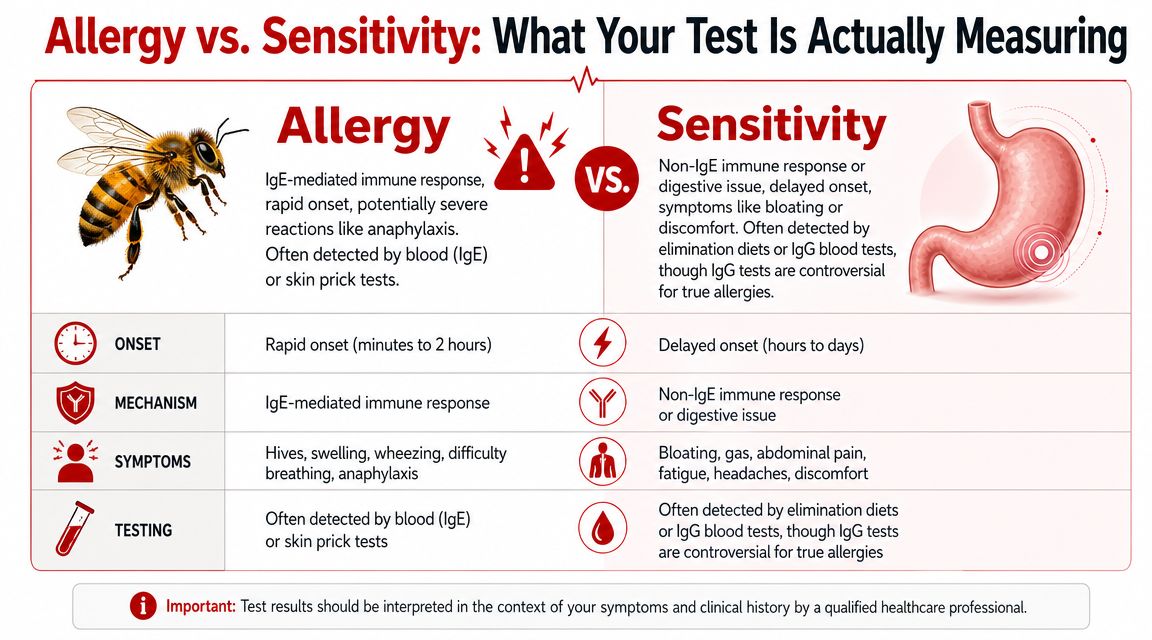
A true food allergy involves an immune response typically linked to IgE antibodies. That's why IgE testing appears in standard allergy assessment. A “sensitivity” test often measures something else entirely, or uses terms that sound medical without showing that the marker predicts a real allergic reaction.
What IgE tells you
IgE testing can support diagnosis when it's used properly. The important phrase is support diagnosis. It doesn't replace your symptom history, and it doesn't magically convert every lab signal into a true allergy.
Think of IgE as a marker that helps answer a focused question. If you repeatedly react after eating one specific food, an IgE test for that trigger may be clinically useful. If you test indiscriminately across a very broad panel, you increase the chance of findings that look dramatic on paper but don't match real life.
The most useful home allergy test kit reviews should say this clearly: a test is stronger when it starts with a genuine suspicion, not when it tries to test everything at once.
What IgG usually tells you
IgG is where many people get pulled off course. A broad IgG panel may tell you that your immune system has seen a food. That's not the same as showing that the food is causing your symptoms.
A simple way to think about it is this. IgE asks whether your immune system may react in an allergy pattern. IgG often reflects exposure or recognition. Seeing IgG to milk, wheat, or egg doesn't automatically mean those foods are harmful for you.
That's why many “food sensitivity” kits create reports that look authoritative but lead to unnecessary elimination diets. People end up removing staples from their diet, feel anxious around meals, and still don't have a clinically sound answer.
A long list of reactive foods is often a sign of a weak testing model, not a strong one.
The hard line UK consumers should draw
This is the distinction many reviews blur and shouldn't. According to UK-aligned guidance referenced in Healthline's summary of BSACI and NHS-aligned allergy testing guidance, IgE blood testing can support diagnosis when interpreted alongside history, but indiscriminate panel testing risks false positives because sensitisation is not the same as clinical allergy. The same guidance states that broad IgG and hair/bioresonance panels are not evidence-based for diagnosing allergy or intolerance.
That gives you a practical filter:
- Clinically aligned usually means targeted IgE testing with proper interpretation.
- Questionable usually means broad IgG “sensitivity” reports.
- Avoid includes hair analysis and bioresonance sold as allergy diagnosis.
If you want a deeper look at recognised routes for testing food reactions, Repose Healthcare has a useful guide on how to test for food allergies.
How to Judge the Quality of a Home Allergy Test Kit
A parent orders a kit after a child develops hives after dinner. The report comes back with a long list of “reactive” foods, but it still does not answer the question that matters. Is there evidence of allergy, or have they paid for a test that only creates more confusion?
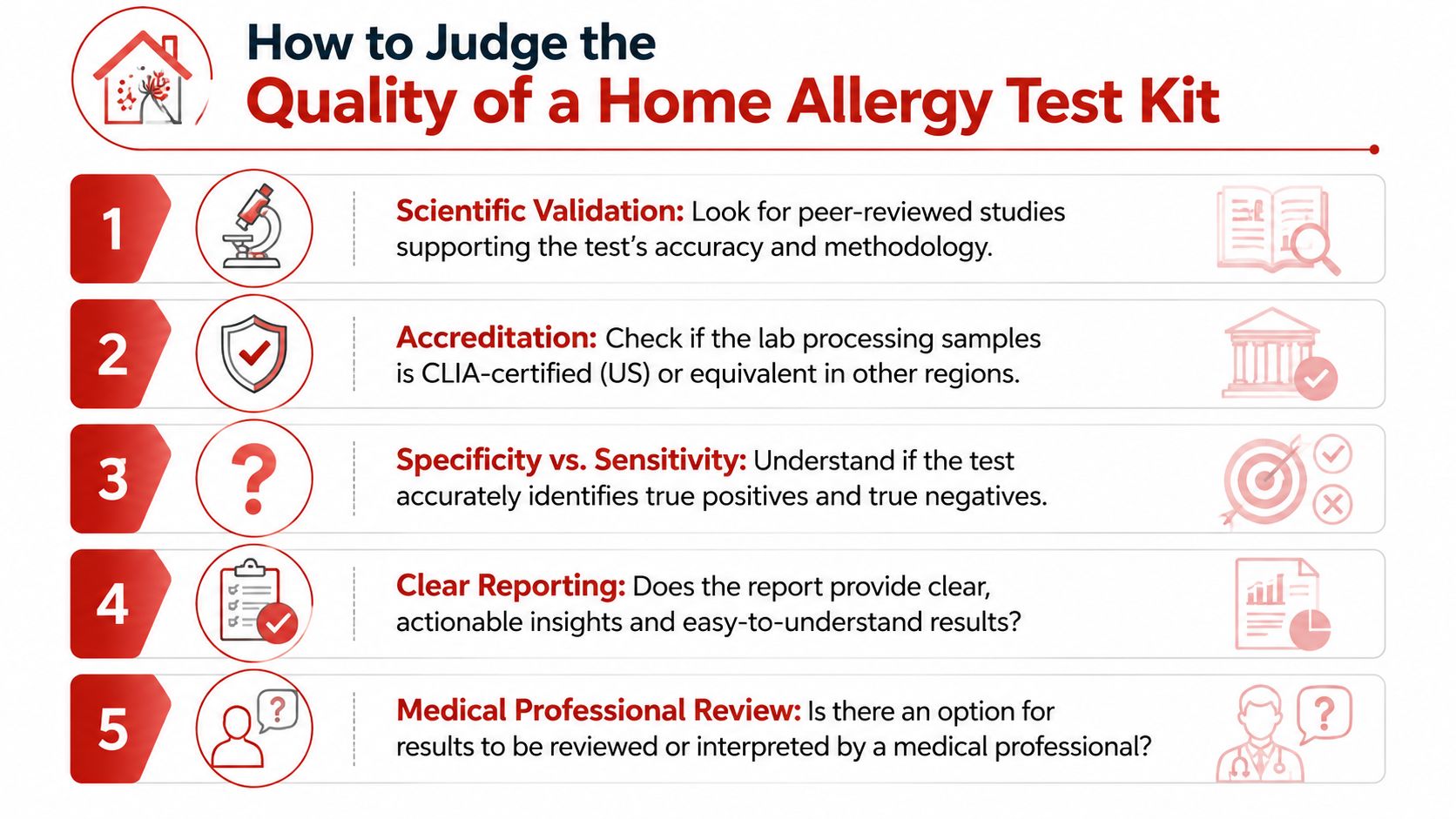
A good home kit should help narrow a clinical question. It should not generate a frightening list of foods to avoid without context. The quickest way to judge quality is to look past the branding and examine what the provider is testing, how the sample is processed, and what support follows the result.
Start with the test method
Ask one clear question first. What does the kit measure?
If it measures specific IgE, you are at least looking at a marker used in standard allergy work-up. That does not make the result self-interpreting, but it puts the test in a clinically recognised category.
If the provider talks about IgG, “food sensitivity”, hair samples, energy readings, or bioresonance, the problem starts there. Those methods should not be treated as allergy diagnosis. A review that skips over the biomarker is missing the single point that matters most.
Check whether the panel matches the clinical question
Quality often shows up in restraint.
A useful kit is usually built around a suspected trigger or a small group of relevant allergens, not a huge shopping-list panel. Broad panels can produce positive results that look persuasive but do not match symptoms. In practice, that can send people into avoidable food restriction, especially when no clinician has reviewed the history.
Sample type matters too. Finger-prick blood testing can be appropriate for blood-based allergy assessment. Hair samples are not part of evidence-based allergy diagnosis.
Look closely at the laboratory pathway
Many buyers often lower their guard. They see a polished website and assume the scientific side is sound.
Check where the sample goes, whether the laboratory standards are clearly stated, and whether the process is traceable from kit to result. If a provider is vague about lab accreditation, turnaround, sample handling, or result review, treat that as a warning sign. In allergy testing, the method behind the report matters as much as the report itself.
Judge the result report, not just the promise on the box
A reliable service explains limits. It does not turn every raised marker into a command to cut out foods.
The report should tell you what was tested, what a positive result may mean, and why results still need to be matched to symptoms. I would also expect clear advice on what to do next if the findings suggest possible allergy, especially if there has been wheeze, swelling, vomiting, or rapid-onset reactions after eating.
Use this checklist when comparing kits:
- Named biomarker: Does the provider clearly state that the test measures IgE, or are they hiding behind “sensitivity” language?
- Relevant panel: Is the test targeted to plausible triggers rather than a very broad panel with weak clinical relevance?
- Transparent lab process: Does the company explain sample handling, laboratory standards, and who reviews the result?
- Interpretation: Is there clinician input or at least medically responsible guidance, rather than an automated traffic-light report?
- Safe follow-up advice: Does the provider tell you when to see a GP, allergy clinic, or dietitian instead of encouraging unsupervised elimination?
For readers comparing providers, this page on online lab testing services in the UK is a useful example of the operational detail worth checking before you buy.
One final point. A high-quality home allergy kit should leave you with a clearer next step, not a longer list of worries.
A Side-by-Side Review of Popular UK Allergy Kits
A parent orders a home test after a child develops hives, bloating, and eczema flare-ups. The search results place IgE allergy kits, IgG food sensitivity panels, hair analysis, and bioresonance side by side as if they answer the same question. They do not. That is the first line I would draw in any honest review.
UK consumers need a comparison based on scientific validity, not packaging, panel size, or how polished the dashboard looks. The primary distinction is between tests that measure a clinically recognised allergy marker and tests that use unrelated or unsupported methods, then overstate what the result means.
| Provider | Test Type | Lab Accreditation | Clinical Validity | Recommendation |
|---|---|---|---|---|
| Repose Healthcare | Targeted at-home blood testing for allergy-related assessment | UK-accredited laboratory processing described by provider | Aligned with clinically recognised IgE-based testing approach when used with symptom history | Consider if you want a home sample kit linked to accredited processing and reviewed results |
| Broad IgG food sensitivity brands | IgG food sensitivity panels | Varies by provider and often not clearly explained to consumers | Not evidence-based for diagnosing allergy or intolerance | Use caution. Don't treat these as allergy diagnosis |
| Hair analysis providers | Hair sample “allergy” or “intolerance” testing | Often unclear or irrelevant to allergy validity | Not evidence-based for diagnosing allergy or intolerance | Avoid |
| Bioresonance providers | Device-based “sensitivity” scanning | Accreditation claims don't address scientific validity of method | Not evidence-based for diagnosing allergy or intolerance | Avoid |
Clinically aligned options
The only category here that fits established allergy practice is targeted blood testing that measures specific IgE. Even then, the value depends on context. A result has to match the symptom pattern, timing, and likely trigger.
Repose Healthcare sits in that more clinically credible group because the model described is a blood-based home sampling service with UK-accredited laboratory processing and reviewed results. That is a reasonable format for a focused question, such as suspected peanut, milk, egg, or pet allergy. It is a poor fit for casual screening of dozens of foods without a clear history.
A clinically useful home kit usually has a narrower scope. That is a strength, not a weakness.
Broad IgG food sensitivity kits
Many review articles err by placing IgG panels in the same buying guide as IgE allergy tests and scoring them on speed, price, and number of foods included. That approach misses the main issue. IgG food panels are not accepted as a way to diagnose allergy, and broad positive lists often create confusion rather than clarity.
That matters in real households. I have seen families cut out milk, wheat, egg, and soya after a mail-order sensitivity report, only to find that the original symptoms were not explained by those results at all. The cost is not just money. It can mean harder mealtimes, nutritional risk, and delayed medical assessment.
Warning signs are usually easy to spot:
- very large food panels sold as a search for “hidden triggers”
- reports that treat reactivity as proof you should avoid a food
- little distinction between exposure, sensitisation, and true allergy
- limited advice on GP, allergy clinic, or dietitian follow-up
For practical home management while you work through symptoms, this guide on how to breathe easier in your home can help reduce common indoor triggers, but it should not replace proper allergy assessment.
Hair analysis and bioresonance
Hair testing and bioresonance should be excluded from any serious allergy shortlist. These methods are marketed to the same worried buyer, but they are not grounded in accepted allergy diagnosis.
If a company claims it can identify food allergy or intolerance from a hair sample or an energy scan, the safest reading is that the method itself is unreliable. Accreditation language does not fix that problem if the underlying test is not scientifically valid.
What a trustworthy review should say plainly
A good review does not blur these categories together. It separates:
- Tests measuring specific IgE, which may support clinical assessment
- Tests measuring something else, then stretching the interpretation
- Tests with no sound basis for allergy diagnosis
That distinction is what guidance from UK clinical bodies keeps returning to, and it is what many commercial roundups avoid. If the goal is a reliable first step, a focused IgE-based option is usually more useful than a broad sensitivity screen. It may test fewer items, but it is far less likely to send you into unnecessary food avoidance or false reassurance.
You Have Your Test Results What Happens Now
Getting a result page can be oddly unsettling. Even when you wanted information, seeing a list of markers in black and white can push you towards quick decisions that aren't always safe.
If you used an IgE-based test
Treat the result as a clinical clue, not a final label.
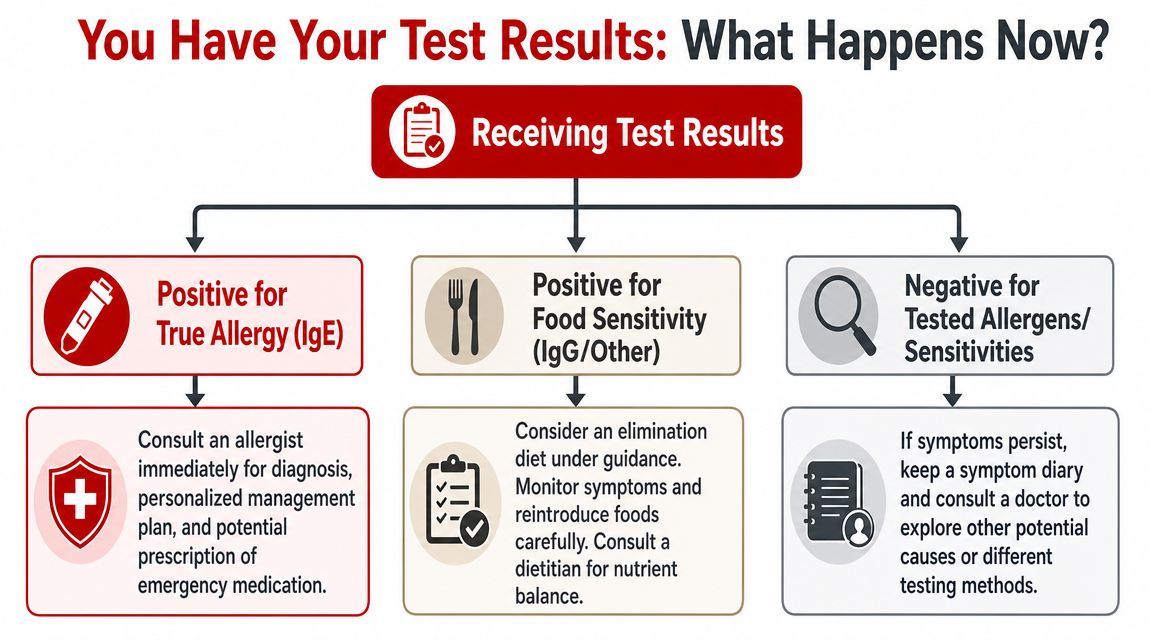
UK allergy experts stress that home tests can produce high rates of false positive results. A positive result must be questioned, because sensitisation is not the same as clinical allergy. They also note that a negative result may be useful for ruling things out, but any positive result needs interpretation by a clinician alongside a full symptom history. That guidance is summarised in the allergist Q&A on what at-home allergy tests can and cannot tell you.
If you've got a positive IgE result, do this next:
- Match it to your symptoms: Ask whether the result fits what happens when you eat or encounter that trigger.
- Book a GP or specialist discussion: Bring the report and a short symptom timeline.
- Avoid self-diagnosing severity: A lab result doesn't tell you on its own how serious a reaction will be.
If you used an IgG or “sensitivity” test
In this context, restraint matters.
Don't cut out a long list of foods just because a report highlights them. If you remove multiple staples at once, you can make eating harder, increase anxiety around food, and still fail to solve the original symptom.
A more sensible route is to discuss persistent symptoms with your GP or a registered dietitian and look at structured assessment instead of reacting to every coloured flag on a dashboard.
Positive results are starting points for questions, not instructions for panic.
If the result is negative but symptoms continue
A negative result doesn't mean “nothing is wrong”. It means the tested route may not explain what you're experiencing.
That's when old-fashioned observation becomes useful:
- Keep a symptom diary: Note foods, timing, environment, and severity.
- Look at your home setting: If respiratory symptoms dominate, practical steps to breathe easier in your home can reduce exposure while you pursue proper assessment.
- Ask about other causes: Intolerance, coeliac disease, reflux, asthma, eczema, rhinitis, and non-allergic gastrointestinal issues can all muddy the picture.
Why Choose a Clinically-Led Home Testing Service
Once you strip away the marketing, the choice becomes simpler. You want a service that uses a recognised testing method, sends samples through an accredited laboratory pathway, and gives results in a format that supports medical follow-up rather than replacing it.
That's the difference between a clinically led service and a consumer wellness product dressed up as diagnostics.
For UK and Ireland buyers, the practical standard is straightforward:
- Use a targeted blood-based approach where appropriate
- Check the lab pathway
- Expect interpretation, not just data
- Avoid broad sensitivity claims that push restrictive diets
- Treat the result as one part of a wider clinical picture
This matters beyond the test itself. If your symptoms are allergy-related, the right next step may include medical review, environmental control, or changes around cleaning and exposure. For people dealing with dust, pet dander, or persistent indoor triggers, practical guides on allergen removal by London House Cleaners can complement, but not replace, proper diagnostic work.
The short version is this. Home allergy test kit reviews are only useful when they separate clinically valid IgE testing from non-scientific sensitivity testing. If a review doesn't draw that line, it won't help you choose safely.
If you want a clinically grounded next step, Repose Healthcare offers at-home health testing with UK-accredited laboratory processing, secure digital results, and a range that includes allergy-related options designed for people who want proper data without guessing.
You Might Also Like
Home Allergy Test Kit Reviews: A UK Expert Guide 2026
You've got symptoms that don't fit neatly into one box. Maybe it's a rash after [...]
NIPT Test Sheffield: Your 2026 Guide to Options & Costs
You've had the booking confirmation for your early pregnancy appointment. You're checking dates, comparing clinics, [...]
Private Scan London: 2026 Guide to Costs & Booking
You wake up with the same worry you had last week. The pelvic pain is [...]
The 2026 Cost of Hepatitis Vaccination in the UK
You're usually looking up the cost of hepatitis vaccination for a practical reason. A trip [...]
Hormone Blood Test London: Find Your Perfect Test
Some London health questions start subtly. Your cycle changes a little. You feel wired at [...]
Peanut Allergy Test Kit: A Practical UK User’s Guide
A peanut reaction often starts with uncertainty, not clarity. You eat a biscuit, satay sauce, [...]
NIPT Test Edinburgh: Your 2026 Guide
If you're searching nipt test edinburgh, you're probably already in that familiar stage of pregnancy [...]
Peripheral Artery Disease UK: Peripheral Artery Disease UK:
You might be reading this because walking has started to feel different. Perhaps your calf [...]
NIPT Test Cardiff: Clinic, Home & NHS Pathways 2026
If you're in Cardiff, newly pregnant, and staring at screening options that all seem to [...]
Gender Scan Difference UK: Accuracy, Timing & Cost Compared
You've probably already done the same search most parents do. One tab shows the NHS [...]
NIPT Test Cambridge: Guide to Options & Booking 2026
You're in Cambridge, you've had the first rush of finding out you're pregnant, and then [...]
Home COVID Test Results: A Practical UK & Ireland Guide
You've done the swab, mixed the sample, added the drops, and now you're staring at [...]
DVT Test Squeeze Calf: Homan’s Sign & Beyond
You notice one calf is sore, a little swollen, and not behaving like an ordinary [...]
Your Guide to Every Travel Clinic Leicester Offers in 2026
Flights are booked. The hotel is sorted. Your passport is still in date. Then one [...]
13 Week Gender Scan: Accuracy, NIPT & What to Expect
By the time you reach 13 weeks, pregnancy often starts to feel more real in [...]
Your Pregnancy Scan London: Guide to Options & Costs
A positive test can make London feel suddenly very small and very complicated. You might [...]
Your Nuchal Dating Scan Explained: A 2026 UK Guide
That appointment message has landed in your phone or come through the post, and suddenly [...]
Normal Cortisol Levels UK: Get Clarity
Some people search for normal cortisol levels uk after weeks of feeling unlike themselves. They’re [...]
How to Test Iron Levels in Blood: A Complete UK Guide
You’re probably not searching how to test iron levels in blood out of curiosity. More [...]
Growth Scan Pregnancy: UK Guide & What to Expect
You’re at an antenatal appointment, everything seems routine, and then your midwife says, “We’d like [...]
Gender Scan Near Me: Your 2026 Guide to Options
You’re probably here because the question has stopped feeling abstract. Maybe you’ve had your booking [...]
Progesterone Test For Pregnancy: Viability & Home Kit
The positive test is there, but relief doesn’t always follow. For many women, early pregnancy [...]
Ovulation Blood Tests: Confirm Your Ovulation
You’ve probably already done some version of this. You’ve checked an app, watched for a [...]
How to Test Testosterone Levels: A UK Guide
You wake up tired, despite a full night in bed. Your training feels flat. Your [...]
UK Vitamin D Test: A Complete At-Home Guide for 2026
You wake up tired, even after a full night’s sleep. By mid-afternoon you’re reaching for [...]
Blood Iron Level Test: A Complete UK Guide for 2026
Some days it isn’t dramatic. You’re just slower than usual. You wake up after a [...]
Cortisol Levels Test: Your Comprehensive UK Guide
You wake up tired, push through the morning on caffeine, feel oddly tense by midday, [...]
Travel Clinic Leeds: Compare 7 Top Options For 2026
You book the flights first. Then the practical questions start. Is a tetanus booster enough [...]
Private Blood Test Leicester: A Complete 2026 Guide
You wake up tired again. Maybe you’ve had weeks of bloating, odd fatigue, headaches, low [...]
Genetic Testing Before Pregnancy: A UK Guide for 2026
You might be at the stage where baby plans still live in half-finished conversations. One [...]