
Private Health Blood Tests: A Complete UK Guide 2026
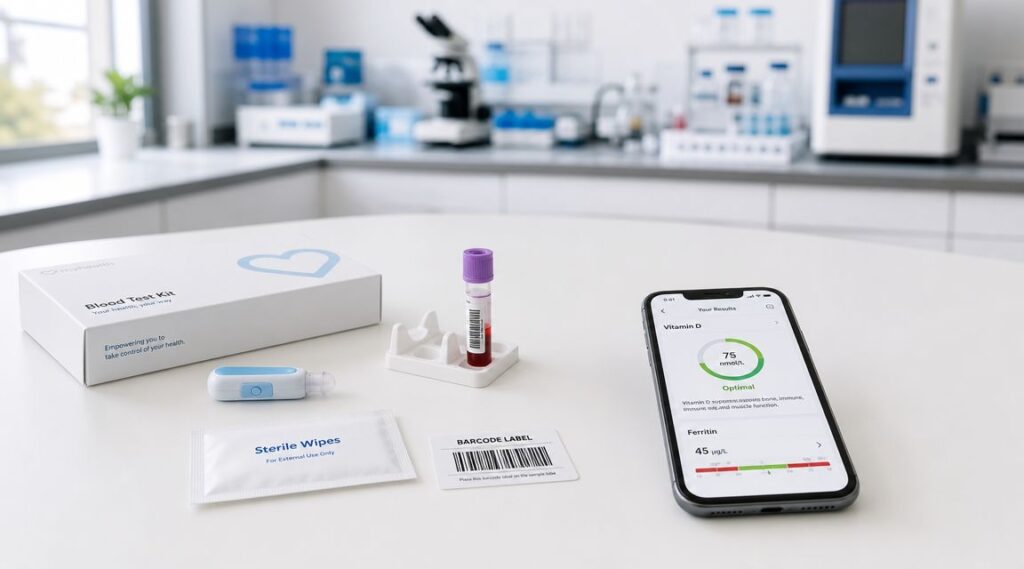
You might be here because something feels off, but not dramatic enough to make sense of straight away. You're tired, your hair seems thinner than usual, your cycle has changed, or you just want to know whether your cholesterol, iron, blood sugar, or hormones are where you expect them to be. The hard part isn't only the symptom. It's the uncertainty.
A lot of people don't want to wait in that uncertainty. They want a practical next step they can take at home, on their own schedule, with clear results they can review privately. That's why private health blood tests have become part of how many people now check symptoms, track ongoing health patterns, and build a baseline before a problem becomes harder to ignore.
The useful question isn't “Should I test everything?” It's “What am I trying to learn, and what will I do with the answer?” That's where private testing becomes more helpful. It gives you data, but its core value comes from choosing the right test, collecting the sample correctly, and knowing what action to take afterward.
Taking Control of Your Health Insights
Sarah is 44. For months she has been waking at 3 a.m., feeling suddenly hot in meetings, and struggling to focus on routine tasks. Nothing feels dramatic enough for an emergency appointment, but it also does not feel sensible to ignore. She wants a clearer answer than, "It might be stress."
That is the point where many people start looking at private health blood tests. They are often trying to move from a broad question to a useful next step. Is this low iron? A thyroid issue? A blood sugar problem? A hormone change? Or is it time to speak to a doctor because the pattern does not fit a simple home-testing question?
For women trying to make sense of cycle changes or whether menopause could be involved, Lila's guide on menopause tests is a useful companion read because it explains where hormone testing can help and where symptoms still need clinical interpretation.
Why blood testing feels so relevant
Blood tests are a familiar part of everyday healthcare, which is one reason private testing feels approachable. They are used to check patterns over time, monitor treatment, and add evidence when symptoms are vague. A result is less like a verdict and more like a clue in a larger assessment.
The takeaway is that many people assume a blood test should give a simple yes-or-no answer. Often, it does something more practical. It helps narrow the field, shows whether follow-up is sensible, and gives you a baseline to compare with later.
A home test can answer the wrong question if you order it too quickly.
That is why the starting point is not, "Which panel looks most detailed?" The better starting point is, "What am I trying to find out, and what would I do if the result is high, low, or normal?" That question turns testing into a decision tool rather than a pile of numbers.
Practical rule: A blood test is most useful when you know what decision it is meant to support.
What control really looks like
Taking control of your health insights means working through a simple sequence. Start with the concern. Match it to the right test category. Follow the sample steps carefully. Then decide what action the result supports, whether that is monitoring, changing a habit, booking a GP appointment, or seeking urgent care if the result or symptoms point to something more serious.
Used well, private testing can support several kinds of decisions:
- Checking a symptom pattern such as fatigue, brain fog, poor exercise recovery, or hair shedding.
- Monitoring a known issue such as iron status, thyroid treatment, or blood sugar.
- Building a baseline when you feel well and want a reference point for later.
- Choosing privacy and convenience if home sampling and direct access to results suit your schedule better.
The main benefit is not the report itself. It is knowing what to do with the report once it arrives.
What Are Private Blood Tests and Who Are They For
You wake up tired for the third week in a row. You are sleeping enough, but something still feels off. At that point, many people do not want a long list of test names. They want to know three things. What can I check? Is it suitable to do from home? What would I do with the result?
Private blood tests are blood tests you can order yourself, without waiting for a GP referral first. Depending on the provider, you may collect a finger-prick sample at home or attend a clinic for a blood draw, then the sample is sent to a laboratory for analysis. The main difference is access and speed. You choose the test, receive the kit or appointment details, and get your results directly.
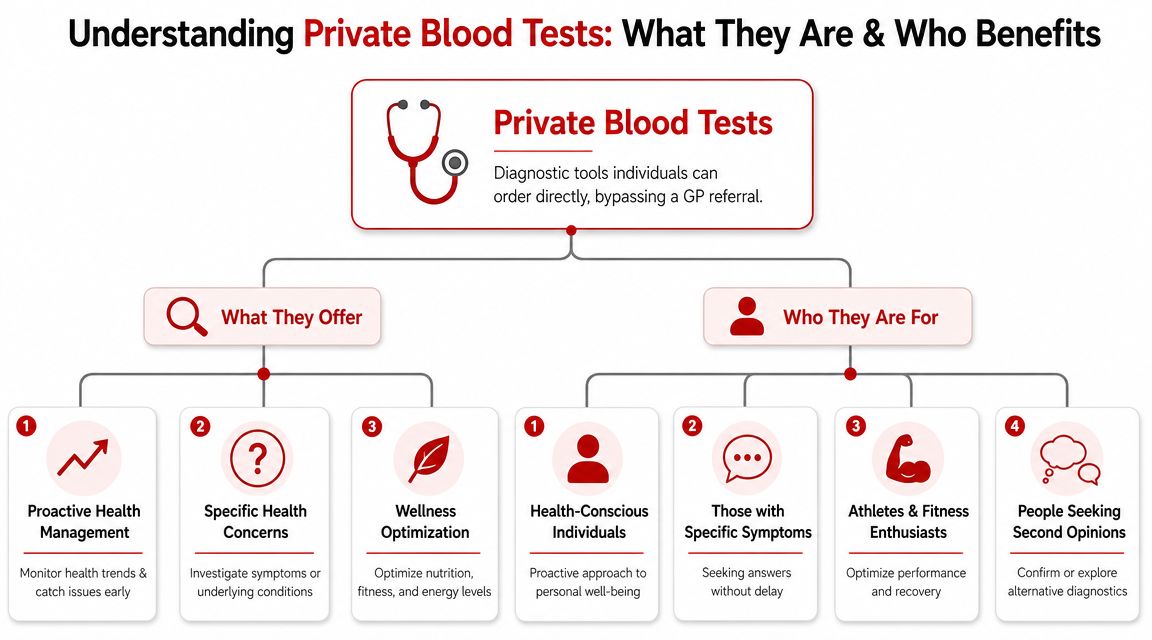
A useful way to view private testing is as a shortcut to information, not a shortcut to diagnosis. The result can point you in a direction, rule out a few common possibilities, or show that you need medical follow-up. It works a bit like checking the dashboard lights in a car. A warning light tells you where to look next, but it does not replace the mechanic.
That distinction matters because private tests are most helpful for people with a clear question. For example, someone with ongoing fatigue may want to check iron status, thyroid markers, blood sugar, or vitamin levels. Someone who feels well may want a baseline to compare against later. If that is your goal, an online vitamin deficiency test can be one example of a targeted starting point.
What private testing can help with
Private testing usually suits four common situations.
- You have a symptom and want a starting point. Fatigue, hair shedding, low mood, poor recovery, or brain fog can have several causes, and a blood test may help narrow the options.
- You want to monitor a known issue. This might include iron levels, thyroid treatment, cholesterol, or blood sugar.
- You want a baseline while you feel well. That gives you a reference point for future comparison.
- You value convenience and privacy. Some people prefer home sampling and direct access to results.
Who tends to get the most value from it
The people who benefit most are usually those who can connect the test to a decision. In other words, they already know what they might do next if a result comes back high, low, or normal.
| Person | Question they are trying to answer | Sensible test direction |
|---|---|---|
| The planner | “I feel fine, but what does my baseline look like?” | A general health panel covering blood count, glucose, cholesterol, liver, and kidney markers |
| The symptom checker | “Why do I feel tired or run down?” | A panel guided by the symptom, often including blood count, iron-related markers, thyroid, or glucose |
| The hormone tracker | “Could hormones be part of this?” | Hormone-focused testing, sometimes alongside thyroid or iron markers |
| The active person | “Am I recovering well, and could I be low in anything?” | Nutritional and metabolic markers linked to training, diet, and energy |
| The follow-up seeker | “Can I bring more information to my next appointment?” | A targeted test linked to an existing concern or previous abnormal result |
One point often causes confusion. Private blood tests do not replace your GP, and they are not designed to diagnose every condition on their own. They are most useful as part of a full journey from question to action. You start with the reason for testing, choose the right category, complete the sample correctly, and then decide whether the result supports monitoring, lifestyle changes, a routine appointment, or prompt medical advice.
Used that way, private testing becomes much more than a report full of numbers. It becomes a clearer next step.
Key Private Blood Test Categories Explained
The easiest way to choose a test is to start with the question you want answered. Individuals don't need a random list of biomarkers. They need the right category.
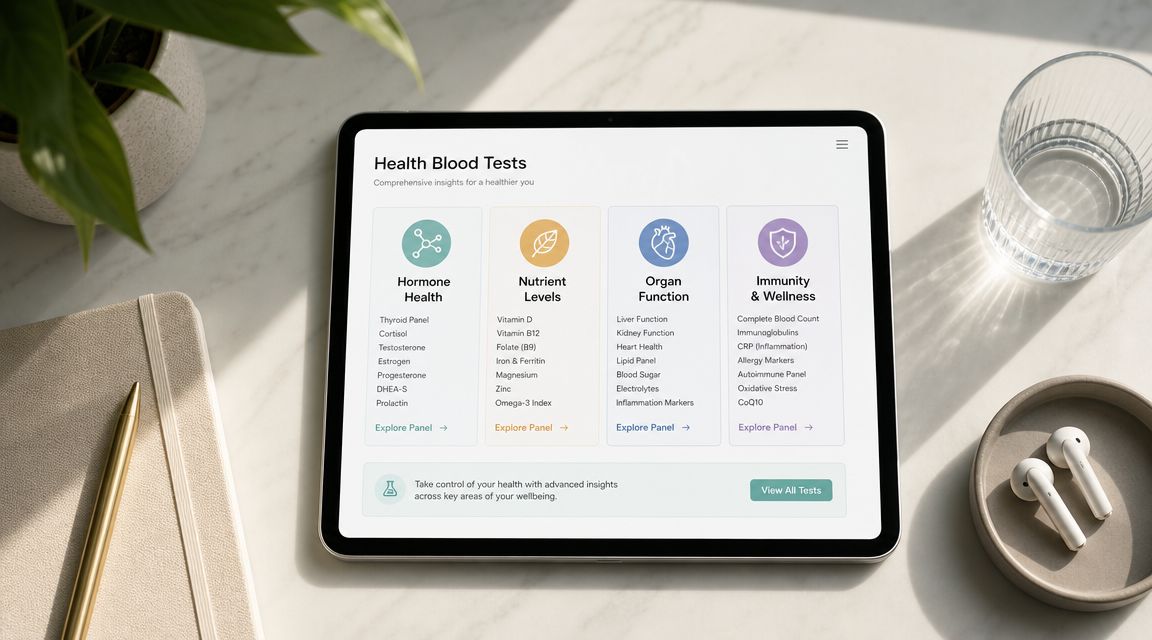
A useful principle is that the most actionable panels often combine a Full Blood Count with chemistry markers such as HbA1c, liver enzymes, and kidney markers, because that lets you see how different body systems relate to each other, as explained in Labcorp OnDemand's overview of comprehensive screening.
General wellness panels
These are the broadest starting point for someone who wants a health snapshot. They usually include core areas such as blood cells, glucose-related markers, cholesterol, kidney function, and liver function.
They suit people who feel generally well but want a baseline, as well as those with nonspecific symptoms that could have several causes. If someone says, “I'm not sure where to begin”, this is often the most sensible category.
A practical example is a person who feels more tired than usual but can't tell whether it's sleep, stress, low iron, blood sugar changes, or something else. A broader panel gives more useful context than a single marker.
Hormone and fertility testing
Hormone-related tests are usually more targeted. They can help when someone is investigating irregular cycles, menopausal symptoms, fertility planning, testosterone-related symptoms, or possible thyroid-related changes in energy, weight, or mood.
The key is timing and context. A hormone result can be informative, but it means more when it's matched to symptoms, cycle stage where relevant, and the reason you're testing in the first place.
Sexual health screening
Private testing is often chosen for discretion here. People may want to screen after a new partner, after unprotected sex, or because they have symptoms they'd rather investigate promptly and privately.
The main advantage isn't only privacy. It's also having a straightforward route from concern to action without needing to explain sensitive details face to face before you're ready.
Gastrointestinal and coeliac-related testing
This category makes sense when symptoms centre on digestion, bloating, bowel changes, or suspected food-related triggers. A GI or coeliac-focused panel can sometimes help identify whether further medical follow-up is worth pursuing.
It's especially useful when someone has persistent symptoms but no clear pattern yet.
Nutrition and deficiency testing
This is often one of the most practical categories because low iron stores, vitamin issues, and related markers can overlap with common complaints like tiredness, poor concentration, low exercise tolerance, and hair changes. If you're weighing up whether a targeted nutrient panel might help, this explainer on an online vitamin deficiency test gives a helpful plain-English overview of what these tests can and can't tell you.
Matching the category to the decision
Use this quick guide when choosing:
- Choose general wellness if your symptoms are broad or you want a baseline.
- Choose hormones if your symptoms are clearly cycle, fertility, libido, or menopause related.
- Choose sexual health if the question is exposure, reassurance, or discreet screening.
- Choose GI or coeliac testing if digestion is the main concern.
- Choose nutrition testing if deficiency feels like the most likely explanation.
If you're browsing provider options, look for named panels that reflect these categories clearly. For example, some services offer options such as a well woman panel, hormone tests, coeliac screening, or a full STI screen. That structure usually makes selection easier than trying to piece together individual markers yourself.
The At-Home Blood Test Process Step by Step
At-home testing sounds more complicated than it usually is. Most confusion comes from not knowing what arrives, how much blood is needed, and what happens after you post the sample.
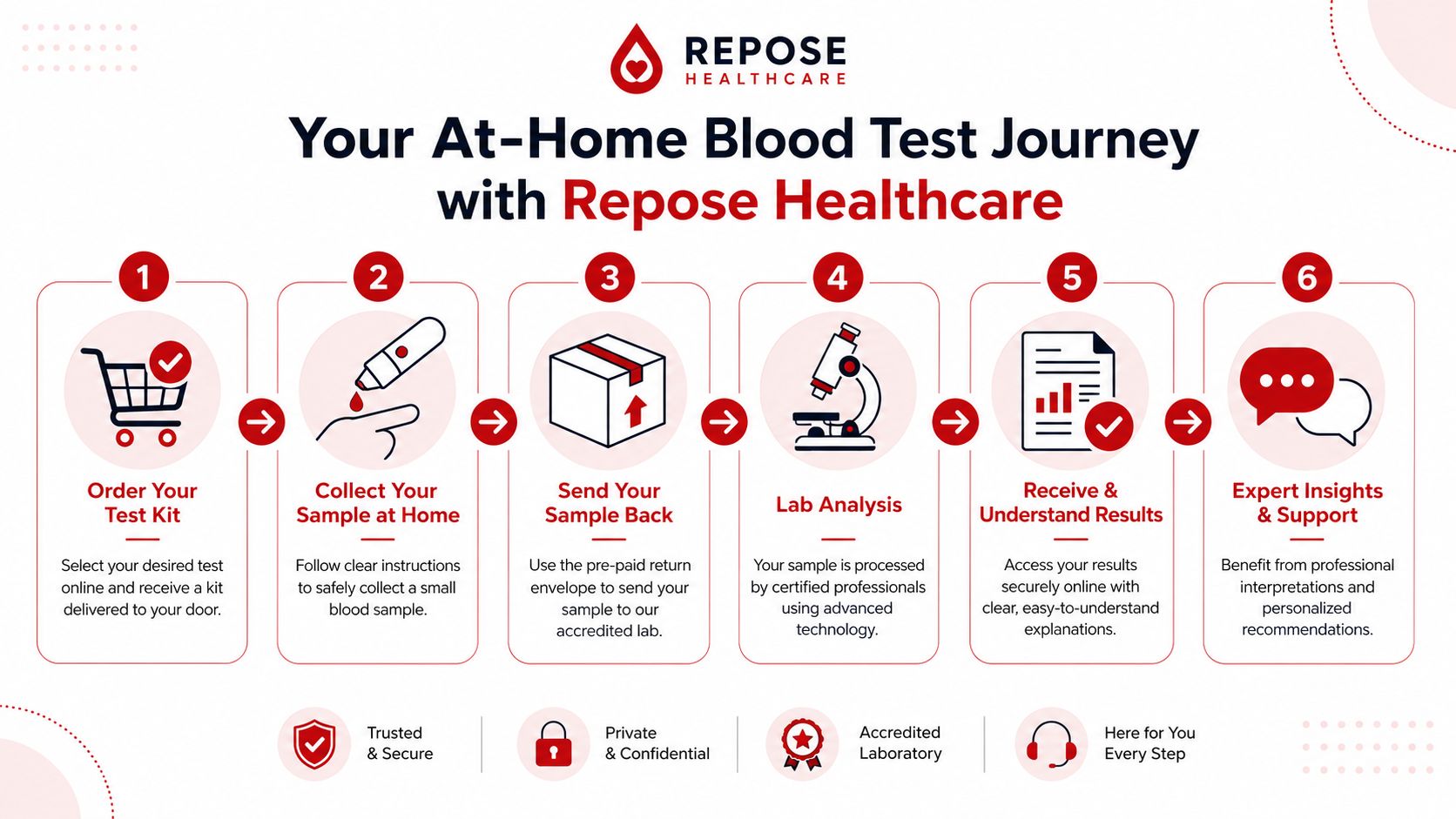
Order the right kit
Start by choosing the panel that matches your question. That sounds obvious, but it's where many mistakes happen. If your concern is tiredness, a narrow hormone-only test may miss common explanations. If your concern is cycle change, a generic wellness panel may not be specific enough.
A provider's guidance page should make the process easier. If you want to see the typical flow from checkout to results, how at-home testing works gives a clear overview of the journey.
Collect the sample at home
Many people worry that they won't be able to collect enough blood. In practice, finger-prick kits are designed around a small but sufficient sample. A Full Blood Count is a multi-parameter panel that analyses red cells, white cells, and platelets from a single sample. While venous draws can require up to about 30 mL, modern methods are designed to obtain the volume needed for analysis efficiently from one collection process, as outlined in Cleveland Clinic's blood test guide.
That's why preparation matters. Warm hands, careful reading of the instructions, and setting everything out before you begin usually makes the process much smoother.
Post the sample promptly
Once collected, the sample needs to get back to the laboratory in the way the kit instructs. Good providers include prepaid return packaging and clear steps for sealing and posting the sample correctly.
This stage matters more than many people realise. A well-collected sample still needs proper handling, packaging, and prompt return to support reliable processing.
If you're nervous about collection, do everything in sequence. Open the kit, read the instructions fully, lay out the items, wash and warm your hands, then begin.
Receive and review your results
Results are usually delivered through a secure dashboard rather than by post. That means you can log in, review the report, and often see measured values alongside reference ranges.
The useful mindset here is simple. Don't hunt for one red flag and stop there. Look at the report as a whole. Patterns across markers often tell you more than one isolated number.
Understanding Accuracy, Labs, and Data Privacy
You order a test, post your sample, and then a new question takes over. Can I trust this result, and who is seeing it?
Those concerns are sensible. A private blood test is only useful if the sample is handled properly, the analysis is done by a qualified laboratory, and your personal information is treated with care.
What accuracy really means
Accuracy starts before the sample reaches a machine. It depends on the right sample being collected, stored, transported, and analysed using validated methods. A poorly collected finger-prick sample can cause problems even if the laboratory itself does good work.
It helps to picture the process like baking with measured ingredients. If the sample is too small, contaminated, or delayed in transit, the final result may be less reliable. Good providers reduce that risk with clear instructions, suitable packaging, and sensible guidance on when to collect and post.
A trustworthy report also shows the actual value, the unit, and the reference range. That matters because a number on its own says very little.
Why the laboratory matters more than the branding
The laboratory is the engine room of the whole service. A polished website cannot make up for weak processing standards.
Look for providers that explain where samples are analysed, how results are reviewed, and what happens if a sample is unsuitable. Some services also make clear that certain abnormal findings should be discussed with a GP rather than treated as a final diagnosis. That is a reassuring sign, because blood testing works best as part of decision-making, not as a stand-alone verdict.
Speed matters, but handling matters more. If you want a realistic sense of reporting windows, this guide on how long blood test results take is useful context.
Privacy should be explained in plain language
Your health data should not disappear into a black box. A credible provider should tell you what information it collects, where results are stored, who can access them, and how identity is protected.
The basic idea is simple. The service needs enough information to match you to your sample and return your report securely, but it should limit access to that information and protect it through controlled systems. If you want background on the principle of separating identity from sensitive records, this article on de-identifying clinical data explains the concept clearly.
Discreet packaging also matters for many people. So does secure login for results rather than casual delivery through open channels.
What these checks mean for your next step
A private blood test should move you from question to action. If the provider is careful about sample quality, laboratory standards, and privacy, you can focus on the part that matters most. Deciding what to do with the result.
That might mean booking a GP appointment, repeating a marker after a period of treatment or lifestyle change, or getting a more specific test. Good testing does not end with a number. It gives you a reliable starting point for the next health decision.
How to Choose a Provider and Interpret Your Results
You order a test because you want clarity. A few days later, a report arrives with numbers, coloured flags, and medical terms. The next decision matters just as much as the test itself. Which provider can you trust, and what should you do with the result once you have it?
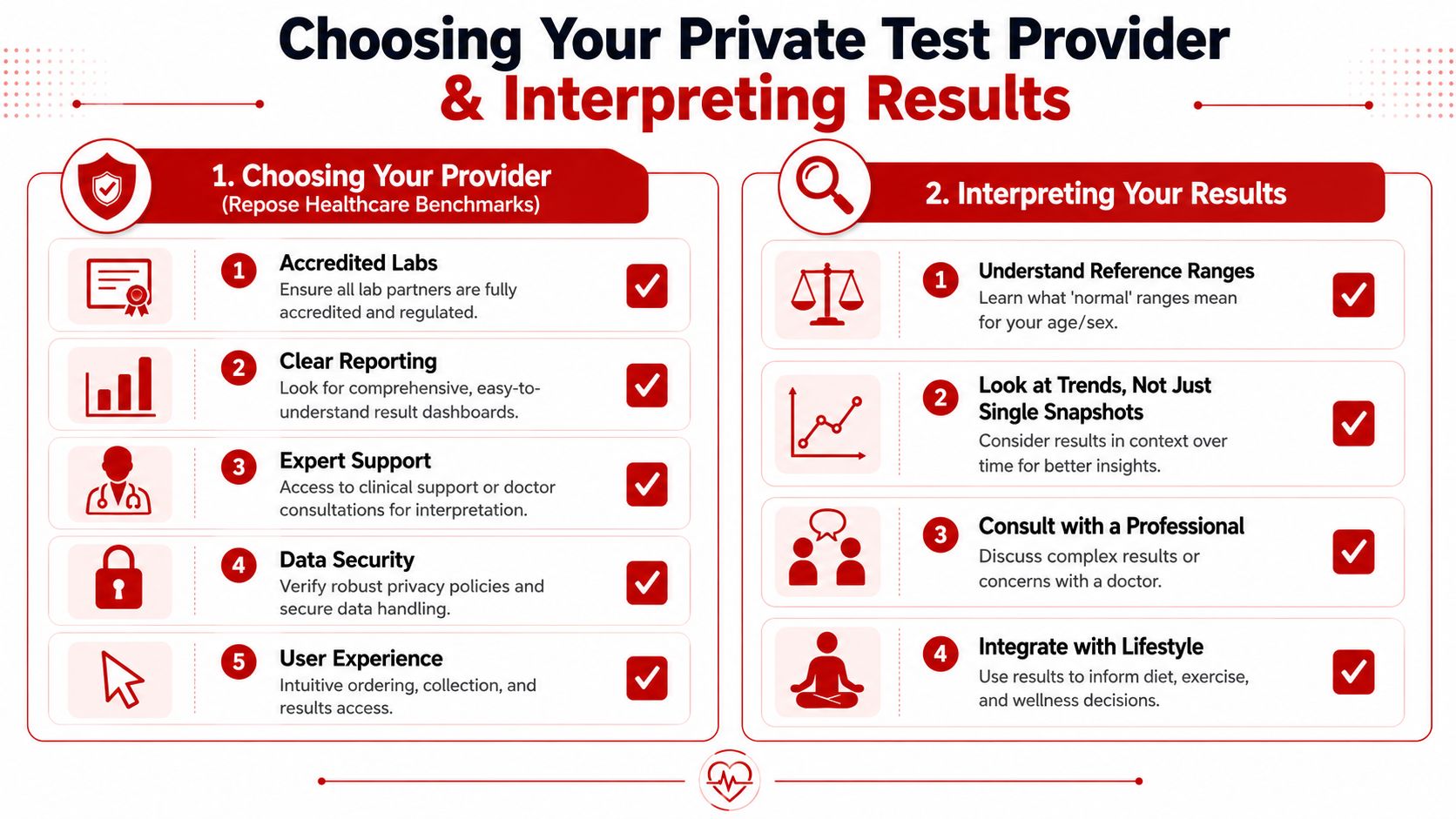
What to look for in a provider
A good provider should make the whole journey clear, from choosing the right panel to knowing what happens after the report arrives. If any part feels vague, pause and look closer.
Start with the questions the provider answers before you buy. What is this test for? Who is it suitable for? What can it tell you, and what can it not tell you? A clear answer helps you avoid paying for a panel that is too broad to be useful or too narrow to answer your question.
Then look at the practical details that affect whether the result will be useful:
- A clear test purpose so you can match the panel to your concern
- Straightforward sampling instructions because a poorly collected sample can lead to delay or retesting
- Secure result delivery through a protected account
- Realistic turnaround times so you know what to expect
- Post-result guidance that explains when self-monitoring is reasonable and when medical follow-up is a better next step
Repose Healthcare is one example of a provider offering at-home private blood test kits in areas such as wellness, hormones, sexual health, gastrointestinal health, and nutrition, with laboratory processing and secure result delivery. The main point is not the brand name. It is the checklist. Use the same questions to compare any provider you are considering.
How to read a report without jumping to conclusions
A blood test report usually gives you three basic pieces of information for each marker: your result, the unit used, and the reference range. The reference range is often misunderstood. It is better viewed as a guide rail than a verdict.
One result slightly outside range does not always mean illness. Blood markers shift for many reasons, including timing, hydration, medicines, supplements, recent exercise, and normal biological variation. Reading a report marker by marker can create more worry than understanding. Reading it as a pattern is usually more helpful.
That is why context matters. Ask simple questions. Does the result fit your symptoms? Is it only just outside the range, or clearly abnormal? Are several related markers pointing in the same direction, or is it a single isolated flag?
If you want a plain-English walkthrough of common report terms, this guide to reading blood test results in the UK can help.
What action should follow the result
A private blood test is a starting point. It helps you decide what to do next.
For many people, the next step falls into one of four groups:
| Result pattern | Sensible next step |
|---|---|
| Clearly normal and fits how you feel | Keep the result as a baseline. Repeat only if symptoms change or you are tracking something over time |
| Borderline or slightly outside range | Review symptoms, medicines, supplements, recent illness, and lifestyle factors. A repeat test may be reasonable, depending on the marker |
| Abnormal and consistent with your symptoms | Share the report with your GP or another clinician for interpretation and follow-up |
| Normal but symptoms continue | Do not stop there. Persistent symptoms still need medical assessment |
A blood test works like a snapshot. Useful, but still only one frame in a larger film. The best providers help close the gap between data and action by making that next step easier to understand.
Normal results can reassure you. They do not rule out every health problem. Abnormal results can be useful too, but they still need interpretation in the context of your symptoms, medical history, and any treatment you are already taking.
Frequently Asked Questions About Private Blood Tests
Do I need a private blood test if I feel healthy
Not always. But some people use private health blood tests to create a baseline while they feel well. That can make later changes easier to spot. Others prefer to test only when symptoms, family history, or a specific concern gives them a reason.
Can I use private testing for vague symptoms like fatigue
Yes, but choose carefully. Fatigue can relate to several systems at once, which is why broader panels are often more useful than a single-marker test. Even then, results need context. A normal panel doesn't automatically explain persistent symptoms away.
Are at-home blood tests difficult to do
Usually not. The process is designed to be simple, but it helps to read the instructions before starting, warm your hands, and set everything out in advance. Most problems come from rushing, not from the process itself.
Are private blood tests confidential
They should be. Look for secure dashboard access, clear privacy information, and discreet packaging. If a provider is vague about data handling, that's a reason to pause.
Can I show my results to my NHS GP
Yes. Private results can be useful in a GP appointment, especially if they help focus the conversation. Your GP may still decide to repeat or expand testing within NHS care, but a private report can still be a valuable starting point.
How much do private blood tests cost
Costs vary by provider and by panel. A targeted test is usually simpler than a broad wellness panel, and specialised hormone or sexual health screens may differ again. The key is to look for transparent pricing before checkout and to choose the narrowest test that still answers your question well.
What if the result is normal but I still feel unwell
That's one of the most important situations to take seriously. A normal blood test does not replace clinical assessment. If symptoms continue, worsen, or don't fit the result, speak to your GP or another qualified clinician.
If you want a practical next step, Repose Healthcare offers at-home testing across common categories including wellness, hormones, nutrition, gastrointestinal health, and sexual health. You can use it to move from uncertainty to a clearer question, a clearer result, and a more informed conversation about what to do next.
You Might Also Like
Private Health Blood Tests: A Complete UK Guide 2026
You might be here because something feels off, but not dramatic enough to make sense [...]
Reassurance Pregnancy Scan: Your Guide for 2026
A positive pregnancy test can bring two feelings at once. Joy arrives first, then the [...]
Progesterone Test for Fertility: Your 2026 UK Guide
If you're trying to conceive, you've probably already taken the usual first steps. You've watched [...]
7 Week Scan Pictures: See Early Development
You get a positive test at home, then wait days for a scan appointment, and [...]
Home Allergy Test Kit Reviews: A UK Expert Guide 2026
You've got symptoms that don't fit neatly into one box. Maybe it's a rash after [...]
NIPT Test Sheffield: Your 2026 Guide to Options & Costs
You've had the booking confirmation for your early pregnancy appointment. You're checking dates, comparing clinics, [...]
Private Scan London: 2026 Guide to Costs & Booking
You wake up with the same worry you had last week. The pelvic pain is [...]
The 2026 Cost of Hepatitis Vaccination in the UK
You're usually looking up the cost of hepatitis vaccination for a practical reason. A trip [...]
Hormone Blood Test London: Find Your Perfect Test
Some London health questions start subtly. Your cycle changes a little. You feel wired at [...]
Peanut Allergy Test Kit: A Practical UK User’s Guide
A peanut reaction often starts with uncertainty, not clarity. You eat a biscuit, satay sauce, [...]
NIPT Test Edinburgh: Your 2026 Guide
If you're searching nipt test edinburgh, you're probably already in that familiar stage of pregnancy [...]
Peripheral Artery Disease UK: Peripheral Artery Disease UK:
You might be reading this because walking has started to feel different. Perhaps your calf [...]
NIPT Test Cardiff: Clinic, Home & NHS Pathways 2026
If you're in Cardiff, newly pregnant, and staring at screening options that all seem to [...]
Gender Scan Difference UK: Accuracy, Timing & Cost Compared
You've probably already done the same search most parents do. One tab shows the NHS [...]
NIPT Test Cambridge: Guide to Options & Booking 2026
You're in Cambridge, you've had the first rush of finding out you're pregnant, and then [...]
Home COVID Test Results: A Practical UK & Ireland Guide
You've done the swab, mixed the sample, added the drops, and now you're staring at [...]
DVT Test Squeeze Calf: Homan’s Sign & Beyond
You notice one calf is sore, a little swollen, and not behaving like an ordinary [...]
Your Guide to Every Travel Clinic Leicester Offers in 2026
Flights are booked. The hotel is sorted. Your passport is still in date. Then one [...]
13 Week Gender Scan: Accuracy, NIPT & What to Expect
By the time you reach 13 weeks, pregnancy often starts to feel more real in [...]
Your Pregnancy Scan London: Guide to Options & Costs
A positive test can make London feel suddenly very small and very complicated. You might [...]
Your Nuchal Dating Scan Explained: A 2026 UK Guide
That appointment message has landed in your phone or come through the post, and suddenly [...]
Normal Cortisol Levels UK: Get Clarity
Some people search for normal cortisol levels uk after weeks of feeling unlike themselves. They’re [...]
How to Test Iron Levels in Blood: A Complete UK Guide
You’re probably not searching how to test iron levels in blood out of curiosity. More [...]
Growth Scan Pregnancy: UK Guide & What to Expect
You’re at an antenatal appointment, everything seems routine, and then your midwife says, “We’d like [...]
Gender Scan Near Me: Your 2026 Guide to Options
You’re probably here because the question has stopped feeling abstract. Maybe you’ve had your booking [...]
Progesterone Test For Pregnancy: Viability & Home Kit
The positive test is there, but relief doesn’t always follow. For many women, early pregnancy [...]
Ovulation Blood Tests: Confirm Your Ovulation
You’ve probably already done some version of this. You’ve checked an app, watched for a [...]
How to Test Testosterone Levels: A UK Guide
You wake up tired, despite a full night in bed. Your training feels flat. Your [...]
UK Vitamin D Test: A Complete At-Home Guide for 2026
You wake up tired, even after a full night’s sleep. By mid-afternoon you’re reaching for [...]
Blood Iron Level Test: A Complete UK Guide for 2026
Some days it isn’t dramatic. You’re just slower than usual. You wake up after a [...]