
Reassurance Pregnancy Scan: Your Guide for 2026

A positive pregnancy test can bring two feelings at once. Joy arrives first, then the waiting starts. If your NHS scan still feels a long way off, it's very common to find yourself checking symptoms, watching the calendar, and wondering whether everything is progressing as it should.
That's where a reassurance pregnancy scan often comes in. For some people, it offers a calm snapshot of what's happening right now. For others, it's part of coping after a previous loss, fertility treatment, or a difficult early pregnancy experience. It can help, but it also has limits, and knowing those limits usually makes the experience less frightening, not more.
Waiting for Your First Scan Anxieties and Answers
Some of the hardest days in pregnancy happen before there's anything to see. You may have had a strong test line, sore breasts, nausea, tiredness, or no symptoms at all. None of those experiences reliably tells you what the scan will show, which is why the early wait can feel so exposed.

A pattern I hear often is this: someone feels relieved for an hour after the pregnancy test, then spends the next week worrying that relief was premature. Another person may already have had a miscarriage and now feels unable to trust any symptom at all. Someone else may have conceived after treatment and wants a visual check before they can take a full breath. All of those reactions are understandable.
Why the waiting period feels so intense
The gap before routine care can feel longer than it looks on paper because there's very little feedback in the meantime. You're being asked to bear a lot of uncertainty alone. That's difficult even in an uncomplicated pregnancy.
A reassurance scan can help by offering an earlier look. It doesn't promise an outcome, but it may answer practical questions such as whether the pregnancy is in the uterus and whether there are early signs of development that match where you think you are.
Practical rule: if anxiety is making it hard to function day to day, wanting more information doesn't make you overreactive. It means you're trying to cope.
Other ways to feel more informed while you wait
An ultrasound checks one part of the picture. Some people also feel better when they understand more about their wider health, especially if they're thinking about thyroid function, iron status, vitamin levels, or other factors that can matter in pregnancy conversations with clinicians. If that kind of information would help you feel more grounded, at-home health testing can be one practical way to gather it while you wait for appointments.
If health anxiety is becoming the loudest part of this experience, it may also help to explore CBT with Therapy with Ben. A structured approach to anxious thoughts can be useful between scans, especially when your mind keeps jumping from one symptom to the worst-case conclusion.
What Exactly Is a Reassurance Pregnancy Scan
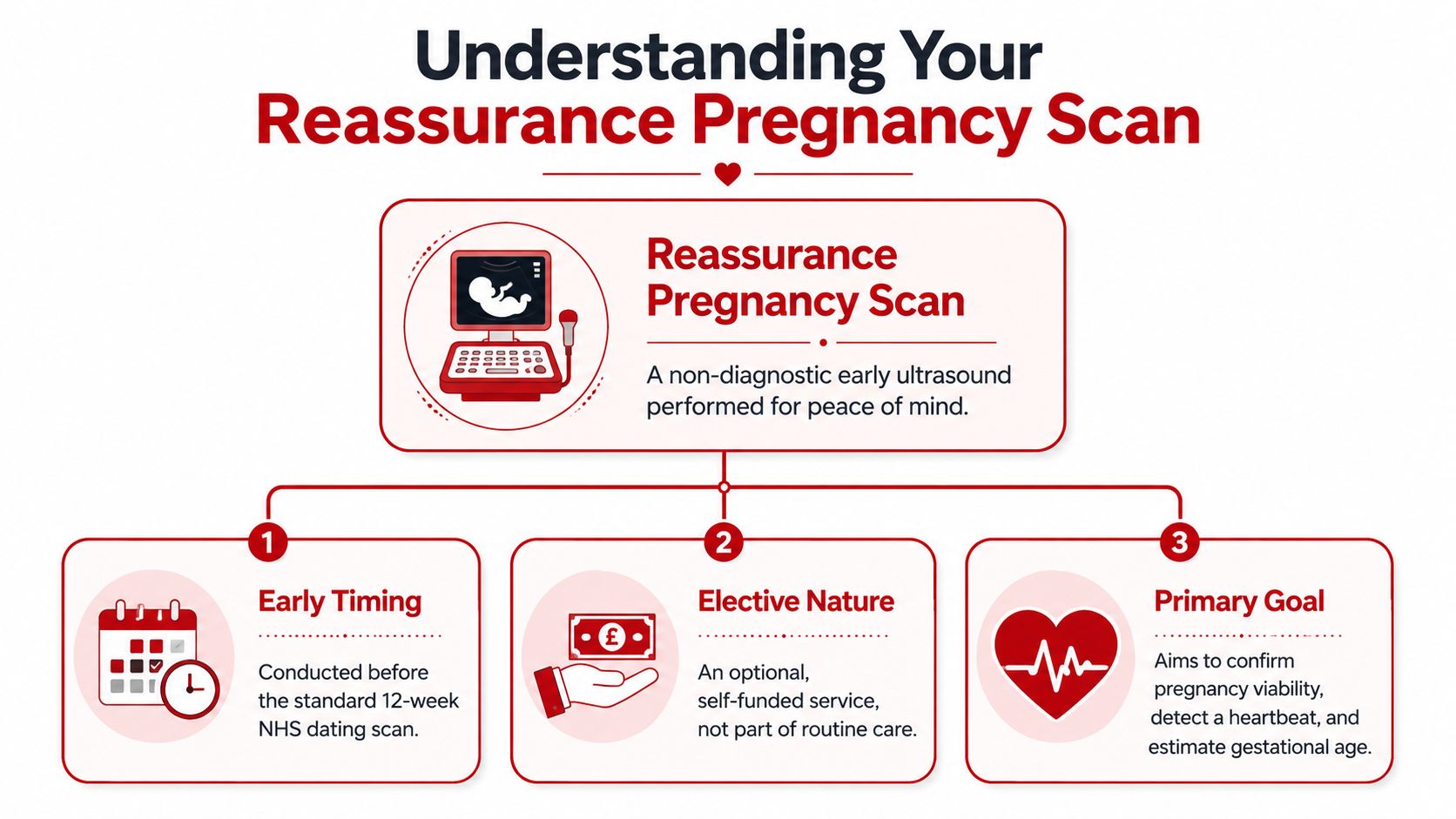
A reassurance pregnancy scan is an early ultrasound done before the usual routine NHS scan timetable. In the UK, reassurance scans are typically offered from 6 to 10 weeks to confirm the pregnancy is in the uterus, check for a heartbeat, and measure size. This is separate from standard NHS care, which includes a dating scan at 10 to 14 weeks and a fetal anomaly scan at 18 to 21 weeks, so the reassurance scan is an extra early check rather than a replacement for routine care, as explained by Tommy's guidance on early scans after miscarriage.
What the scan is for
At this stage, the sonographer is usually trying to answer a short list of focused questions:
- Location: Is the pregnancy seen in the uterus?
- Heartbeat: Is cardiac activity visible yet?
- Size: Does the measurement broadly fit the expected timing?
- Basic early picture: Is there one pregnancy or more than one?
That narrow focus matters. A reassurance scan isn't trying to do the detailed job of later pregnancy screening. It's more like an early check-in.
Who usually books one
Some people seek one because they've had a previous miscarriage or pregnancy loss. Others book after IVF or another fertility journey because the early weeks can feel especially loaded. Some have no medical history at all and find the wait overwhelming.
You don't need to justify wanting clarity. But it helps to book with the right expectations. If you attend very early, the scan may provide less certainty than you hoped for. That doesn't always mean something is wrong. It may mean nature is still at a stage where very small changes happen over a few days.
A reassurance scan gives information about today. It doesn't replace the later checks that look at the pregnancy in more detail.
Why timing matters so much
If someone tells me they're thinking of booking at “about six weeks”, my next question is always how sure they are of their dates. Ovulation and implantation don't happen by calendar rules, and even a small shift can affect what's visible. The closer you are to the edge of early development, the easier it is for a normal pregnancy to look inconclusive on one scan.
That's why understanding the purpose of the appointment helps. You're not buying certainty in the abstract. You're booking a focused look at a very early stage of pregnancy.
What an Early Scan Can and Cannot Reveal
This is the part people deserve most honesty about. An early scan can be very useful. It can also leave questions unanswered, especially if it's done at the earliest end of the window.
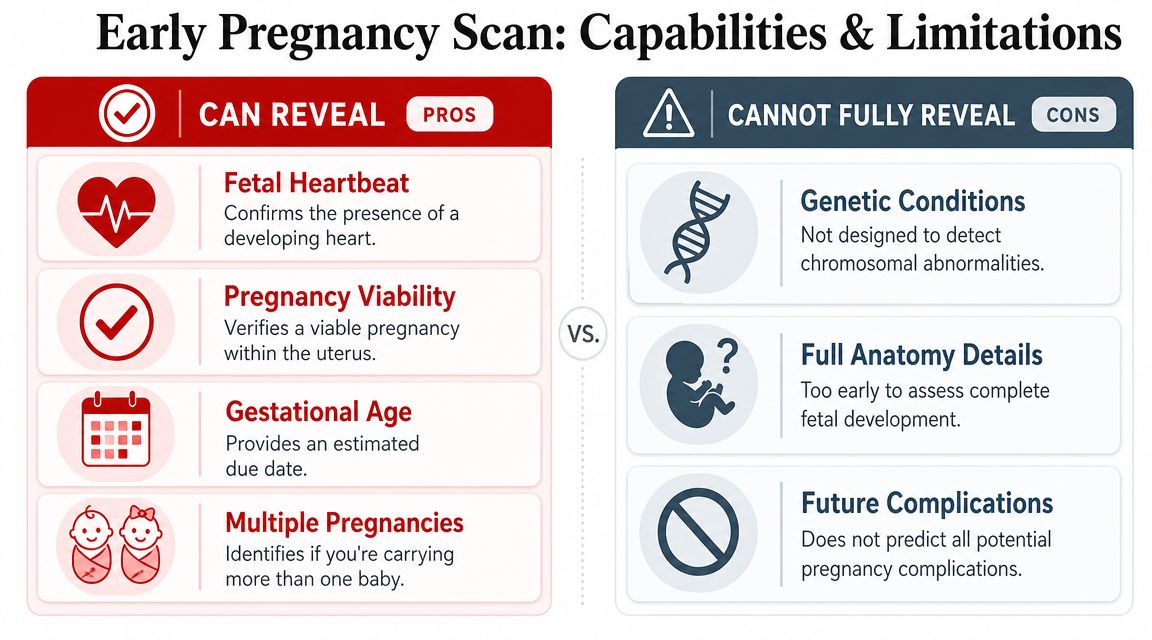
A reassurance scan provides valuable but limited information. It primarily confirms location and heartbeat to assess immediate risk, but with miscarriage affecting roughly 1 in 8 known pregnancies, it cannot guarantee future viability. Guidance referenced in this overview of ultrasound limitations and ectopic risk also stresses that ultrasound is used for risk assessment rather than absolute reassurance.
What the scan can tell you
At the right stage, an early scan can often clarify several immediate questions.
| Stage | What may be visible | What that means |
|---|---|---|
| Around 6 weeks | Early pregnancy structures may be seen, and sometimes a heartbeat | A normal scan can still be limited at this point |
| Around 8 weeks | Development is usually easier to assess, including heartbeat and size | The picture is often clearer and easier to interpret |
The most practical use of the scan is to check whether the pregnancy is in the uterus and whether there are early signs of development that fit the stage. That can be valuable information if you've had pain, previous loss, uncertain dates, or high anxiety.
What the scan cannot promise
An early scan cannot tell you that everything for the whole pregnancy will be fine. It cannot rule out all future problems. It cannot assess later structural development in the way a much later anomaly scan is designed to do.
It also can't always settle every question about viability in one visit. If the pregnancy is very early, the result may be “too soon to say clearly” rather than “good” or “bad”.
A helpful way to consider it is:
- A heartbeat is reassuring, not a guarantee
- A pregnancy in the uterus is important to confirm, but symptoms still matter
- A normal early appearance doesn't replace later NHS screening
- An unclear scan often reflects timing, not immediately a problem
If you're comparing scan options, it helps to read what clinics class as an early viability scan and what questions that appointment is designed to answer. The wording matters because “reassurance” can sound broader than the scan's true role.
The scan is a snapshot, not a forecast.
Why this honest framing helps
False reassurance creates its own distress later. So does unnecessary panic after a scan done too early. Most confusion comes from expecting a six-week scan to answer eight-week questions.
That's why I often suggest patients ask themselves one simple thing before booking: “Do I want the earliest possible look, or the clearest possible look?” Those are not always the same appointment.
Your Reassurance Scan Appointment Explained
For many people, the appointment itself feels less daunting once they know what will happen in the room. The practical steps are usually straightforward.
Before the scan
You may be asked to arrive with a full bladder if an abdominal scan is planned. That's because fluid in the bladder can help lift the uterus into a better position for imaging. If the pregnancy is very early, the sonographer may still recommend an internal scan for a clearer view.
Wear something easy to change in and give yourself a few extra minutes before the appointment. Rushing tends to amplify anxiety.
The two main scan types
Clinically, a reassurance scan at 6 to 10 weeks uses either a transvaginal ultrasound, which can detect cardiac activity from around 5 to 6 weeks, or a transabdominal ultrasound, which typically finds a heartbeat from about 6 to 7 weeks. The main goals are to confirm an intrauterine pregnancy, document fetal heart activity, and measure crown-rump length to estimate the due date, as described in this clinical summary of reassurance scan timing and method.
The easiest way to understand the difference is this:
- Transabdominal scan: the probe moves over the lower tummy. It's less invasive, but very early images can be less clear.
- Transvaginal scan: a slim internal probe is used to get a closer view. It often gives better detail in the earliest weeks.
Think of it as close-up versus further away. If you're trying to see something tiny, the close-up view usually helps.
What the sonographer looks for
During the scan, the sonographer is watching for a small number of specific features. Depending on timing, they may identify the pregnancy sac, early fetal development, cardiac activity, and measurements used for dating.
You may or may not immediately recognise what's on the screen. That's normal. Early ultrasound images can be hard to interpret if you've never seen them before.
A few practical questions can help:
- How do the findings fit my dates?
- Was the pregnancy seen clearly in the uterus?
- Is a follow-up scan recommended?
- Should I contact my GP, midwife, or early pregnancy service for anything specific?
If a sonographer suggests an internal scan, that usually means they want a clearer answer, not that they've already found a problem.
Private Scans vs NHS Options in the UK and Ireland
Private reassurance scans and NHS early pregnancy care don't compete with each other. They serve different purposes.
How the two pathways differ
A private scan is usually something you choose and arrange yourself because you want an earlier update. The NHS pathway is based on routine care and clinical need. If someone has pain, bleeding, a concerning history, or symptoms that need assessment, NHS services may arrange earlier review. If someone mainly wants peace of mind during the waiting period, that's more often where private scanning comes in.
This distinction matters because it changes what the appointment is for. One route is elective. The other is clinical.
A side by side view
| Pathway | Typical reason for booking | Main role |
|---|---|---|
| Private scan | You want an early check before routine care | Extra information and reassurance |
| NHS early assessment | Symptoms or clinical concern need review | Medical assessment and management |
| Routine NHS scans | Standard antenatal schedule | Ongoing pregnancy care |
If you're comparing private options in a city setting, a page such as private scan appointments in London can help you see how this kind of appointment is positioned alongside routine care.
What to keep in mind
A private scan can be emotionally useful, but it doesn't replace the NHS pathway you'll still need for routine pregnancy care. It also doesn't remove the need to seek urgent medical advice if you have worrying symptoms.
Some people find it helpful to pair scan planning with broader health monitoring at home, especially if they want a clearer conversation with their GP or maternity team about general wellbeing. That can include checking factors such as thyroid, iron, or vitamin status through at-home testing if those issues are relevant to them.
Interpreting Scan Results and Deciding Next Steps
The report matters, but the wording can sound more technical than it feels in practice. Most early results fall into one of a few broad patterns.
If the scan shows a viable intrauterine pregnancy
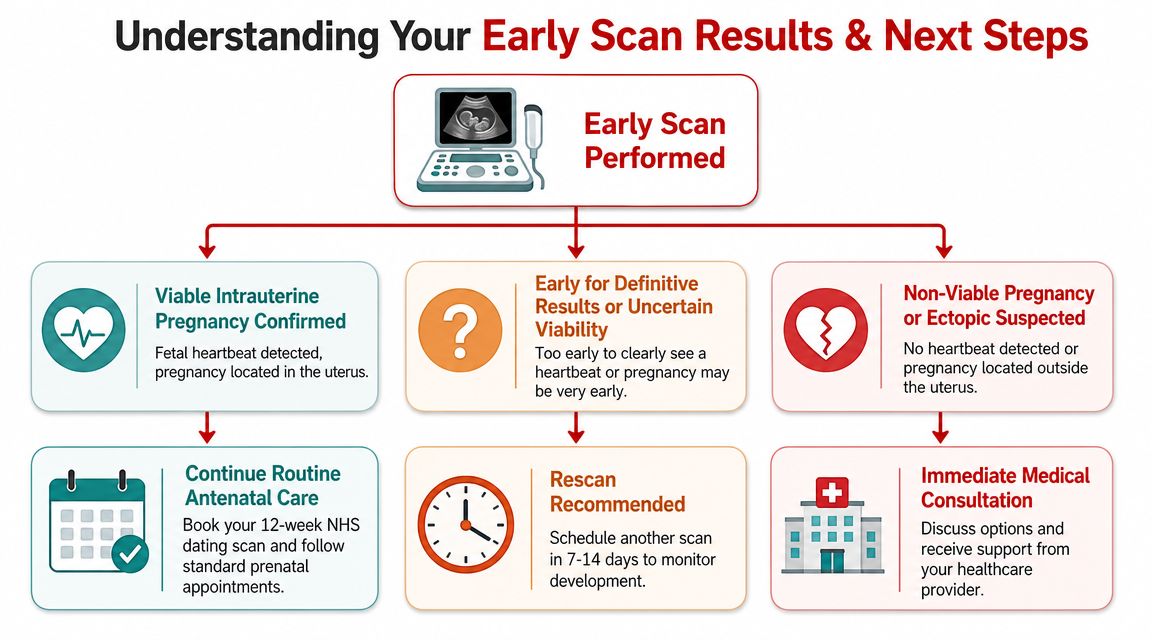
This usually means the pregnancy was seen in the uterus and the sonographer identified signs of current viability, such as cardiac activity. For many people, this brings huge relief. That relief is real and it matters.
Even so, some anxiety often returns later. A UK study found that anxiety fell significantly immediately after a 10-week reassurance scan, particularly in women with a history of recurrent miscarriage, but that emotional benefit could be temporary, as discussed in King's College London research on reassurance scanning.
If the result is unclear
This is one of the most misunderstood outcomes. “Too early to confirm” is not the same as “bad news”. In very early pregnancy, a few days can make a meaningful difference to what is visible.
If an early scan is unclear, another scan is often offered 10 to 14 days later according to Tommy's guidance discussed earlier in this article. That waiting period can feel difficult, but it's often the most clinically sensible next step.
Common examples of unclear but not definitive findings include:
- Pregnancy seen, but no heartbeat yet
- Dates not matching your expectation
- Very early structures only
- Need for repeat imaging to confirm progression
If the findings raise concern
Sometimes the sonographer may advise prompt follow-up because the findings suggest the pregnancy may not be developing as expected, or because the location is not confirmed clearly enough. That's when you may be directed to your GP, midwife, or an Early Pregnancy Unit.
At that point, the next steps usually matter more than the wording on the report. Ask who you should contact, how quickly, and what symptoms should trigger urgent care.
A scan result is most useful when it leads to a clear plan for what happens next.
If your mind immediately jumps from one scan to every later test in pregnancy, it may help to separate the roles. An early reassurance scan answers early questions. Different tests answer different ones. For example, if you later want to understand screening for chromosomal conditions, reading about NIPT test accuracy and what the result can mean can help place that next decision in its proper context rather than expecting one scan to do every job.
Frequently Asked Questions About Reassurance Scans
Many people wonder whether an early private scan can replace the NHS dating scan. It can't. Routine NHS care still includes the first standard scan at around 11 to 14 weeks, and an early private scan at 6 to 10 weeks is an initial check-in rather than a substitute, as explained in this guide to the timing of the first routine ultrasound.
Common questions about reassurance scans
| Question | Answer |
|---|---|
| When is the best time to book one? | It depends on whether you want the earliest possible view or a clearer one. Earlier scans can be more uncertain. |
| Can it tell me everything is okay? | No. It can provide useful information about what is visible at that moment, but it can't guarantee the rest of the pregnancy. |
| Will I need an internal scan? | Sometimes, yes. Very early pregnancies are often seen more clearly internally than through the abdomen. |
| What if no heartbeat is seen? | That can mean several things, including that the scan was simply too early. A repeat scan is often the next step when dates are uncertain. |
| Does a reassuring result mean I can skip later scans? | No. Later routine scans look at different things and remain important. |
| Who might find this kind of scan especially helpful? | People with previous loss, uncertain dates, fertility treatment, worrying symptoms, or significant anxiety often seek one. |
A final practical note
Try to go into the appointment with one main question in mind. It might be “Is the pregnancy in the uterus?” or “Am I far enough along to expect a heartbeat?” A focused question often leads to a calmer experience than hoping one scan will settle every fear at once.
If you leave with a plan, you've gained something important, even if that plan is to repeat the scan after the right interval.
If you'd like a broader view of your health alongside pregnancy care, Repose Healthcare offers at-home health testing across the UK and Republic of Ireland, including hormone and wellness testing, with results delivered through a secure online dashboard.
You Might Also Like
Private Health Blood Tests: A Complete UK Guide 2026
You might be here because something feels off, but not dramatic enough to make sense [...]
Reassurance Pregnancy Scan: Your Guide for 2026
A positive pregnancy test can bring two feelings at once. Joy arrives first, then the [...]
Progesterone Test for Fertility: Your 2026 UK Guide
If you're trying to conceive, you've probably already taken the usual first steps. You've watched [...]
7 Week Scan Pictures: See Early Development
You get a positive test at home, then wait days for a scan appointment, and [...]
Home Allergy Test Kit Reviews: A UK Expert Guide 2026
You've got symptoms that don't fit neatly into one box. Maybe it's a rash after [...]
NIPT Test Sheffield: Your 2026 Guide to Options & Costs
You've had the booking confirmation for your early pregnancy appointment. You're checking dates, comparing clinics, [...]
Private Scan London: 2026 Guide to Costs & Booking
You wake up with the same worry you had last week. The pelvic pain is [...]
The 2026 Cost of Hepatitis Vaccination in the UK
You're usually looking up the cost of hepatitis vaccination for a practical reason. A trip [...]
Hormone Blood Test London: Find Your Perfect Test
Some London health questions start subtly. Your cycle changes a little. You feel wired at [...]
Peanut Allergy Test Kit: A Practical UK User’s Guide
A peanut reaction often starts with uncertainty, not clarity. You eat a biscuit, satay sauce, [...]
NIPT Test Edinburgh: Your 2026 Guide
If you're searching nipt test edinburgh, you're probably already in that familiar stage of pregnancy [...]
Peripheral Artery Disease UK: Peripheral Artery Disease UK:
You might be reading this because walking has started to feel different. Perhaps your calf [...]
NIPT Test Cardiff: Clinic, Home & NHS Pathways 2026
If you're in Cardiff, newly pregnant, and staring at screening options that all seem to [...]
Gender Scan Difference UK: Accuracy, Timing & Cost Compared
You've probably already done the same search most parents do. One tab shows the NHS [...]
NIPT Test Cambridge: Guide to Options & Booking 2026
You're in Cambridge, you've had the first rush of finding out you're pregnant, and then [...]
Home COVID Test Results: A Practical UK & Ireland Guide
You've done the swab, mixed the sample, added the drops, and now you're staring at [...]
DVT Test Squeeze Calf: Homan’s Sign & Beyond
You notice one calf is sore, a little swollen, and not behaving like an ordinary [...]
Your Guide to Every Travel Clinic Leicester Offers in 2026
Flights are booked. The hotel is sorted. Your passport is still in date. Then one [...]
13 Week Gender Scan: Accuracy, NIPT & What to Expect
By the time you reach 13 weeks, pregnancy often starts to feel more real in [...]
Your Pregnancy Scan London: Guide to Options & Costs
A positive test can make London feel suddenly very small and very complicated. You might [...]
Your Nuchal Dating Scan Explained: A 2026 UK Guide
That appointment message has landed in your phone or come through the post, and suddenly [...]
Normal Cortisol Levels UK: Get Clarity
Some people search for normal cortisol levels uk after weeks of feeling unlike themselves. They’re [...]
How to Test Iron Levels in Blood: A Complete UK Guide
You’re probably not searching how to test iron levels in blood out of curiosity. More [...]
Growth Scan Pregnancy: UK Guide & What to Expect
You’re at an antenatal appointment, everything seems routine, and then your midwife says, “We’d like [...]
Gender Scan Near Me: Your 2026 Guide to Options
You’re probably here because the question has stopped feeling abstract. Maybe you’ve had your booking [...]
Progesterone Test For Pregnancy: Viability & Home Kit
The positive test is there, but relief doesn’t always follow. For many women, early pregnancy [...]
Ovulation Blood Tests: Confirm Your Ovulation
You’ve probably already done some version of this. You’ve checked an app, watched for a [...]
How to Test Testosterone Levels: A UK Guide
You wake up tired, despite a full night in bed. Your training feels flat. Your [...]
UK Vitamin D Test: A Complete At-Home Guide for 2026
You wake up tired, even after a full night’s sleep. By mid-afternoon you’re reaching for [...]
Blood Iron Level Test: A Complete UK Guide for 2026
Some days it isn’t dramatic. You’re just slower than usual. You wake up after a [...]