 Skip to content
Diabetes Tests UK: Your Complete Guide to Getting Checked
Some people land on this topic after weeks of quiet worry. You might have noticed you are thirstier than usual, more tired than you expect, or getting up to use the loo more often. You might feel absolutely fine, but diabetes runs in your family and you want clarity.
That is a sensible reason to look into diabetes tests uk options. A test does not commit you to anything dramatic. It gives you information. From there, you can decide whether you need GP follow-up, lifestyle changes, or just reassurance.
In the UK, you usually have two practical routes. You can go through the NHS, or you can use a private at-home test. Both can be useful. The right choice depends on your symptoms, your risk, how quickly you want answers, and whether convenience matters to you.
Why You Should Consider a Diabetes Test in the UK
A common story goes like this. Someone in their thirties or forties feels a bit “off” for a while. Nothing severe. Just more tired, more thirsty, maybe a little foggy after meals. They put it down to stress, poor sleep, or being busy. Then a routine check, or a test ordered because of family history, shows raised blood sugar.
That matters because blood sugar problems often develop without obvious symptoms. You do not need dramatic symptoms to benefit from testing.

Small concerns can be worth checking
You may want a test if any of these sound familiar:
- Family history: A parent or sibling has type 2 diabetes.
- Subtle symptoms: You feel more thirsty, more tired, or notice blurred vision or frequent urination.
- A previous warning: A clinician has mentioned high blood sugar, pre-diabetes, or insulin resistance before.
- You want a baseline: You do not feel unwell, but you want a clear picture of your health.
Testing can also help people who dislike uncertainty. Waiting and wondering tends to make symptoms feel bigger and more confusing.
Why this has become more urgent
The scale of diabetes risk in England is hard to ignore. The NHS reported that the number of people registered with a GP who were found to have non-diabetic hyperglycaemia rose from 3,065,825 to 3,615,330 between 2022 and 2023, which is 549,000 more people, or about an 18% increase. The same NHS update says the service spends around £10 billion each year on identifying and treating diabetes. You can read that in the NHS announcement on the rise in people identified as at risk of type 2 diabetes.
One detail catches many readers off guard. This is not only an older adult issue. The same NHS report says identification of pre-diabetes in people under 40 also rose sharply.
Key takeaway: A diabetes test is not only for people who already feel ill. It is often most useful when you catch changes early.
NHS or at-home
If you have strong symptoms, your first stop should usually be your GP. If your symptoms are mild, or you want a quick check without arranging an appointment, an at-home test can be a practical starting point.
The important thing is not which route looks more “official”. It is choosing a route you will use.
The Main Types of Diabetes Tests Explained
The names can sound technical, but the basic idea is simple. Different tests answer different questions.
One test looks at your blood sugar over time. Another checks it at a single moment. Another looks at how your body handles a sugar load.
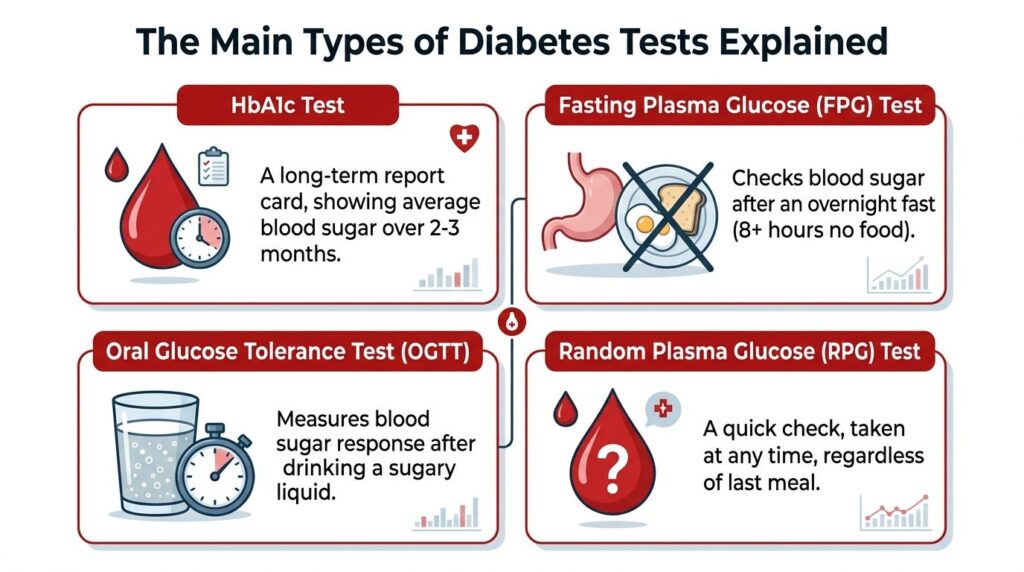
HbA1c is your longer-term picture
Think of HbA1c as a report card for the last few months. It does not just tell you what your blood sugar is doing right now. It shows your average blood sugar exposure over the previous 2 to 3 months.
In UK guidance, HbA1c is the preferred diagnostic test for diabetes in many adults because it is reproducible and does not require fasting. A result of 48 mmol/mol (6.5%) or above indicates diabetes, but it should be confirmed with a repeat laboratory test. The same guidance also explains that HbA1c is not suitable in some situations, including pregnancy, where glucose-based testing is used instead. That is set out in the Barnsley guideline on which test should be used to diagnose diabetes.
HbA1c is often the most convenient choice for adults who want a straightforward first check.
Fasting glucose is a snapshot
A fasting plasma glucose test is more like a photograph taken at one specific time. You do not eat beforehand, then your blood sugar is measured.
This can be very useful, but it is more affected by what is happening on that day. Illness, stress, or short-term variation can matter more than they do with HbA1c.
OGTT shows how your body handles sugar
An oral glucose tolerance test, often shortened to OGTT, checks how your body responds after you drink a sugary liquid. It is less convenient than HbA1c, but it can be helpful when a clinician needs a more detailed answer.
People often find this the most confusing test because it is more involved. In plain terms, it asks: after sugar enters your system, does your body clear it properly?
Random glucose is a quick check
A random plasma glucose test can be taken at any time, without fasting. It is often used when someone has symptoms and needs quick assessment. It is useful in the right setting, but on its own it is not usually the first choice for routine screening in someone without symptoms.
Comparison of Key Diabetes Tests
| Test Name | What It Measures | Preparation Needed | Best For |
|---|---|---|---|
| HbA1c | Average blood sugar over the past 2 to 3 months | Usually no fasting | Baseline checks, routine assessment, many adults being evaluated for diabetes |
| Fasting Plasma Glucose | Blood sugar at one moment after fasting | Overnight fast | Situations where a clinician wants a same-time glucose reading |
| OGTT | Blood sugar response after a sugary drink | Fasting and timed blood samples | Cases where a more detailed glucose response is needed |
| Random Plasma Glucose | Blood sugar at any time | No special preparation | Quick checks, especially when symptoms are present |
Tip: If you want a simple first step and do not know where to begin, HbA1c is often the easiest test to understand because it reflects a longer period, not just one meal or one morning.
Where insulin resistance fits in
Some readers searching for diabetes tests are really trying to understand whether they may be heading in that direction. In that case, it can also help to learn about insulin resistance and related markers. This guide on the HOMA-IR insulin resistance test and what you need to know gives useful background if you want to understand the earlier stages of blood sugar problems.
Understanding Your Diabetes Test Results
A result feels far less intimidating when you know what the numbers mean. A simple way to think about them is a traffic light system.
Green means things are in the expected range. Amber means warning sign. Red means you need prompt clinical follow-up.
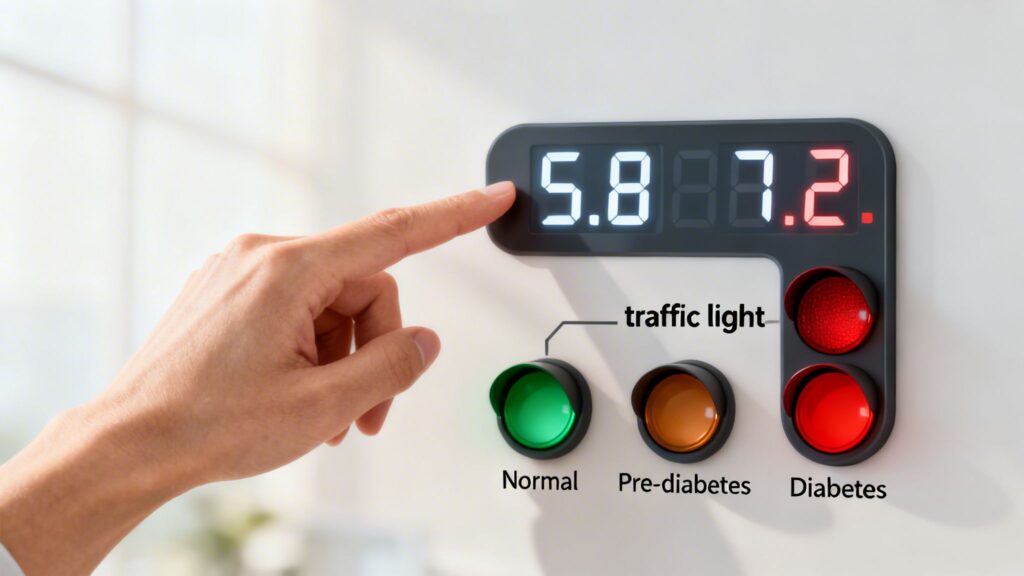
HbA1c ranges in plain English
For HbA1c, UK guidance commonly uses these categories:
- Green: Below the pre-diabetes range
- Amber: 42 to 47 mmol/mol
- Red: 48 mmol/mol (6.5%) or above, which is in the diabetes range and usually needs confirmation with a repeat lab test
If you have an amber result, that does not mean you have diabetes. It means your blood sugar is running higher than ideal and deserves attention.
If you have a red-range result, do not panic. It does mean you should speak to a GP promptly to confirm the diagnosis and discuss next steps.
Fasting and OGTT results
For glucose-based tests, UK diagnostic guidance includes these diabetes thresholds:
- Fasting plasma glucose: 7.0 mmol/L or above
- 2-hour OGTT result: 11.1 mmol/L or above
These are laboratory thresholds used for diagnosis in the right clinical context.
Why amber results matter
Many people wrongly assume that only a diabetes-range result counts. In reality, the amber zone is often where you have the best opportunity to act early.
That matters because pre-diabetes affects about 1 in 9 adults in England, which is 12% or about 5.1 million people, and around 30% of adults with type 2 diabetes remain undiagnosed. Among adults aged 16 to 44 who do have type 2 diabetes, 50% are undiagnosed. These figures appear in the government’s diabetes profile statistical commentary for March 2025.
A simple way to read your result
Here is a practical way to respond:
- Green result: Keep doing the basics well. Healthy eating, movement, weight management if relevant, and periodic retesting if your risk is ongoing.
- Amber result: Treat it as an early warning. Book a GP discussion or review your lifestyle carefully. This is often the stage where change can make a real difference.
- Red result: Arrange medical follow-up. You need proper interpretation and usually a confirmatory pathway.
Key takeaway: A test result is not a moral verdict. It is a health signal. The useful question is, “What does this tell me to do next?”
One example
If your HbA1c comes back at 44 mmol/mol, that sits in the pre-diabetes range. It is not the same as a confirmed diabetes diagnosis. But it is also not something to ignore. That result would usually justify a conversation with your GP and a plan for repeat testing and lifestyle review.
If your HbA1c is 50 mmol/mol, you need formal medical follow-up because that is in the diabetes range and should be checked in line with UK diagnostic guidance.
NHS vs Private At-Home Testing Pathways
People often ask the same question in different ways. Should I wait for my GP? Is a home test good enough to start with? Which route makes sense if I am worried but not acutely unwell?
The honest answer is that both pathways have strengths.
What the NHS route usually looks like
With the NHS, the process often starts with a GP appointment or practice review. The clinician asks about symptoms, family history, weight, previous blood results, and other risk factors. They may then arrange a blood test.
This route makes most sense when:
- You have symptoms that need medical assessment
- You may need diagnosis and treatment, not just screening
- You want your testing built directly into your ongoing NHS care
The biggest advantage is clinical continuity. Your GP can interpret the result in context and decide what should happen next.
The downside is practical. Appointments, blood draws, and follow-up can take time, and some people delay testing because organising it feels difficult.
What private at-home testing offers
At-home testing is usually simpler in day-to-day life. You order a kit, collect a finger-prick sample, send it to a laboratory, and review your result privately online.
That route tends to suit people who:
- Want a convenient baseline check
- Prefer privacy
- Need a practical way to monitor between GP visits
- Do not want to wait before taking a first step
If you want to understand the general process, this overview of private blood test at home options is a useful starting point.
One practical example is the Repose Healthcare HbA1c test, which uses a finger-prick sample collected at home and sent to a UK-accredited laboratory for analysis. That type of test does not replace a GP when diagnosis or treatment is needed, but it can help you spot a problem early or monitor trends between appointments.
Side-by-side comparison
| Pathway | Main strengths | Main limitations | Often best suited to |
|---|---|---|---|
| NHS testing | Clinical assessment, diagnosis, treatment planning | Less convenient for some people, may involve appointments and waiting | Strong symptoms, complex cases, follow-up after abnormal results |
| Private at-home testing | Convenience, privacy, quick first step, useful for monitoring | You may still need GP confirmation and treatment planning | Proactive screening, repeat checks, people who value ease and discretion |
Access is not equal for everyone
This choice is not just about convenience. Access can vary by background and experience of care.
A UK study highlighted significant ethnic disparities in access to diabetes technology such as continuous glucose monitoring through the NHS. The summary reports lower CGM prescription rates for black and south Asian people and notes that ethnicity and deprivation explain a large share of the variation in type 2 prescribing. You can read that in the report on ethnic disparities in access to diabetes technology in England.
For some people, that makes private testing more than a convenience purchase. It becomes a way to get data about their health without depending entirely on a system that may not feel equally accessible.
Tip: If you have severe thirst, weight loss, vomiting, drowsiness, or feel acutely unwell, skip the home-testing debate and seek urgent medical advice.
A sensible way to decide
Use the NHS when you need medical assessment. Use at-home testing when you need a practical first answer, ongoing monitoring, or a private route to information.
They do not have to compete. Many people use both.
How to Prepare and Collect Your Sample Correctly
A good test is only useful if the sample is collected properly. That is where many people lose confidence, especially with finger-prick blood tests.
The good news is that most problems come from a few fixable mistakes. Cold hands, rushing, squeezing too hard, or not reading the instructions fully are the usual culprits.
If your test needs fasting
Some diabetes tests need you to fast. That usually means no food for the required period before your blood sample. Water is generally allowed, but follow the instructions for your specific test or appointment.
Fasting matters because the test is trying to measure your blood sugar without the immediate effect of a recent meal.
For at-home finger-prick tests
HbA1c home tests are often easier because they usually do not require fasting. Still, sample quality matters.
Use this checklist:
- Read the instruction leaflet first: Do this before you open everything. It sounds obvious, but it prevents most avoidable errors.
- Warm your hands: Wash them in warm water and dry them well. Warm fingers produce blood more easily.
- Choose the side of a fingertip: This is often more comfortable than the centre.
- Stand up or let your hand hang down briefly: Gravity can help blood flow.
- Do not over-squeeze: Gentle pressure is fine. Hard squeezing can make collection harder.
- Fill the sample as instructed: Too little blood can mean the lab cannot process it.
- Package and post it promptly: Delays can affect the sample.
Common reasons samples fail
A few patterns come up again and again:
- Cold fingers: Blood flow is poor.
- Tiny drops collected too slowly: The sample may not be enough.
- Touching the collection area too much: This can interfere with the sample.
- Leaving the kit unposted: Even a well-collected sample needs to reach the lab correctly.
Practical tip: Set up everything on a clean table before you prick your finger. Open the return packaging, place the lancet, sample device, and instructions in order, and only then start.
If you struggle with finger-prick tests
Some people find them fiddly the first time. That does not mean home testing is not for you.
Try this approach:
- Pick a calm time of day: Not when you are rushing out the door.
- Hydrate normally beforehand: Being well hydrated can help.
- Ask someone to sit with you: Not to do it for you, but to help you stay organised.
- Order a replacement if needed: A failed first attempt is frustrating, but it happens.
Lab-based venous blood testing may suit you better if you strongly dislike finger-prick collection or have difficulty getting a sample.
After Your Results What Are the Next Steps?
People often focus so much on getting tested that they forget the more important part. What you do with the result.
A result should lead to a decision. Not just a feeling.
If your result is in the normal range
This is reassuring, but it is not a free pass forever. If you tested because of family history, weight concerns, previous borderline results, or ongoing symptoms, keep your habits under review.
Useful next steps include:
- Keep a note of the result: It becomes your baseline.
- Look at patterns, not perfection: Eating, sleep, movement, and weight trends matter.
- Repeat testing when appropriate: Especially if your risk factors remain.
If your result suggests pre-diabetes
This is the stage where many people can make meaningful changes. It is a warning sign, not a sentence.
Your GP may discuss lifestyle support and local prevention options. You can also use repeat testing over time to see whether your efforts are moving you in the right direction.
A practical response often includes:
- Book a GP review: Especially if this is your first abnormal result.
- Look closely at everyday eating habits: Focus on consistency rather than crash diets.
- Increase regular movement: Walking after meals, resistance exercise, and routine activity all help.
- Track over time: Rechecking later can show whether your blood sugar exposure is improving.
If your result is in the diabetes range
A result in the diabetes range should lead to formal medical follow-up. In the UK, diagnosis is usually confirmed in line with laboratory guidance rather than based on a single home result alone.
Do not sit on the result because you feel well. You need a GP to confirm the diagnosis, assess symptoms, and talk through treatment and monitoring.
Key takeaway: Home testing can start the conversation. It should not end it when the result is clearly abnormal.
What ongoing NHS care often includes
If you are diagnosed with diabetes, monitoring becomes part of routine care. Annual NHS diabetes health checks include HbA1c, cholesterol, and kidney function tests such as eGFR and ACR, as outlined in Diabetes UK information shared by Greater Manchester Integrated Care.
That same information also notes common self-monitoring targets of 4 to 7 mmol/L fasting and less than 8.5 mmol/L after meals for people who are checking blood glucose at home.
How self-monitoring fits in
Self-monitoring is useful when it answers a question. For example:
- Are your levels changing after you started new habits?
- Are your readings stable between appointments?
- Are you noticing patterns with meals or medication?
Monitoring without a plan can become stressful. Monitoring with a purpose helps you and your clinician make better decisions.
How to Choose the Right Diabetes Test for You
When deciding, many individuals want a straight answer to this question. Not every test suits every person.
The easiest way to decide is to match the test to your situation.
If this sounds like you
-
You have no symptoms, but you have risk factors
Consider an HbA1c test. It is often the most practical baseline because it reflects your average blood sugar over time rather than one moment.
-
You want convenience and privacy
A home HbA1c kit can make sense. If you are comparing options, the Repose Healthcare HbA1c test is one example of a finger-prick at-home test processed by a UK-accredited laboratory.
-
You have symptoms such as excessive thirst, frequent urination, blurred vision, or unexplained weight loss
Book a GP appointment urgently. Symptoms change the decision. You need clinical assessment, not just a screening result.
-
You were told before that your blood sugar was borderline
Repeat testing is sensible. HbA1c is often useful for tracking the bigger picture over time.
-
You are pregnant, or there is a reason HbA1c may not be reliable for you
Speak to your clinician about a glucose-based test instead. In some situations, HbA1c is not the right diagnostic tool.
A simple decision rule
Use this quick rule of thumb:
- Need diagnosis and treatment planning: NHS first
- Need a fast baseline or private check: at-home HbA1c can be a sensible first step
- Need ongoing monitoring between appointments: home testing can complement NHS care
- Need urgent help because you feel unwell: seek medical advice now
The goal is clarity, not collecting tests
The best test is the one that answers your actual question.
If your question is, “Am I likely to have a blood sugar problem?” an HbA1c test is often a strong first move. If your question is, “Why do I feel unwell right now?” you need a clinician, not just a kit.
Choose the route that gets you to action. That is what makes testing useful.
If you want a convenient way to check your blood sugar from home, Repose Healthcare offers private at-home testing with clear instructions, UK-accredited laboratory processing, and secure online results. It can be a practical option if you want an HbA1c baseline, a repeat check, or a private first step before speaking with your GP.

You Might Also Like
STI Test Kit at Home: How It Works and What to Expect
You've had condomless sex with a new partner, feel completely well, and are now deciding [...]
Fertility Blood Test Day 3: What to Expect
You've booked your first fertility appointment, but one phrase on the instructions keeps bothering you: [...]
Home Liver Function Test: What Results Mean
You've opened the results from a home liver function test and found a mildly raised [...]
Glucose Tolerance Test at Home: What You Need to Know
A true diagnostic oral glucose tolerance test in the UK is usually a supervised clinic [...]
At Home PSA Test: Accuracy, Process, and UK Guidelines
You notice that you're urinating more often, your stream seems weaker, or you want a [...]
A1C Blood Test UK: What It Measures and How to Get One
You've just opened a private or at-home A1C blood test UK result and found two [...]
STI Screening for Men: What to Test and When
You've recently ended a relationship, ordered an STI test kit online, and now you're staring [...]
Fertility Testing Before Trying to Get Pregnant: Key Info
You and your partner may have chosen a rough timeline, checked your finances and started [...]
Nutrition Testing Kit: What It Measures and Why It Matters
You're doing the sensible thing, eating reasonably, trying to sleep, and still feeling flat. That's [...]
Private Coeliac Testing UK: A Practical Patient Guide
You've been bloated after pasta for months. You've searched “coeliac symptoms”, noticed the fatigue and [...]
STI Test Kit Price Guide for UK Home Testing
Private STI test kits in the UK usually start at about £29 to £30 for [...]
Sexual Health Screening: Your Guide to 2026
You're often here for a very ordinary reason that suddenly feels loaded. A new partner. [...]
Pregnancy Screening Tests Private: Your UK Guide
You've had a positive pregnancy test, the NHS booking appointment is still ahead, and your [...]
What Is Glucose Tolerance Test and How It Works
A glucose tolerance test is a two-hour challenge test: after an overnight fast, your fasting [...]
Blood Test for Night Sweats What to Check and When
You wake in the early hours with damp nightwear, wet sheets and a racing mind. [...]
The 2026 Cost of Hepatitis Vaccination in the UK
You're usually looking up the cost of hepatitis vaccination for a practical reason. A trip [...]
Hormone Blood Test London: Find Your Perfect Test
Some London health questions start subtly. Your cycle changes a little. You feel wired at [...]
Peanut Allergy Test Kit: A Practical UK User’s Guide
A peanut reaction often starts with uncertainty, not clarity. You eat a biscuit, satay sauce, [...]
NIPT Test Edinburgh: Your 2026 Guide
If you're searching nipt test edinburgh, you're probably already in that familiar stage of pregnancy [...]
Peripheral Artery Disease UK: Peripheral Artery Disease UK:
You might be reading this because walking has started to feel different. Perhaps your calf [...]
NIPT Test Cardiff: Clinic, Home & NHS Pathways 2026
If you're in Cardiff, newly pregnant, and staring at screening options that all seem to [...]
Gender Scan Difference UK: Accuracy, Timing & Cost Compared
You've probably already done the same search most parents do. One tab shows the NHS [...]
NIPT Test Cambridge: Guide to Options & Booking 2026
You're in Cambridge, you've had the first rush of finding out you're pregnant, and then [...]
Home COVID Test Results: A Practical UK & Ireland Guide
You've done the swab, mixed the sample, added the drops, and now you're staring at [...]
DVT Test Squeeze Calf: Homan’s Sign & Beyond
You notice one calf is sore, a little swollen, and not behaving like an ordinary [...]
Your Guide to Every Travel Clinic Leicester Offers in 2026
Flights are booked. The hotel is sorted. Your passport is still in date. Then one [...]
13 Week Gender Scan: Accuracy, NIPT & What to Expect
By the time you reach 13 weeks, pregnancy often starts to feel more real in [...]
Your Pregnancy Scan London: Guide to Options & Costs
A positive test can make London feel suddenly very small and very complicated. You might [...]
Your Nuchal Dating Scan Explained: A 2026 UK Guide
That appointment message has landed in your phone or come through the post, and suddenly [...]
Normal Cortisol Levels UK: Get Clarity
Some people search for normal cortisol levels uk after weeks of feeling unlike themselves. They’re [...]