
NIPT Test Sheffield: Your 2026 Guide to Options & Costs
You've had the booking confirmation for your early pregnancy appointment. You're checking dates, comparing clinics, and trying to work out whether the standard NHS pathway will feel enough or whether a private test would give you answers sooner. At the same time, you're probably juggling the usual first-trimester mix of excitement, nerves, and too much conflicting information.
That's where NIPT often enters the conversation.
For many Sheffield parents, a search for NIPT test Sheffield starts with one simple question: “Should I have it?” Very quickly, that turns into several others. What does it test for? How early can you do it? Is private better than NHS? If a result comes back high chance, what happens next? Those practical questions matter far more than the marketing language you'll often see online.
A useful way to think about NIPT is this. It's an early screening test that can give you clearer information than older screening approaches, using a blood sample from you rather than anything invasive around the pregnancy. It can be done early in pregnancy, which is one reason so many people consider it when waiting feels especially hard.
Parents in Sheffield are often choosing between two real-world routes. One is the NHS pathway, usually after an earlier screening result suggests a higher chance. The other is private testing, where you can usually self-book from early pregnancy if that suits your needs better. Both routes can be appropriate. The right choice depends on your timing, your anxiety level, your budget, and what kind of follow-up support you want if the result raises concern.
Your Guide to NIPT in Sheffield
Sarah is ten weeks pregnant, lives in Sheffield, and has already spent an evening reading three clinic websites, two parenting forums, and a hospital leaflet. One page says NIPT is “highly accurate”. Another says it's “only a screening test”. A third mentions private booking, but says very little about what happens if the result isn't reassuring.
That confusion is common.
Why this decision can feel harder than it should
In early pregnancy, almost everything seems urgent and unclear at the same time. You may be waiting for your booking appointment, deciding whether to pay privately for extra reassurance, or trying to understand a result from combined screening. The emotional part and the medical part get tangled together very quickly.
NIPT stands for Non-Invasive Prenatal Testing. In plain terms, it's a blood test taken from the pregnant woman that looks at tiny DNA fragments in the bloodstream to estimate the chance of certain chromosomal conditions. In the UK, it became established as an early pregnancy blood test partly because it can be done from around 9 to 10 weeks, carries no risk of miscarriage, and is more accurate than some other screening tests, according to the Nuffield Council on Bioethics guidance on non-invasive prenatal testing.
Practical rule: If you want earlier information without an invasive procedure, NIPT is often the test people compare first.
What Sheffield parents usually want to know
The question isn't merely what NIPT is. It's really asking:
- Can I get it early enough? You usually want answers before the wait starts to feel overwhelming.
- Do I need it if I'm already under NHS care? Sometimes yes, sometimes no. It depends on your pathway and what information you're hoping to get.
- Will a private result help me decide what to do next? Often it can, but only if you understand the next step after the result.
- If the result is high chance, where do I go in Sheffield? That's one of the most important practical questions, and many simple clinic pages don't answer it well.
The most useful approach is to think of NIPT as part of a pathway, not just a standalone test. Booking is only the beginning. Understanding timing, options, and follow-up is what helps you make a calm, informed choice.
What Is NIPT and Who Is It For
NIPT works by analysing cell-free DNA, often shortened to cfDNA, in a blood sample from the pregnant woman. A simple analogy helps here. Think of your bloodstream as carrying tiny snippets of a baby's instruction manual mixed in with your own. The test looks at those fragments and uses them to estimate whether certain chromosome patterns are more likely.
It's important that the blood test is taken from you, not from the baby. No needle goes near the pregnancy itself.

What NIPT usually screens for
In UK practice, NIPT is mainly used to screen for the three common trisomies:
- Down's syndrome, also called Trisomy 21
- Edwards' syndrome, also called Trisomy 18
- Patau's syndrome, also called Trisomy 13
Some private providers also offer screening for sex chromosome differences and wider panels. That broader scope can sound appealing, but it also means you need to understand what each panel does and does not reliably tell you.
When you can have it
NIPT can be performed from as early as 10 weeks' gestation, and results from a single maternal blood draw are typically returned within 7 to 10 working days, according to the Nuffield Council on Bioethics overview of NIPT timing. For many people, that early timing is the main attraction. It can bring reassurance sooner than some traditional screening routes.
Who tends to consider a NIPT test in Sheffield
Some people seek NIPT after an NHS combined screening result suggests a higher chance. Others choose it because uncertainty feels difficult and they want earlier information. You might recognise yourself in one of these situations:
- You've had a higher-chance screening result and want a more refined next screening step.
- You've had a previous pregnancy with a chromosomal condition and want more information early on.
- You want earlier reassurance than standard screening offers.
- You prefer private testing because you'd like to self-book from around ten weeks rather than wait for NHS eligibility.
- You're comparing clinics in Sheffield or nearby areas and trying to decide whether the private route fits your priorities.
NIPT can feel more straightforward once you stop thinking of it as a “pregnancy blood test” and start seeing it as a focused screening tool with a specific purpose.
The best candidates for NIPT aren't defined only by medical history. They're also defined by what kind of information would help them at this stage of pregnancy.
Understanding NIPT Accuracy and Limitations
The single biggest misunderstanding about NIPT is this. It is a screening test, not a diagnostic test.
A good analogy is a very advanced smoke alarm. If it goes off, you take it seriously. But the alarm itself hasn't confirmed where the fire is, how big it is, or whether there even is one. A diagnostic test is the person who goes in and checks directly.
Why people trust the test
NIPT is valued because it performs very well for the main trisomies. UK NHS genomics guidance describes it as a maternal-blood screening assay using cell-free DNA rather than a diagnostic test. That guidance also notes that, for the main trisomies, published sensitivity is typically more than 90% and specificity more than 99%, with a reported false-positive rate for Trisomy 21 of around 0.10% in one cited study, compared with around 5% for traditional nuchal translucency and serum-marker screening in that comparison, as outlined in the NHS Genomics Education knowledge hub on NIPT.
If you want a deeper breakdown of what test performance terms mean in plain English, this guide on NIPT test accuracy is a helpful companion.
What a high-chance result really means
Positive predictive value, or PPV, then becomes useful. PPV asks a practical question: if the test says high chance, how likely is that to be correct?
In a large UK audit, the positive predictive value for Trisomy 21 was about 98%, while for sex chromosome aneuploidies it could be around 50%, according to the UK audit published on PMC. The same audit found 1,638 of 1,831 singleton pregnancies with high-chance NIPT results were confirmed to have genomic imbalance after follow-up invasive testing, and Trisomy 21 was confirmed in 1,305 of 1,329 invasive samples taken after a high-chance T21 result.
That difference matters. A high-chance result for one condition doesn't behave exactly like a high-chance result for another.
Key point: NIPT is excellent at refining risk. It does not replace confirmatory testing when the result is high chance.
Where readers often get confused
People often hear “very accurate” and assume “certain”. That's understandable, but they're not the same. NIPT reduces uncertainty far better than older screening methods for some conditions, yet a positive result still needs to be confirmed before any irreversible decision is made.
That's not a flaw in the test. It's the difference between screening and diagnosis.
NHS vs Private NIPT Options in Sheffield
You might be ten weeks pregnant, trying to compare clinics on your phone after work, and asking a very practical question. Should you wait and follow the NHS screening pathway, or pay for a private NIPT test in Sheffield now?
That choice often feels bigger than the test itself, because you are not only choosing how to access screening. You are also choosing how quickly you get information, how much you pay, and what support you will want if the result raises more questions.
How the NHS route usually works
In Sheffield, the NHS pathway is usually linked to your standard antenatal screening rather than offered to everyone as a first test. In simple terms, the NHS process works a bit like a stepped filter. Your earlier screening result helps decide whether NIPT is offered as the next screening step for conditions such as T21, T18, and T13.
That structure suits many parents because it sits inside their existing maternity care. Your midwife, hospital team, and any later referrals are already connected. If you like having one joined-up route, that can feel reassuring.
Some parents also want to understand how patient views shape NHS services over time. If that matters to you, this guide on how to get involved with NHS is a useful starting point.
How private testing differs
Private NIPT is usually available from around 10 weeks, and you can often book it directly without waiting for an NHS screening result first. That gives you more control over timing, which can matter if waiting is likely to make the first trimester feel longer and more stressful.
Private care also gives you more choice, but more choice is not always simpler. Some clinics offer wider panels, different brands of test, and different levels of explanation. A useful way to compare them is to ask, “If my result is high chance or unclear, who speaks to me next, and what happens after that?”
Cost is part of the decision too. If you want a clearer picture of pricing and what is usually included, this guide to NIPT test costs in Sheffield and what affects the price can help.
NIPT in Sheffield NHS pathway vs private option
| Factor | NHS NIPT Pathway | Private NIPT Option |
|---|---|---|
| Eligibility | Usually offered after a higher-chance initial NHS screening result | Usually self-booked from early pregnancy |
| Cost to you | Free within the NHS pathway | Paid for privately |
| What it usually screens for | Common trisomies such as T21, T18, and T13 | Often common trisomies, sometimes wider panels depending on clinic |
| Booking process | Through NHS maternity care and screening pathway | Direct booking with a private clinic |
| Timing | Depends on your NHS screening timeline and referral process | Often available from around ten weeks, depending on provider |
| Follow-up after a high-chance result | Managed within NHS referral and diagnostic services | Private results usually still lead back into NHS fetal medicine for confirmatory follow-up |
| Best suited to | Parents happy to follow the standard NHS sequence | Parents who want earlier access, more flexibility, or different test options |
A practical way to choose
A good decision usually comes down to your priorities, not to a single “best” route.
If joined-up NHS care matters most, and you are comfortable with the standard screening sequence, the NHS pathway may feel right for you. If earlier information would ease anxiety, or if timing matters because of work, travel, childcare, or previous pregnancy experience, private testing may be the better fit.
Try to judge each option by one final question. If the result is not the one you hoped for, will you know exactly who to call and what happens next?
That is where good support matters. Repose Healthcare can help you think through the wider pregnancy wellbeing picture, so you are not only choosing a test, but also choosing a path that feels clear, supported, and manageable.
How to Arrange a Private NIPT Test in Sheffield
Private booking is usually straightforward, but a little preparation can save you stress later. Many people focus on price first. A better approach is to check quality, clarity, and follow-up before you pay.
What to look for when comparing clinics
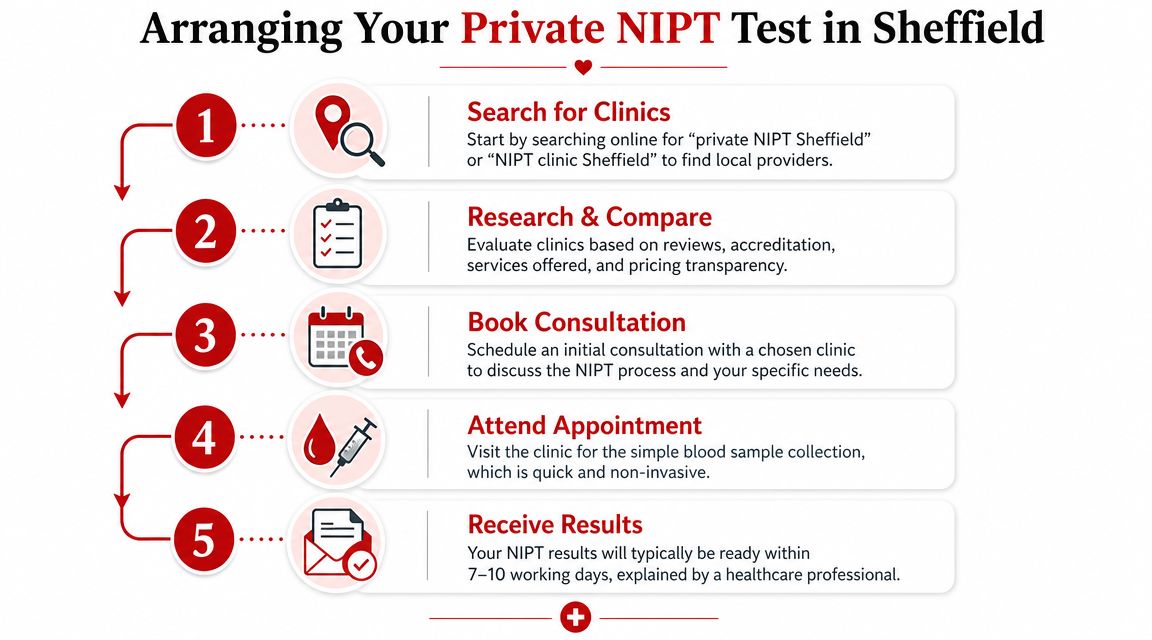
If you're searching online, try terms like “private NIPT Sheffield” or “NIPT clinic Sheffield”. Then look beyond the headline claims.
Check for:
- Clear pricing so you know whether the quoted fee includes consultation, blood draw, and laboratory analysis
- Transparent test details including the name of the NIPT brand or laboratory used
- Clinical governance information such as CQC registration where relevant
- A stated result pathway so you know who will contact you and what happens if the result is high chance
- Location and travel practicality especially if you're balancing work, childcare, or pregnancy symptoms
A clinic that explains these points clearly is usually easier to deal with if anything unexpected comes up.
What the appointment usually involves
Most private NIPT appointments follow a simple sequence:
Initial discussion
You'll usually review your gestation, medical background, and what the test can screen for.Consent and package choice
At this point, you should ask exactly what is included, especially if the clinic offers several panel options.Blood sample collection
The test itself is just a maternal blood draw and is usually quick.Laboratory processing
The sample is sent to the chosen laboratory for analysis.Results communication
You're then contacted with the result and told what the next step is, if any.
For a fuller overview of what private testing can involve, this page on private NIPT test options may help.
Ask one direct question before booking: “If my result is high chance, who explains it to me, and how do I access follow-up care in Sheffield?”
Small details that make a big difference
A smooth private experience often comes down to practicalities rather than the blood test itself.
- Confirm gestation first: Make sure you'll be at the right stage of pregnancy on the day of testing.
- Check turnaround expectations: Clinics often quote results in working days, not calendar days.
- Ask about redraws: Sometimes a sample may need repeating, so it helps to know the clinic's policy.
- Find out who calls with results: A named clinician or trained team member is more reassuring than a generic message.
If a website makes booking look easy but says very little about results counselling, that's a sign to ask more questions before going ahead.
After the Test Understanding Your NIPT Results
You get the message that your result is ready. For a moment, everything else stops. Then you open it and see wording like low chance or high chance, and the next question arrives straight away. What happens now?

This part matters just as much as the blood test itself. NIPT gives a probability result, a bit like a weather forecast. It can tell you whether something looks unlikely or whether it needs closer checking, but it does not give the final answer on its own.
If your result is low chance
A low-chance result means the test found a much lower likelihood of the chromosome conditions it screened for. For many parents, that brings real relief.
It helps to read this result as reassuring rather than absolute. A low-chance result does not rule out every condition, and it does not replace your routine scans, midwife appointments, or any other care already planned. It means the specific conditions screened for look much less likely.
In practical terms, your next steps are usually simple. Keep attending your usual antenatal care, go to your scheduled scans, and raise any new symptoms or concerns in the normal way.
If anything in the wording is unclear, ask for the result to be explained in plain language. You should not have to interpret medical phrasing on your own.
If your result is high chance
A high-chance result needs careful follow-up. It suggests a higher likelihood of the condition screened for, but it does not confirm that your baby has that condition.
The most useful way to read it is this: the screening test has raised a flag, and the flag now needs checking properly. The next step is usually a conversation with a specialist team about diagnostic testing, such as CVS or amniocentesis, which can give a clearer answer.
If you had your NIPT privately in Sheffield, follow-up care often links back into the NHS pathway. That may mean referral to a fetal medicine team, often through services connected with the Jessop Wing, so you can talk through what the result means, what tests are available, and how timing fits with your stage of pregnancy. As noted earlier, NHS practice has increasingly built NIPT into follow-up pathways rather than treating it as a final answer.
That appointment is usually the point where decisions become more specific. You can ask what condition is being screened for, how strong the signal was, what diagnostic test is being offered, what the risks are, and how long results are likely to take.
A high-chance result means further checking is needed.
What to do in the first 24 hours after a result
Parents often feel pressure to understand everything immediately. You do not need to solve the whole situation in one conversation.
A calmer approach usually helps more:
- Ask for a phone call or appointment with a clinician if the result was sent by message or email.
- Write down the exact wording of the result so you can refer to it accurately.
- Make a short list of questions for your next appointment.
- Bring your partner, a family member, or a friend if you want support hearing information clearly.
- Ask about timescales for referral, diagnostic testing, and further results.
Small practical steps can make an overwhelming day feel more manageable.
Questions worth asking after any NIPT result
You do not need to ask all of these, but having a few ready can help:
- What exactly was screened for?
- Is this result low chance, high chance, or inconclusive?
- Do I need any further tests?
- Who will explain the next step to me in Sheffield?
- How quickly do I need to decide?
- Should my routine maternity appointments continue as planned?
These questions help turn a worrying result into a clearer plan.
If the result is inconclusive or the sample needs repeating
Sometimes the result is not usable, often because there was not enough fetal DNA in the sample. That can happen without meaning anything is wrong. It usually means the laboratory could not make a reliable call from that blood sample.
If this happens, ask whether you need a repeat blood test, how soon it can be done, and whether there are any extra costs if you tested privately. You can also ask what the backup plan is if a repeat sample still does not produce a result.
Looking after yourself while you wait
Waiting can be the hardest part. Some parents want every detail straight away. Others need one clear explanation and a bit of time. Both are completely understandable.
Try to keep your focus on the next decision, not every possible outcome. Eat, rest, attend your usual appointments, and lean on the people who help you feel steady. If broader pregnancy wellbeing is also on your mind, some parents look at areas like iron, vitamin D, or thyroid health through their usual care or separate testing where appropriate. Repose Healthcare can be a useful resource for that wider picture of pregnancy wellness, alongside the screening and maternity care you are already receiving.
Common Questions About NIPT
| Question | Answer |
|---|---|
| How early can I have a NIPT test in Sheffield? | NIPT can usually be done from around ten weeks of pregnancy, depending on the provider and your exact gestation. |
| Is NIPT the same as a diagnostic test? | No. It's a screening test that estimates chance. A high-chance result needs confirmatory testing such as CVS or amniocentesis. |
| Can I get NIPT on the NHS in Sheffield? | You may be offered it within the NHS pathway after a higher-chance initial screening result. It isn't usually the first test offered to everyone. |
| Can I book privately without an NHS referral? | In many cases, yes. Private clinics commonly allow direct booking from early pregnancy. |
| Does a low-chance result mean everything is ruled out? | No. It greatly reduces the likelihood of the conditions screened for, but it doesn't rule out every possible condition or replace routine pregnancy care. |
| What should I ask a private clinic before booking? | Ask what panel is included, what the quoted price covers, how results are explained, and what support is available if the result is high chance. |
If you're looking beyond prenatal screening and want a convenient way to stay on top of your wider health during pregnancy, Repose Healthcare offers UK-based at-home testing for areas such as vitamins, thyroid health, hormones, and general wellness. It's a practical option when you want clear, clinically reliable insights from home, alongside the advice you receive from your maternity team.
You Might Also Like
NIPT Test Sheffield: Your 2026 Guide to Options & Costs
You've had the booking confirmation for your early pregnancy appointment. You're checking dates, comparing clinics, [...]
Private Scan London: 2026 Guide to Costs & Booking
You wake up with the same worry you had last week. The pelvic pain is [...]
The 2026 Cost of Hepatitis Vaccination in the UK
You're usually looking up the cost of hepatitis vaccination for a practical reason. A trip [...]
Hormone Blood Test London: Find Your Perfect Test
Some London health questions start subtly. Your cycle changes a little. You feel wired at [...]
Peanut Allergy Test Kit: A Practical UK User’s Guide
A peanut reaction often starts with uncertainty, not clarity. You eat a biscuit, satay sauce, [...]
NIPT Test Edinburgh: Your 2026 Guide
If you're searching nipt test edinburgh, you're probably already in that familiar stage of pregnancy [...]
Peripheral Artery Disease UK: Peripheral Artery Disease UK:
You might be reading this because walking has started to feel different. Perhaps your calf [...]
NIPT Test Cardiff: Clinic, Home & NHS Pathways 2026
If you're in Cardiff, newly pregnant, and staring at screening options that all seem to [...]
Gender Scan Difference UK: Accuracy, Timing & Cost Compared
You've probably already done the same search most parents do. One tab shows the NHS [...]
NIPT Test Cambridge: Guide to Options & Booking 2026
You're in Cambridge, you've had the first rush of finding out you're pregnant, and then [...]
Home COVID Test Results: A Practical UK & Ireland Guide
You've done the swab, mixed the sample, added the drops, and now you're staring at [...]
DVT Test Squeeze Calf: Homan’s Sign & Beyond
You notice one calf is sore, a little swollen, and not behaving like an ordinary [...]
Your Guide to Every Travel Clinic Leicester Offers in 2026
Flights are booked. The hotel is sorted. Your passport is still in date. Then one [...]
13 Week Gender Scan: Accuracy, NIPT & What to Expect
By the time you reach 13 weeks, pregnancy often starts to feel more real in [...]
Your Pregnancy Scan London: Guide to Options & Costs
A positive test can make London feel suddenly very small and very complicated. You might [...]
Your Nuchal Dating Scan Explained: A 2026 UK Guide
That appointment message has landed in your phone or come through the post, and suddenly [...]
Normal Cortisol Levels UK: Get Clarity
Some people search for normal cortisol levels uk after weeks of feeling unlike themselves. They’re [...]
How to Test Iron Levels in Blood: A Complete UK Guide
You’re probably not searching how to test iron levels in blood out of curiosity. More [...]
Growth Scan Pregnancy: UK Guide & What to Expect
You’re at an antenatal appointment, everything seems routine, and then your midwife says, “We’d like [...]
Gender Scan Near Me: Your 2026 Guide to Options
You’re probably here because the question has stopped feeling abstract. Maybe you’ve had your booking [...]
Progesterone Test For Pregnancy: Viability & Home Kit
The positive test is there, but relief doesn’t always follow. For many women, early pregnancy [...]
Ovulation Blood Tests: Confirm Your Ovulation
You’ve probably already done some version of this. You’ve checked an app, watched for a [...]
How to Test Testosterone Levels: A UK Guide
You wake up tired, despite a full night in bed. Your training feels flat. Your [...]
UK Vitamin D Test: A Complete At-Home Guide for 2026
You wake up tired, even after a full night’s sleep. By mid-afternoon you’re reaching for [...]
Blood Iron Level Test: A Complete UK Guide for 2026
Some days it isn’t dramatic. You’re just slower than usual. You wake up after a [...]
Cortisol Levels Test: Your Comprehensive UK Guide
You wake up tired, push through the morning on caffeine, feel oddly tense by midday, [...]
Travel Clinic Leeds: Compare 7 Top Options For 2026
You book the flights first. Then the practical questions start. Is a tetanus booster enough [...]
Private Blood Test Leicester: A Complete 2026 Guide
You wake up tired again. Maybe you’ve had weeks of bloating, odd fatigue, headaches, low [...]
Genetic Testing Before Pregnancy: A UK Guide for 2026
You might be at the stage where baby plans still live in half-finished conversations. One [...]
Harmony NIPT Test: A Clear Guide for Expectant Parents
You may be sitting with a booking slip from your midwife, a browser full of [...]