
Private Scan London: 2026 Guide to Costs & Booking
You wake up with the same worry you had last week. The pelvic pain is still there. The lump still feels odd. The early pregnancy symptoms don't quite match what you expected. It's not an A&E situation, but it's hard to carry on normally when you don't know what's going on.
That's where the private scan london market often comes in. Not as a luxury add-on, and not as a replacement for proper medical care, but as a practical way to reduce uncertainty. People usually aren't paying for the scan itself so much as paying to shorten the gap between concern and clarity.
The hard part is that booking the scan is only one piece of the journey. You also need to know whether a scan is the right next step, what kind of scan fits the problem, what the appointment will feel like, and what to do with the result afterwards. In many cases, the smartest start isn't imaging at all, but getting some structured information first through symptoms, a GP discussion, or an at-home test that helps narrow the question.
Navigating Health Scans in London
It often starts with a problem that is worrying enough to dominate your week, but not dramatic enough to trigger urgent NHS action. You may be waiting for a GP appointment, waiting for a referral, or sitting with symptoms that are clearly real but still undefined. In London, that is usually the point where people start looking at private scan options.
The reason is simple. Speed changes the experience. A scan can turn a vague fear into a clearer question, and that makes the next decision easier. I have seen this matter most with pelvic pain, early pregnancy concerns, breast changes, abdominal symptoms, and injuries where people need to know whether rest is sensible or whether they need proper treatment.
A private scan is most useful when it sits inside a wider plan. Start by being clear about the question you need answered. If there is a practical first step before imaging, take it. Symptom tracking, a blood test, a pregnancy test, hormone testing, or a simple home kit can sometimes make the scan request more focused and the result easier to act on. For families already sorting through testing decisions, Family Caregiving Kit's guide gives a useful example of how to think about the test itself and the follow-up that comes after it.
One rule helps. Use private imaging to answer a defined clinical question, not to buy general reassurance with no plan attached.
That distinction matters. A well-chosen scan can confirm a cyst, check the location and progress of an early pregnancy, assess a tendon or ligament injury, or help a clinician decide whether same-day treatment is needed. A poorly chosen scan can still leave you with a report you do not understand, no onward referral, and the same anxiety you had before the appointment.
The strongest approach is to treat the whole process as one journey. Get the right background information first, choose the scan that matches the symptom, and know in advance who will review the result with you. If the findings need NHS follow-up, specialist treatment, or urgent assessment, you want that next step lined up before you book.
Understanding Private Scans and When to Use Them
A private scan is diagnostic imaging arranged outside the NHS. It might be done at a private hospital, a specialist imaging centre, or a consultant-led clinic. The actual technologies are the same broad family you'd encounter in mainstream medicine. What changes is access, speed, service model, and sometimes who interprets the result and how that result is handed back to you.
The main reasons people choose private imaging
Individuals booking private scan london services typically fall into one of a few groups:
- They need speed. They don't want to sit with symptoms while waiting for routine imaging.
- They want a second opinion. An NHS finding may need clarification, or symptoms may still not fit the original explanation.
- They want reassurance. This is common in early pregnancy, breast concerns, abdominal symptoms, and musculoskeletal injuries.
- They need a specialist route. Some clinics make it easier to access targeted imaging in a specific area of concern.
That doesn't mean every symptom should go straight to scanning. A scan is most useful when there's a defined clinical question behind it. “I feel off” is harder to scan well than “I have one-sided pelvic pain and need to know if there's a cyst or another pelvic cause”.
Referral, self-referral, and making the request smarter
Some scans can be arranged by self-referral, while others may need a GP or consultant referral depending on the clinic and the type of imaging. That matters because a referral often sharpens the clinical question. It tells the radiology team what they're looking for and why.
A practical way to improve that conversation is to gather basic evidence before you book. Depending on the symptom, that might include a pregnancy test, a hormone panel, a gut-health panel, or a simple symptom diary. If someone has cycle disruption, for example, blood-based hormone information may help decide whether pelvic ultrasound is the best next step or whether the first move should be endocrine review.
A scan is strongest when it answers a focused question. It's weaker when it's used as a substitute for basic clinical triage.
This is especially true in areas where imaging and lab testing overlap. Fertility, thyroid symptoms, digestive complaints, and menopause-related changes often benefit from both. If you're exploring the broader world of testing decisions, including where genetics can fit into family care planning, Family Caregiving Kit's guide is a useful example of how to think through what a test can and can't answer.
When a private scan is useful, and when it isn't
A private scan often makes sense when:
- Symptoms are persistent but not emergency-level
- You already know the body area involved
- The result will change what you do next
- You have a clinician ready to review the outcome, or a clear plan to involve your GP
It's a poor substitute when you have red-flag symptoms that need urgent assessment, or when you're booking from panic without knowing what kind of scan you need. In those situations, the private route can become expensive and fragmented very quickly.
A Guide to Common Scans Available in London
You wake up with a swollen calf, or you have weeks of pelvic pain, or a GP has suggested imaging but the NHS route may take time. At that point, the useful question is not “Which scan sounds most advanced?” It is “Which scan is most likely to answer this specific problem, and what will I do with the result?”
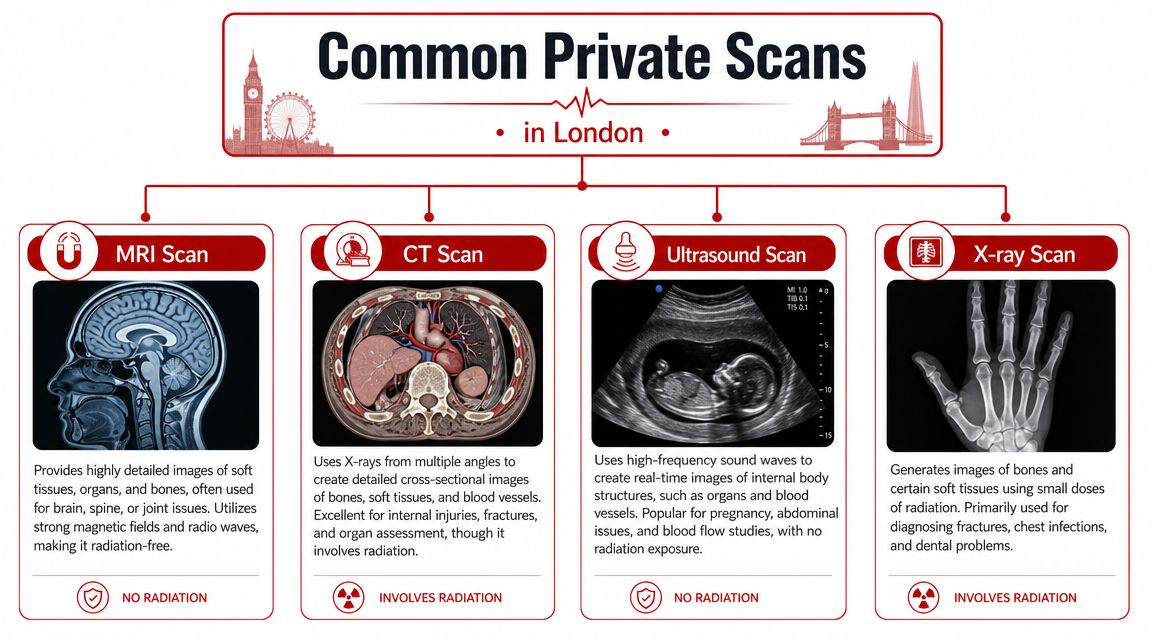
In practice, most private scan choices in London come down to four imaging types. Each has a different job, a different patient experience, and a different limit. Getting that match right saves time, money, and the frustration of paying for a scan that still leaves the main question unanswered.
MRI scan
MRI is usually the best fit for soft tissue detail. It is commonly used for joints, spine, brain, muscles, ligaments, and some organ-related questions where detail matters more than speed. If the issue is a knee injury and the concern is cartilage, ligament, or meniscus rather than a simple break, MRI is often the better choice.
The trade-off is the appointment itself. MRI can feel long, noisy, and enclosed, and some people find the stillness harder than the scan. That matters more than clinics sometimes admit. If claustrophobia, pain when lying flat, or metal implants are part of the picture, it is worth checking suitability before you book rather than on the day.
MRI is good at adding detail. It is less useful as a broad first look when the question is still vague.
CT scan
CT gives a fast cross-sectional view of the body and is often chosen when clinicians need a broad overview quickly. It is commonly used for bones, chest, abdomen, and some urgent internal problems where speed changes decisions.
For the patient, CT is usually straightforward. The scan is brief, and the machine is generally easier to tolerate than MRI. The main trade-off is radiation exposure, so it is chosen when that downside is justified by the clinical question.
This is often where private patients go wrong. They assume faster means better. Sometimes it does. Sometimes a quicker CT still leads to follow-up ultrasound, bloods, or specialist review because the first question was too broad.
Ultrasound scan
Ultrasound is often the most practical starting point in private care. It is widely used for pregnancy, pelvis, abdomen, testicular symptoms, thyroid checks, and vascular concerns. It does not use radiation, and the appointment is usually more approachable than MRI or CT.
The experience is simple. Gel is applied to the skin, a probe is moved over the area, and images are captured in real time. For abdominal scans, pelvic scans, and early pregnancy scans, preparation matters. You may be asked to arrive with a full bladder, avoid food for several hours, or time the appointment around your cycle. Small details like that can make the images more useful and reduce the chance of needing a repeat visit.
Ultrasound also works best when paired with a bit of pre-scan thinking. If symptoms suggest hormonal change, infection, or pregnancy, at-home testing or recent blood work can sharpen the referral question. That can help a sonographer or reporting clinician focus on the right area instead of performing a broad scan that reassures only partly.
In pregnancy care, private ultrasound is often used for reassurance, dating, viability, or later wellbeing checks. A consultant-led London clinic lists pricing for viability scans, combined viability and NIPT options, and later pregnancy scan packages on its private baby scans page. If you want a visual sense of how very early pregnancy scans are commonly discussed and what people expect to see, VirusFAQ insights on 2-month scans are a helpful companion read.
For suspected clot symptoms, a generic scan request is not enough. Swelling, calf pain, tenderness, or sudden asymmetry usually call for a focused vascular pathway such as a private DVT scan in the UK. Specificity matters here because speed only helps if the right test is booked first.
X-ray scan
X-ray remains the simplest imaging option for a narrow set of questions. It is mainly used for bones and chest imaging, and it is often the first choice after a fall, a suspected fracture, or a straightforward chest assessment.
It is quick and familiar. It is also limited.
An X-ray will not answer many soft-tissue, pelvic, abdominal, or early pregnancy questions well, so it is best seen as a targeted tool rather than a general health screen.
| Scan type | Best for | What it feels like |
|---|---|---|
| MRI | Soft tissue, spine, joints, brain | Longer, noisy, very still |
| CT | Broad internal overview, some urgent assessments | Quick, brief, uses radiation |
| Ultrasound | Pregnancy, pelvic, abdominal, vascular imaging | Real-time, gel on skin, no radiation |
| X-ray | Bones and chest | Very quick, simple positioning |
Private Scan Costs and Wait Times in 2026
You wake up with a new symptom, call your GP, and realise the hardest part may be the wait rather than the scan itself. That is why people usually ask two questions first. What will this cost, and how soon can I be seen?
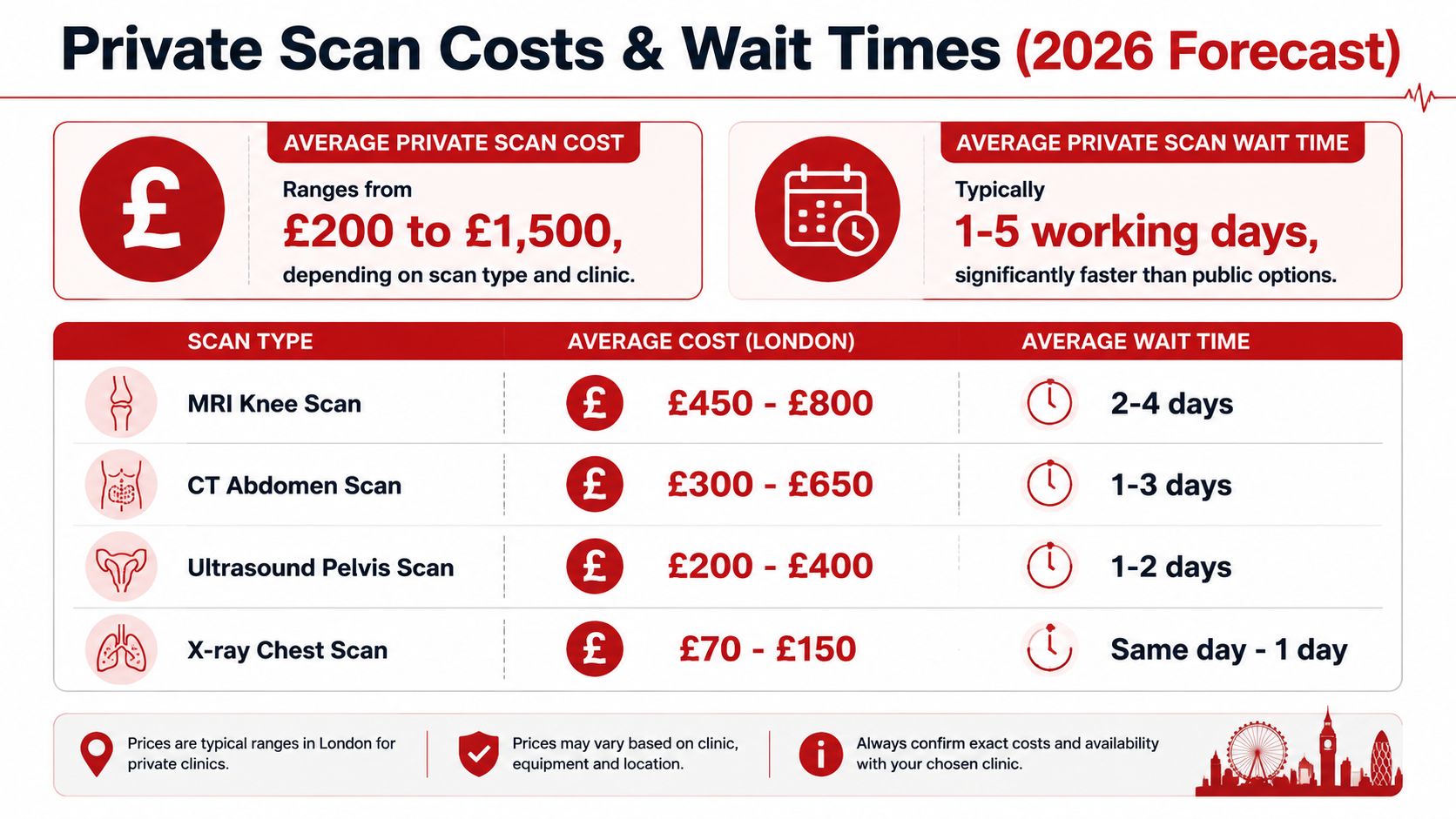
Private scan london pricing is wide because clinics are selling different things under the same label. One appointment may be a straightforward image capture with a written report. Another may include a consultant review, faster escalation, and clear instructions on what to do next, including whether to take the result back to your GP or NHS team.
What the current benchmark tells you
As noted earlier, private providers are handling a large volume of diagnostic work and often market short waits. In practical terms, many London clinics aim to offer appointments within days rather than weeks, but the fastest slots are usually for standard ultrasound or X-ray, not every MRI or consultant-led pathway.
Price follows the same pattern. A basic private ultrasound is often the lowest-cost entry point. MRI usually sits higher. CT often costs more again, especially if contrast, radiologist reporting speed, or specialist review is included.
That gives you a rough frame. It does not tell you what is included.
Why one ultrasound quote can be much lower than another
London is a good example of how confusing scan pricing can be. A low headline price may cover the scan alone. A higher quote may include the report, consultant input, and a clearer route for follow-up if the result needs action.
The practical cost drivers are usually these:
- Location. Central London and Harley Street addresses often charge more.
- Type of scan. A focused ultrasound for one question costs less than a more involved study.
- Who reviews it. Sonographer-performed scans and radiologist-reported scans are priced differently.
- Urgency. Same-day or next-day appointments can cost more.
- What happens after. Some clinics stop at the report. Others help arrange onward referral or urgent review.
Before booking, ask one direct question: Does this fee include the scan, the written report, and a clear next-step plan if something important shows up?
That question saves people money.
Wait time is often the real purchase
For many patients, the value of going private is not the machine. It is shortening the period of uncertainty.
That matters most when the symptom is worrying but does not clearly meet the threshold for A&E. Early pregnancy bleeding, one-sided leg swelling, persistent pelvic pain, or a new lump often fall into that category. Speed helps, but only if you book the right test and understand what the result will let you do next.
This is also where the wider patient journey matters. Sometimes a scan is only part of the decision. In pregnancy, for example, blood testing may shape whether you need imaging now, later, or both. If that applies to you, it helps to look at what affects the cost of NIPT in the UK before you book, because the scan fee is often only one piece of the total spend.
A sensible comparison method is to get a written quote with three points clearly listed:
- The full scan fee
- Who will report the scan
- How quickly you will receive results, and in what format
If a clinic is vague on any of those, keep looking. A cheaper appointment is poor value if the report arrives late, lacks clinical detail, or leaves you unsure whether to return to your GP, use your NHS consultant, or seek urgent care.
How to Choose a Reputable Clinic and Book Your Scan
You call a clinic because you want an answer this week, not another round of uncertainty. The booking goes well until you ask who reports the scan, whether the fee includes the written result, and what happens if something important is found. The quality of the answers at that point usually tells you more than the website does.
The clinic checklist that actually matters
Good private scanning is operationally tidy. Poor private scanning often shows cracks before you book.
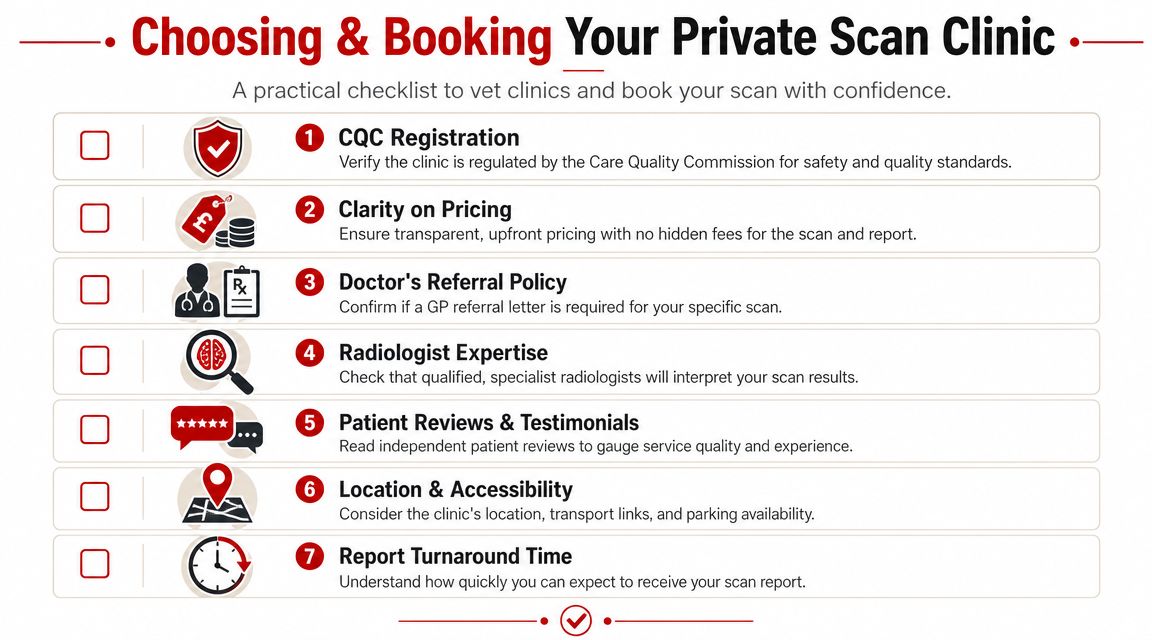
Start by checking whether the clinic is CQC registered and easy to verify. Then ask exactly who will perform the scan and who will write the report. Those are not interchangeable roles, and the answer affects how useful the result will be to your GP, your NHS consultant, or any clinician you see next.
A few more checks save trouble later:
- Referral rules. Some clinics accept self-referral for certain scans. Others require a GP or consultant request.
- Report timing. Ask for a real timeframe, not “usually quite quick”.
- Reviews with detail. Ignore the star rating for a moment and read complaints about billing, delays, admin errors, and unclear results.
- Practical access. A clinic can look ideal online and still be a poor choice if you need to arrive fasting, with a full bladder, or while managing pain.
Well-run London providers often make a point of their location network and short booking times. That can help, especially if you need a same-week appointment, but speed only helps if the clinic is organised at the reporting and follow-up stage too.
Questions worth asking on the phone
Short questions work best. Reception teams answer these every day, and a good clinic should respond clearly.
“Who reports my scan, and when will I receive the written report?”
Then ask:
- If the scan shows something abnormal, who explains the next step
- Can you send the report and images to my GP or consultant
- Is the quoted fee the full cost, or could extra charges be added
- Do I need any preparation, such as fasting, hydration, or a full bladder
- If English is not my first language, can you support safe communication, because poor communication can lead to preventable patient harm from translation
Listen for confidence, not sales language. If the answers sound improvised, keep looking.
Booking the right scan the first time
The common booking mistake is choosing a scan by body area instead of by clinical question. “Abdominal pain” can point to several different tests depending on where the pain is, how long it has been there, whether bloods have been done, and what your doctor is trying to rule in or rule out.
That is why a little preparation helps. Bring a short symptom timeline. Have details of previous imaging, blood tests, discharge letters, pregnancy dates, or family history ready if they are relevant. Sometimes an at-home test or earlier screening result helps frame the booking properly, especially if you are trying to work out whether imaging is the next step or only one part of a bigger assessment. A practical overview of private health screening options in the UK can help you sort that out before you spend money on the wrong appointment.
A reputable clinic will correct you if you ask for the wrong modality. It will also tell you plainly when your symptoms need urgent NHS or emergency assessment instead of a routine private booking. That honesty matters. It saves time, money, and in some cases a dangerous delay.
After Your Scan Interpreting Results and Next Steps
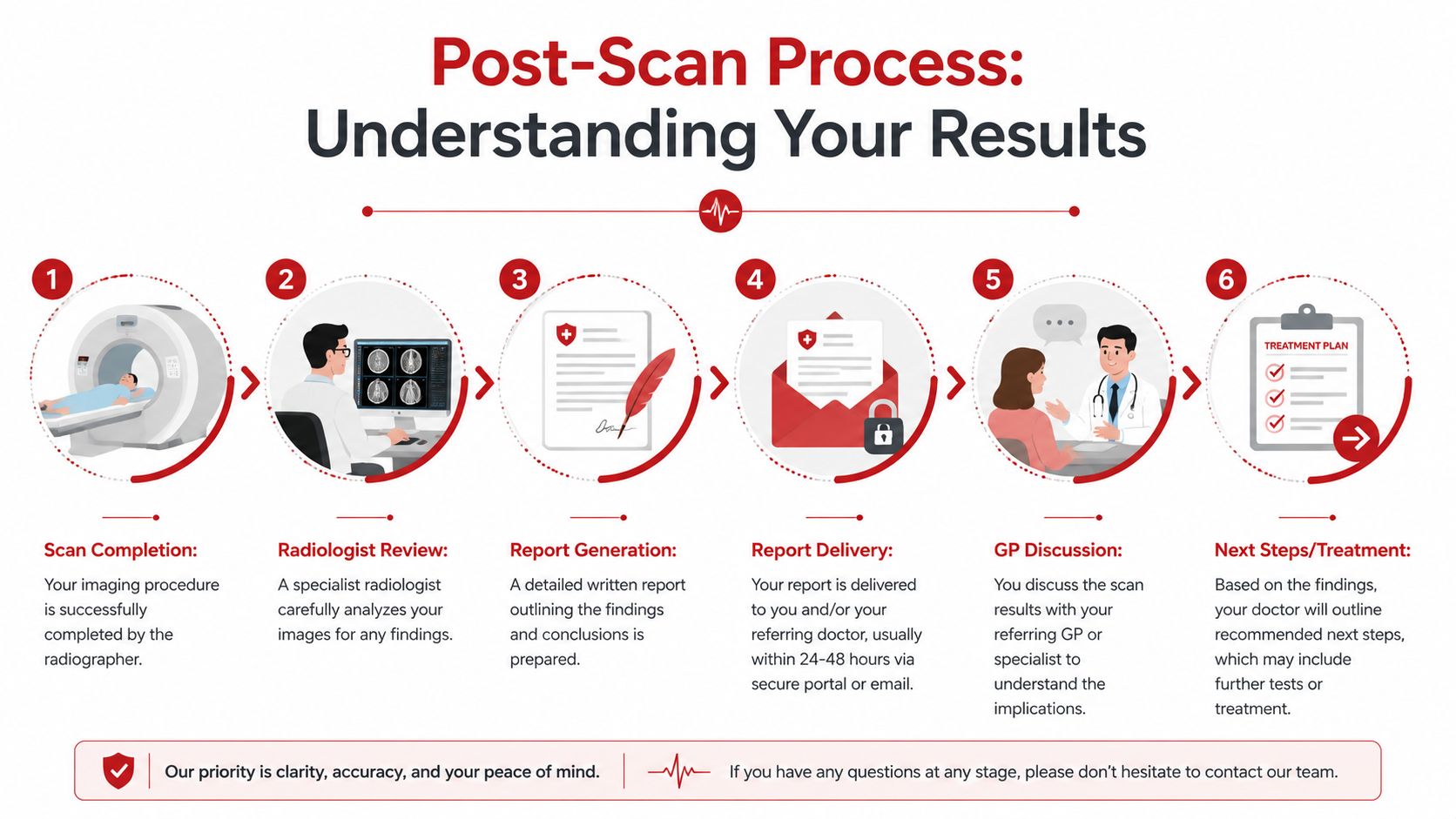
This is the part many guides skip. You've had the scan, the images are done, and now the worry changes shape. Instead of “What if I can't get booked?” it becomes “What if they found something?” or “What does this report mean?”
Fast reports aren't the same as clear follow-up
A major gap in private scanning is the post-scan pathway. Clinics often promote fast report turnaround, but patients still need to know how those findings connect to NHS care, especially when something abnormal appears. That need for structured follow-up is consistent with the concern highlighted by providers discussing how scan findings should be integrated with onward care (IUS London on the post-scan pathway and follow-up).
A useful private scan gives you three things:
- A report written in plain enough terms to use
- A clear statement of whether follow-up is needed
- A practical route for who reviews it next
If any of those are missing, ask for clarification before you leave the pathway behind.
How to use your result properly
Don't let the report sit in your inbox. Send it to your NHS GP and keep a copy of the images and written findings. Continuity matters. A private scan that never enters your wider medical record can create repetition, delays, and confusion later.
If the result is normal but symptoms continue, that still matters. “Normal imaging” doesn't mean “nothing is wrong”. It may narrow the field. If the result is abnormal, ask one very direct question: what is the next medical action, and how quickly should it happen?
A scan report is not a treatment plan. It's evidence that needs a clinician to place it in context.
For patients and families who use English as an additional language, accuracy in explaining findings is especially important. Misunderstanding can happen at the most sensitive point, when decisions need to be made quickly. That's why broader discussions about preventable patient harm from translation are relevant to scan follow-up, not just hospital admissions.
When to escalate urgently
Some findings or symptom combinations need prompt action rather than routine follow-up. If the clinic tells you to attend A&E, contact an Early Pregnancy Unit, or seek urgent GP review, treat that as part of the diagnostic process, not an inconvenience. The private appointment has done its job by identifying that you need a faster clinical lane.
The calmest way to handle private imaging is to think in sequence:
- Before the scan: define the question
- During booking: confirm the right modality and the reporting pathway
- After the scan: move the result into active care, not passive storage
If you want to get clearer on symptoms before committing to imaging, Repose Healthcare offers private at-home health tests across hormone, fertility, sexual health, gut health, nutrition, infectious disease, and general wellness. For many people, that's a useful first step before a scan, or a sensible follow-up after one, because it helps turn worry into specific information you can act on with your GP or specialist.
You Might Also Like
Private Scan London: 2026 Guide to Costs & Booking
You wake up with the same worry you had last week. The pelvic pain is [...]
The 2026 Cost of Hepatitis Vaccination in the UK
You're usually looking up the cost of hepatitis vaccination for a practical reason. A trip [...]
Hormone Blood Test London: Find Your Perfect Test
Some London health questions start subtly. Your cycle changes a little. You feel wired at [...]
Peanut Allergy Test Kit: A Practical UK User’s Guide
A peanut reaction often starts with uncertainty, not clarity. You eat a biscuit, satay sauce, [...]
NIPT Test Edinburgh: Your 2026 Guide
If you're searching nipt test edinburgh, you're probably already in that familiar stage of pregnancy [...]
Peripheral Artery Disease UK: Peripheral Artery Disease UK:
You might be reading this because walking has started to feel different. Perhaps your calf [...]
NIPT Test Cardiff: Clinic, Home & NHS Pathways 2026
If you're in Cardiff, newly pregnant, and staring at screening options that all seem to [...]
Gender Scan Difference UK: Accuracy, Timing & Cost Compared
You've probably already done the same search most parents do. One tab shows the NHS [...]
NIPT Test Cambridge: Guide to Options & Booking 2026
You're in Cambridge, you've had the first rush of finding out you're pregnant, and then [...]
Home COVID Test Results: A Practical UK & Ireland Guide
You've done the swab, mixed the sample, added the drops, and now you're staring at [...]
DVT Test Squeeze Calf: Homan’s Sign & Beyond
You notice one calf is sore, a little swollen, and not behaving like an ordinary [...]
Your Guide to Every Travel Clinic Leicester Offers in 2026
Flights are booked. The hotel is sorted. Your passport is still in date. Then one [...]
13 Week Gender Scan: Accuracy, NIPT & What to Expect
By the time you reach 13 weeks, pregnancy often starts to feel more real in [...]
Your Pregnancy Scan London: Guide to Options & Costs
A positive test can make London feel suddenly very small and very complicated. You might [...]
Your Nuchal Dating Scan Explained: A 2026 UK Guide
That appointment message has landed in your phone or come through the post, and suddenly [...]
Normal Cortisol Levels UK: Get Clarity
Some people search for normal cortisol levels uk after weeks of feeling unlike themselves. They’re [...]
How to Test Iron Levels in Blood: A Complete UK Guide
You’re probably not searching how to test iron levels in blood out of curiosity. More [...]
Growth Scan Pregnancy: UK Guide & What to Expect
You’re at an antenatal appointment, everything seems routine, and then your midwife says, “We’d like [...]
Gender Scan Near Me: Your 2026 Guide to Options
You’re probably here because the question has stopped feeling abstract. Maybe you’ve had your booking [...]
Progesterone Test For Pregnancy: Viability & Home Kit
The positive test is there, but relief doesn’t always follow. For many women, early pregnancy [...]
Ovulation Blood Tests: Confirm Your Ovulation
You’ve probably already done some version of this. You’ve checked an app, watched for a [...]
How to Test Testosterone Levels: A UK Guide
You wake up tired, despite a full night in bed. Your training feels flat. Your [...]
UK Vitamin D Test: A Complete At-Home Guide for 2026
You wake up tired, even after a full night’s sleep. By mid-afternoon you’re reaching for [...]
Blood Iron Level Test: A Complete UK Guide for 2026
Some days it isn’t dramatic. You’re just slower than usual. You wake up after a [...]
Cortisol Levels Test: Your Comprehensive UK Guide
You wake up tired, push through the morning on caffeine, feel oddly tense by midday, [...]
Travel Clinic Leeds: Compare 7 Top Options For 2026
You book the flights first. Then the practical questions start. Is a tetanus booster enough [...]
Private Blood Test Leicester: A Complete 2026 Guide
You wake up tired again. Maybe you’ve had weeks of bloating, odd fatigue, headaches, low [...]
Genetic Testing Before Pregnancy: A UK Guide for 2026
You might be at the stage where baby plans still live in half-finished conversations. One [...]
Harmony NIPT Test: A Clear Guide for Expectant Parents
You may be sitting with a booking slip from your midwife, a browser full of [...]
Decode Your Health: Understanding Full Blood Count Results
That moment is familiar. You open your blood test report on your phone, see a [...]