
NIPT Test Edinburgh: Your 2026 Guide

If you're searching nipt test edinburgh, you're probably already in that familiar stage of pregnancy where excitement and decision-making arrive together. You may have had your booking appointment, started thinking about the 12-week scan, or been told about screening and realised that the word "screening" covers several very different tests.
For many Edinburgh parents, the fundamental question isn't just what NIPT is. It's whether you can get it on the NHS, whether you need to go private, and whether paying for a test makes sense if your pregnancy is already considered low risk. Those are practical questions, and they deserve practical answers.
NIPT has become a widely used option because it offers a non-invasive way to screen for certain chromosomal conditions using a maternal blood sample rather than an invasive procedure. That makes it easier to consider, but it doesn't make the choices around timing, eligibility, follow-up, and expectations any less important. Good care is often about making the next step feel clearer, not adding more jargon. The same principle applies in digital access too. A useful read on optimizing the healthcare digital front door shows why patients value clear pathways, fast answers, and fewer unnecessary barriers.
Your Guide to NIPT in Edinburgh

In Edinburgh, there are really two main routes to think about. One is the NHS pathway, where NIPT is offered in specific circumstances. The other is the private pathway, where you can usually arrange testing directly if you want earlier reassurance, more convenience, or access outside NHS criteria.
That distinction matters because many people assume NIPT is available to anyone who asks. In practice, NHS Scotland doesn't offer universal NIPT to every pregnant person. Access is tied to clinical pathway and screening context. If your first-line screening suggests a higher chance result, NIPT may be offered as the next step. If it doesn't, and you still want the test, private testing is often the route people explore.
What most parents want to know first
A few questions come up repeatedly:
- Can I get NIPT without an NHS referral? Yes, through private providers.
- If I'm low risk, can I still choose NIPT? Usually yes, privately.
- Will a normal result guarantee everything is fine? No. It can be very reassuring, but it doesn't replace all other pregnancy care.
- If the result is high chance, what happens next? You'll still need a diagnostic test to confirm the finding.
Practical rule: The right test isn't just the one with the best headline. It's the one that fits your stage of pregnancy, your risk level, and what you'd actually do with the result.
What makes this guide useful locally
Edinburgh has no shortage of private clinic pages, but many don't explain the difference between a marketing promise and a real care pathway. The useful details are simpler than that. Who qualifies on the NHS. When a private test is worth considering. What the sample process looks like. And what results can, and can't, tell you.
Understanding Non-Invasive Prenatal Testing

NIPT stands for non-invasive prenatal testing. In the UK, it is a maternal blood-based screening test that analyses cell-free DNA from the placenta, not a direct sample from the fetus. The test is used to screen for common fetal aneuploidies, but it isn't diagnostic, so a high-risk result still needs follow-up diagnostic testing for confirmation, as explained by Health Education England's NIPT guidance.
A simple way to think about it is this. During pregnancy, tiny fragments of placental DNA circulate in the mother's bloodstream. The lab looks at those fragments for clues about whether there is a higher chance of certain chromosome differences. It's a bit like reading signals from a trace sample rather than looking directly at the full picture.
What NIPT usually screens for
In standard UK practice, the main focus is screening for:
- Down's syndrome
- Edwards' syndrome
- Patau's syndrome
Some private tests may include additional findings, but the core purpose is usually centred on those three conditions. That's why it's important to ask what a specific panel covers rather than assuming every NIPT product is identical.
Screening versus diagnosis
This is the distinction that causes the most confusion.
A screening test estimates the chance that a condition may be present. It helps sort pregnancies into lower-chance and higher-chance groups. A diagnostic test is used when you need a much more definite answer.
If NIPT comes back high chance, the next conversation is usually about diagnostic testing such as CVS or amniocentesis. If you're comparing those options, it's useful to read about the amniocentesis test cost as part of the wider decision-making process.
A reassuring NIPT result can reduce uncertainty. It doesn't remove the need for scans, routine antenatal care, or clinical review when something else in the pregnancy needs attention.
Why that difference matters emotionally
Parents often hear "99%" style claims in the wider market and understandably assume the test gives a final answer. The practical reality is more nuanced. NIPT is valuable because it can reduce uncertainty without the miscarriage risk linked to invasive testing. But it doesn't stand on its own as the whole story of fetal health.
That matters most when someone is deciding what they would do with the result. If a result would change whether you want further testing, more specialist review, or more time to consider options, NIPT can be very helpful. If your ultrasound already shows a major concern, NIPT may not be the test that answers the important question.
NIPT in Edinburgh NHS vs Private Options
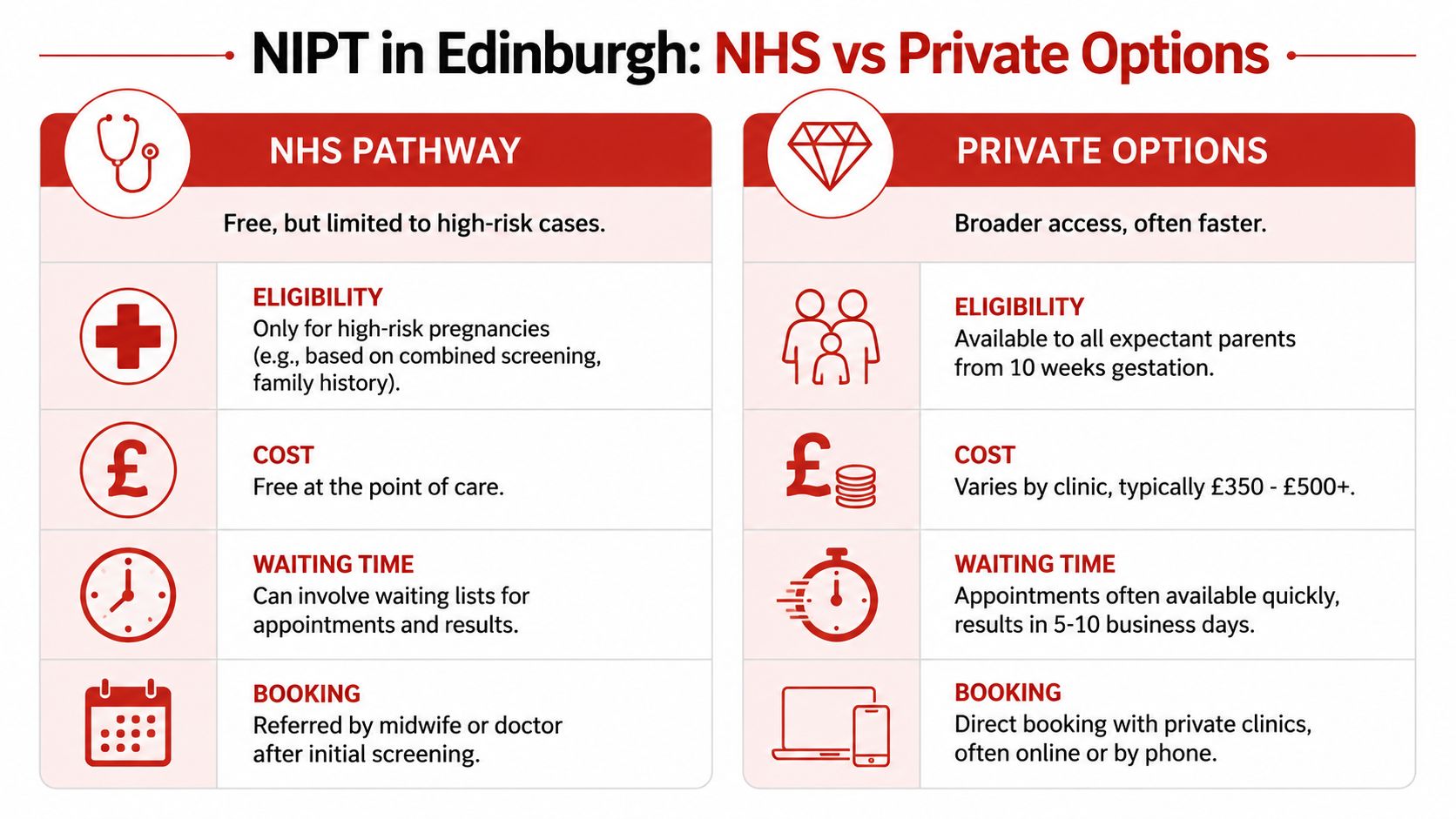
The biggest practical difference in nipt test edinburgh searches is access. Expectant parents aren't choosing between two identical services. They're choosing between two different pathways with different entry points, timing, and reasons for testing.
The NHS route in Edinburgh
On the NHS, NIPT is used as a second-line screening test, not as a universal test for everyone. In Scotland, Public Health Scotland reports that 80% of women with a higher-chance first-line screening result went on to have NIPT, and 7.9% of those who had NIPT received a high-chance result for Down's, Edwards', or Patau's syndrome, according to Public Health Scotland pregnancy screening data.
In day-to-day terms, that means the NHS pathway is designed for people whose earlier screening has already flagged increased chance, or where there is a relevant clinical reason to involve fetal medicine or genetics. It isn't usually a walk-in request.
Typical NHS flow looks like this:
- First-line screening is offered in routine antenatal care.
- A higher-chance result leads to discussion with your maternity team.
- Referral onward is arranged if NIPT is appropriate within the pathway.
- Follow-up planning depends on whether the result is low chance, high chance, or inconclusive.
For the right patient, this is an excellent pathway. It's funded, clinically integrated, and linked directly to specialist follow-up.
When private testing makes sense
Private NIPT is often a sensible choice when the NHS isn't offering it, but you still want information.
That usually includes people who:
- Received a low-risk first-line screen but still feel anxious and want additional reassurance
- Want testing earlier in their decision-making
- Prefer direct access and simpler booking
- Would rather avoid extra appointments where possible
- Want a private route for convenience or confidentiality
A private pathway can also feel more straightforward if you're comfortable paying for the test and know exactly why you're ordering it.
One option in this space is the private NIPT cost guide, which helps compare what private testing includes and how pricing differs between routes. Repose Healthcare also offers an at-home NIPT pathway from 10 weeks, which is relevant for people in Edinburgh who want direct-access testing without waiting for an NHS screening outcome.
Side-by-side comparison
| Pathway | NHS | Private |
|---|---|---|
| Who it's for | Higher-chance screening result or specific clinical indication | Usually broader direct access |
| Cost to patient | Free at the point of care | Paid by the patient |
| How you access it | Through maternity care and referral pathway | Direct booking |
| Main advantage | Integrated follow-up within NHS care | Speed, convenience, and access outside NHS criteria |
| Main limitation | Not universally available | You need to self-fund |
What works well: Private testing is most useful when you've already decided that additional information would help you. It works less well when you're hoping the test will answer every possible concern in pregnancy.
The NIPT Process From Sample to Results
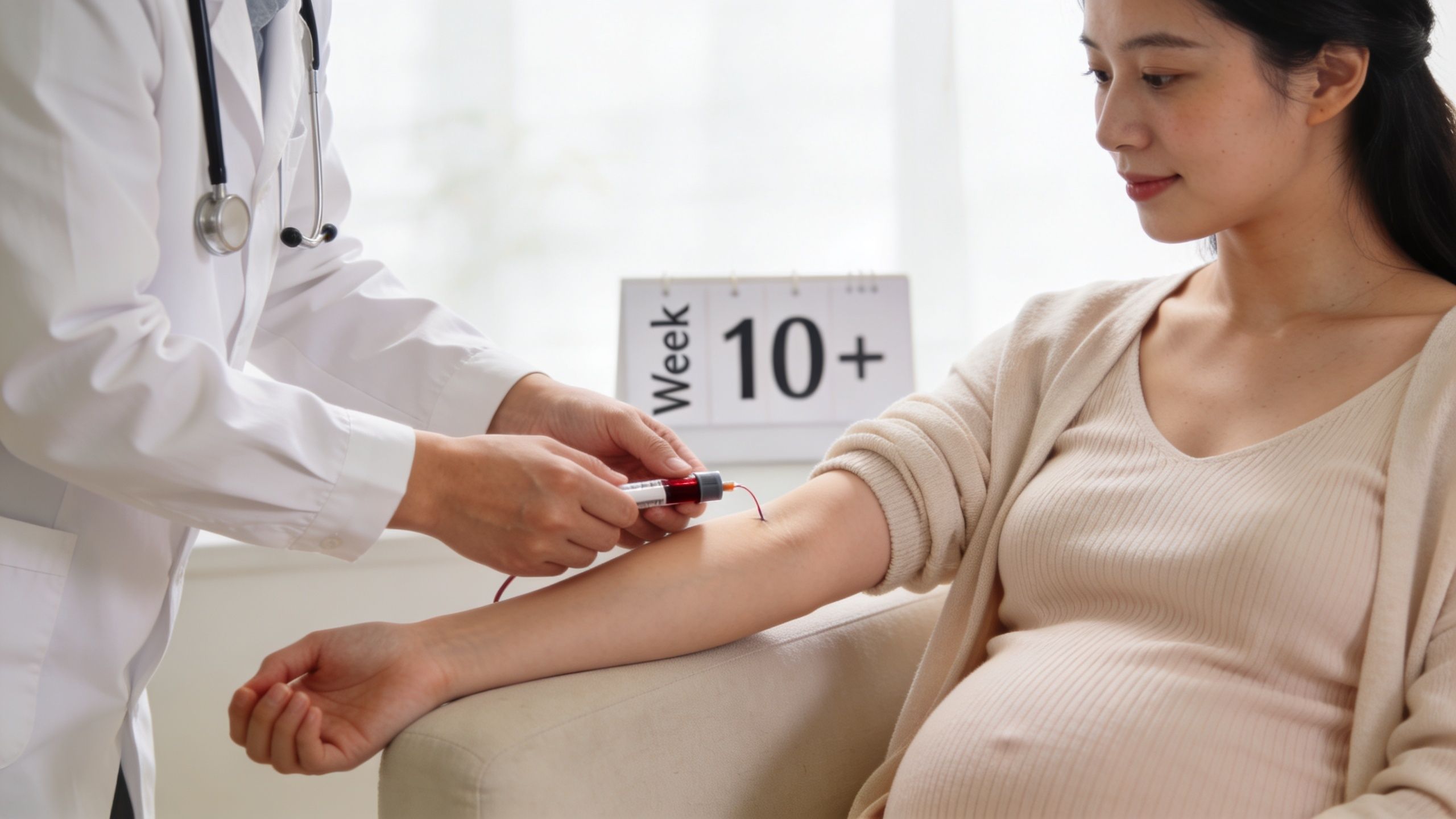
The process itself is much simpler than expected. The harder part is usually deciding when to test and what you'll do with the result.
Timing matters more than people realise
NIPT works best once there is enough placental DNA in the maternal blood sample. NHS Lothian guidance notes that the test works best from around 9 to 10 weeks' gestation because the fetal fraction rises with gestational age, and testing too early can lead to a test failure because there isn't enough DNA to analyse reliably, as outlined in NHS Lothian guidance on NIPT timing.
That has a practical consequence. If someone is very early and desperate for fast reassurance, the best next step isn't always "test immediately". Sometimes the better decision is to wait a short time so the sample is more likely to produce a clear result.
What actually happens
Most NIPT pathways involve these stages:
Booking and eligibility check
On the NHS, this follows screening and referral. Privately, you usually book directly after confirming gestation and suitability.Sample collection
Many services use a standard maternal blood sample. Some private routes are designed for home collection, which appeals to people balancing work, childcare, or privacy concerns.Laboratory analysis
The lab analyses the placental cell-free DNA fragments in the sample and reports whether the result is low chance, high chance, or not reportable.Results and next steps
The important part isn't only receiving the report. It's understanding whether the result means reassurance, repeat sampling, or referral onward.
Clinic sample versus at-home sample
A clinic blood draw suits people who want face-to-face support on the day and are happy attending an appointment. An at-home pathway suits people who want fewer moving parts.
Neither route changes the central issue. The sample still needs to be taken at the right stage of pregnancy and handled properly. Convenience helps. Timing helps more.
If your priority is reliability, don't focus only on how early a provider says they can test. Focus on whether you're testing at a point where the result is likely to be reportable.
How long results take
Turnaround varies by pathway and provider. NHS timing depends on local workflow, referral steps, and lab processing. Private services are often chosen because the booking process is quicker and the route to results feels more direct.
What matters most is planning around what happens after the result. A fast result is only useful if you also know who you'll speak to next, especially if the answer isn't straightforward.
Making Sense of Your NIPT Results
The emotional weight of NIPT usually arrives when the report lands. Most results are easier to process once you translate them into plain language.
If your result is low chance
A low-chance result is reassuring. It means the test did not identify a higher chance for the conditions screened. For many parents, that reduces a great deal of anxiety.
But low chance doesn't mean every possible genetic, structural, or developmental issue has been ruled out. NIPT isn't designed to do that. Routine scans and standard antenatal care still matter.
If your result is high chance
A high-chance result is not a diagnosis. It means the screening result suggests a higher likelihood of the condition and should be followed by specialist discussion and confirmatory testing.
People often need calm, clear guidance at this stage. The practical next step is usually a discussion about diagnostic options and what answer you need next. If you're trying to understand how screening performance and interpretation fit together, this guide to NIPT test accuracy is a useful companion read.
If your result is no result
A no-result or unreportable result usually means the lab couldn't confidently issue a result from that sample. One common reason is low fetal fraction. In many cases, the next step is a repeat sample, though the exact plan depends on your provider and clinical situation.
A no-result isn't the same thing as a bad result. It's frustrating, but it often reflects a technical limitation rather than a specific diagnosis.
What NIPT does not cover
This is the part that protects people from false reassurance.
NIPT doesn't screen for every condition, and it doesn't replace ultrasound assessment. If an ultrasound shows significant anomalies, NIPT may not be enough. St George's guidance notes that if there is a nuchal translucency over 3.5 mm or major anomalies, invasive diagnostic testing may be recommended instead of relying on NIPT alone, as described in St George's Hospital guidance on when NIPT may be insufficient.
Important: A screening test answers one question well. It doesn't answer every question in pregnancy.
A sensible way to read the result
Use this order of thinking:
- What exactly was screened for?
- Was the result low chance, high chance, or no result?
- Is there anything on ultrasound that changes the picture?
- Do I now need reassurance, a redraw, or a diagnostic conversation?
That approach helps keep the result in proportion. It avoids two common mistakes. Treating a low-chance result as a guarantee, or treating a high-chance result as a final diagnosis.
Edinburgh NIPT Frequently Asked Questions
Can I get NIPT on the NHS in Edinburgh if I'm low risk
Usually, NHS access is tied to the screening pathway rather than simple preference. If your first-line screening hasn't shown a higher chance result, private testing is often the route people consider when they still want reassurance.
Is private NIPT worth it
It can be, if the information would genuinely help you. The strongest reasons are usually convenience, direct access, wanting reassurance despite not meeting NHS criteria, or wanting to avoid waiting for multiple appointments.
Is NIPT the same as the 12-week scan
No. They complement each other. NIPT looks at placental DNA in a blood sample. The 12-week scan looks at the pregnancy structurally and helps assess development, dating, and visible concerns. One doesn't replace the other.
Can NIPT tell me everything is fine
No test can do that. NIPT can be very reassuring for the conditions it screens for, but it doesn't cover all chromosomal or structural issues. That's why scans, clinical review, and follow-up remain important.
Where can I get a private NIPT test in Edinburgh
You can look at local private clinics or choose a UK provider that offers a home-based pathway. The best option depends on what matters most to you. Speed, whether you want face-to-face support, what the panel includes, and how results are explained afterwards.
What should I ask before booking
Keep it simple:
- What does this specific test screen for?
- From what gestation can I test?
- What happens if the result is no result?
- What support is available after a high-chance result?
- Will I still need follow-up through my NHS maternity team?
Those questions usually tell you more than glossy marketing ever will.
If you're weighing up NHS versus private testing and want a straightforward home-based option, Repose Healthcare offers private at-home health testing across the UK, including NIPT access for people who want a direct, confidential route without relying on NHS eligibility.
You Might Also Like
STI Test Kit at Home: How It Works and What to Expect
You've had condomless sex with a new partner, feel completely well, and are now deciding [...]
Fertility Blood Test Day 3: What to Expect
You've booked your first fertility appointment, but one phrase on the instructions keeps bothering you: [...]
Home Liver Function Test: What Results Mean
You've opened the results from a home liver function test and found a mildly raised [...]
Glucose Tolerance Test at Home: What You Need to Know
A true diagnostic oral glucose tolerance test in the UK is usually a supervised clinic [...]
At Home PSA Test: Accuracy, Process, and UK Guidelines
You notice that you're urinating more often, your stream seems weaker, or you want a [...]
A1C Blood Test UK: What It Measures and How to Get One
You've just opened a private or at-home A1C blood test UK result and found two [...]
STI Screening for Men: What to Test and When
You've recently ended a relationship, ordered an STI test kit online, and now you're staring [...]
Fertility Testing Before Trying to Get Pregnant: Key Info
You and your partner may have chosen a rough timeline, checked your finances and started [...]
Nutrition Testing Kit: What It Measures and Why It Matters
You're doing the sensible thing, eating reasonably, trying to sleep, and still feeling flat. That's [...]
Private Coeliac Testing UK: A Practical Patient Guide
You've been bloated after pasta for months. You've searched “coeliac symptoms”, noticed the fatigue and [...]
STI Test Kit Price Guide for UK Home Testing
Private STI test kits in the UK usually start at about £29 to £30 for [...]
Sexual Health Screening: Your Guide to 2026
You're often here for a very ordinary reason that suddenly feels loaded. A new partner. [...]
Pregnancy Screening Tests Private: Your UK Guide
You've had a positive pregnancy test, the NHS booking appointment is still ahead, and your [...]
What Is Glucose Tolerance Test and How It Works
A glucose tolerance test is a two-hour challenge test: after an overnight fast, your fasting [...]
Blood Test for Night Sweats What to Check and When
You wake in the early hours with damp nightwear, wet sheets and a racing mind. [...]
The 2026 Cost of Hepatitis Vaccination in the UK
You're usually looking up the cost of hepatitis vaccination for a practical reason. A trip [...]
Hormone Blood Test London: Find Your Perfect Test
Some London health questions start subtly. Your cycle changes a little. You feel wired at [...]
Peanut Allergy Test Kit: A Practical UK User’s Guide
A peanut reaction often starts with uncertainty, not clarity. You eat a biscuit, satay sauce, [...]
NIPT Test Edinburgh: Your 2026 Guide
If you're searching nipt test edinburgh, you're probably already in that familiar stage of pregnancy [...]
Peripheral Artery Disease UK: Peripheral Artery Disease UK:
You might be reading this because walking has started to feel different. Perhaps your calf [...]
NIPT Test Cardiff: Clinic, Home & NHS Pathways 2026
If you're in Cardiff, newly pregnant, and staring at screening options that all seem to [...]
Gender Scan Difference UK: Accuracy, Timing & Cost Compared
You've probably already done the same search most parents do. One tab shows the NHS [...]
NIPT Test Cambridge: Guide to Options & Booking 2026
You're in Cambridge, you've had the first rush of finding out you're pregnant, and then [...]
Home COVID Test Results: A Practical UK & Ireland Guide
You've done the swab, mixed the sample, added the drops, and now you're staring at [...]
DVT Test Squeeze Calf: Homan’s Sign & Beyond
You notice one calf is sore, a little swollen, and not behaving like an ordinary [...]
Your Guide to Every Travel Clinic Leicester Offers in 2026
Flights are booked. The hotel is sorted. Your passport is still in date. Then one [...]
13 Week Gender Scan: Accuracy, NIPT & What to Expect
By the time you reach 13 weeks, pregnancy often starts to feel more real in [...]
Your Pregnancy Scan London: Guide to Options & Costs
A positive test can make London feel suddenly very small and very complicated. You might [...]
Your Nuchal Dating Scan Explained: A 2026 UK Guide
That appointment message has landed in your phone or come through the post, and suddenly [...]
Normal Cortisol Levels UK: Get Clarity
Some people search for normal cortisol levels uk after weeks of feeling unlike themselves. They’re [...]