Skip to content



A comprehensive biochemistry blood test with cholesterol profile
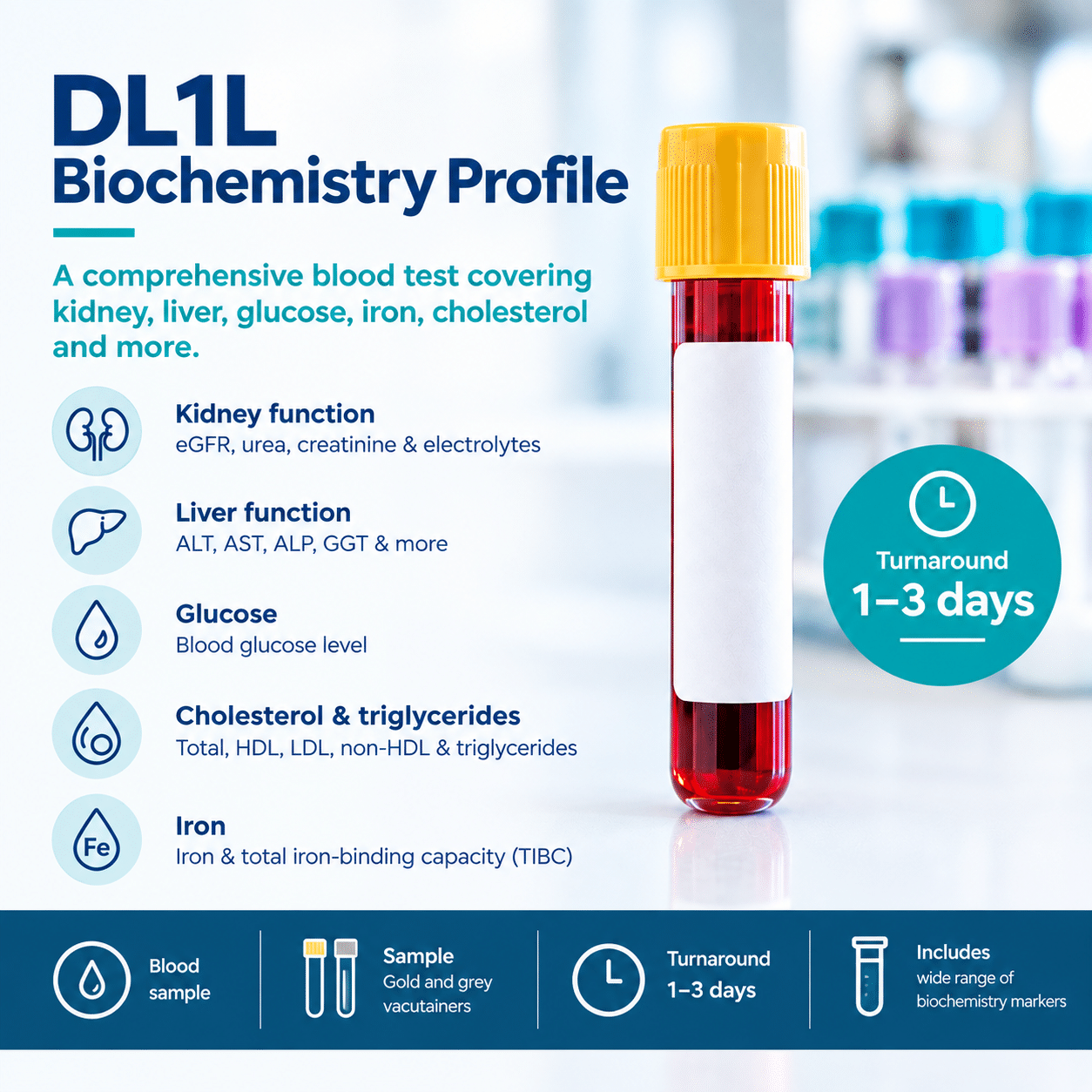
The TDL DL1L Biochemistry Profile is a comprehensive blood test that measures a broad range of routine biochemical markers, including kidney function, liver function, glucose, iron, bone and mineral markers, cholesterol and triglycerides.
In addition to the core biochemistry profile, DL1L includes HDL cholesterol, LDL cholesterol and non-HDL cholesterol, providing a more detailed cholesterol profile.
The test is performed by The Doctors Laboratory (TDL) and has a currently listed laboratory turnaround time of 1 day.
At a glance
- Test: TDL DL1L Biochemistry Profile
- Test code: DL1L
- Sample: Blood
- Laboratory: The Doctors Laboratory (TDL)
- Turnaround: 1 day*
- Includes: Kidney, liver, glucose, iron, bone, cholesterol and triglyceride markers
- Additional lipid markers: HDL cholesterol, LDL cholesterol and non-HDL cholesterol
*Turnaround times are a guide and depend on sample receipt and laboratory processing.
What does the TDL DL1L Biochemistry Profile include?
The DL1L profile combines a range of routine biochemical tests into a single laboratory profile.
Kidney function and electrolytes
The profile includes:
- Sodium
- Potassium
- Chloride
- Bicarbonate
- Urea
- Creatinine
- eGFR
These measurements provide information about kidney-related biochemistry and electrolyte balance.
Liver function
The liver-related markers included in DL1L are:
- Bilirubin
- Alkaline phosphatase (ALP)
- AST
- ALT
- Gamma GT (GGT)
- Total protein
- Albumin
- Globulin
These markers are commonly included in routine liver function testing.
Bone and mineral markers
The profile includes:
- Calcium
- Phosphate
- Uric acid
- Magnesium
These measurements relate to mineral and metabolic balance.
Glucose
DL1L includes a blood glucose measurement, providing a measurement of the glucose level in the blood at the time the sample is taken.
Cholesterol and triglycerides
The profile includes a comprehensive range of lipid measurements:
- Total cholesterol
- HDL cholesterol
- LDL cholesterol
- Non-HDL cholesterol
- Triglycerides
This provides more detailed cholesterol information than the standard DL1 Biochemistry Profile.
Iron
The profile also includes:
- Iron
- Total iron-binding capacity (TIBC)
These tests provide information about iron-related blood biochemistry and can be considered alongside other relevant laboratory results.
What is the difference between DL1 and DL1L?
Both profiles provide a broad range of routine biochemistry measurements.
The key difference is that DL1L additionally includes HDL cholesterol, LDL cholesterol and non-HDL cholesterol.
| DL1 | DL1L | |
|---|---|---|
| Kidney function | ✓ | ✓ |
| Electrolytes | ✓ | ✓ |
| Liver function | ✓ | ✓ |
| Bone & mineral markers | ✓ | ✓ |
| Glucose | ✓ | ✓ |
| Triglycerides | ✓ | ✓ |
| Total cholesterol | ✓ | ✓ |
| HDL cholesterol | — | ✓ |
| LDL cholesterol | — | ✓ |
| Non-HDL cholesterol | — | ✓ |
| Iron & TIBC | ✓ | ✓ |
If you want the additional HDL, LDL and non-HDL cholesterol measurements alongside the wider biochemistry profile, DL1L is the appropriate TDL profile.
Why choose a comprehensive biochemistry blood test?
A comprehensive biochemistry profile can be useful when multiple routine biochemical markers are required together.
Rather than testing individual markers separately, the DL1L profile combines testing across several areas, including:
Kidney function · Liver function · Electrolytes · Bone and mineral markers · Glucose · Cholesterol · Triglycerides · Iron
The additional HDL, LDL and non-HDL cholesterol measurements make DL1L a broader lipid and biochemistry profile than DL1.
Who might have a DL1L Biochemistry Profile?
A healthcare professional may request a broad biochemistry profile when several biochemical measurements are required.
People may also choose private blood testing when they want access to laboratory testing outside of NHS pathways, subject to the requirements of the healthcare provider offering the test.
The most appropriate blood tests depend on your individual circumstances. If you have specific symptoms, an existing medical condition, take medication or have been advised to undergo particular investigations, you should discuss your testing requirements with a qualified healthcare professional.
Sample requirements
TDL currently lists the following sample requirements for DL1L:
Gold Vacutainer (B)
SST/Gel anticoagulant, 5ml
Grey Vacutainer (G)
Fluoride oxalate anticoagulant, 2ml/4ml
TDL currently lists no special instructions for the DL1L profile.
Samples should be collected by an appropriately trained healthcare professional and handled according to the laboratory’s requirements.
How quickly will my results be available?
TDL currently lists a 1-day turnaround time for the DL1L Biochemistry Profile.
Turnaround times are indicative and can vary depending on when the sample reaches the laboratory and other laboratory processing requirements.
Your healthcare provider will advise you how and when your results will be made available.
Frequently Asked Questions
What is the TDL DL1L Biochemistry Profile?
The TDL DL1L Biochemistry Profile is a broad blood test measuring routine biochemical markers relating to kidney function, liver function, electrolytes, glucose, bone and mineral balance, iron, cholesterol and triglycerides. It also includes HDL, LDL and non-HDL cholesterol.
What tests are included in DL1L?
DL1L includes sodium, potassium, chloride, bicarbonate, urea, creatinine, eGFR, bilirubin, alkaline phosphatase, AST, ALT, Gamma GT, total protein, albumin, globulin, calcium, phosphate, uric acid, magnesium, glucose, triglycerides, cholesterol, HDL cholesterol, LDL cholesterol, non-HDL cholesterol, iron and TIBC.
Does DL1L include HDL and LDL cholesterol?
Yes. HDL cholesterol, LDL cholesterol and non-HDL cholesterol are included in the DL1L profile. These are additional lipid measurements compared with the standard DL1 profile.
What is the difference between DL1 and DL1L?
DL1L includes the core TDL DL1 Biochemistry Profile plus HDL cholesterol, LDL cholesterol and non-HDL cholesterol.
Does DL1L include a kidney function test?
Yes. The profile includes sodium, potassium, chloride, bicarbonate, urea, creatinine and eGFR, which are commonly used as part of kidney function and electrolyte assessment.
Does DL1L include liver function tests?
Yes. The profile includes bilirubin, alkaline phosphatase, AST, ALT, Gamma GT, total protein, albumin and globulin.
Does DL1L include an iron test?
Yes. DL1L includes iron and total iron-binding capacity (TIBC).
Does DL1L include a glucose test?
Yes. The profile includes a blood glucose measurement.
Do I need to fast before a DL1L blood test?
TDL currently lists no special instructions for the DL1L profile. However, preparation requirements can depend on the reason for testing and the instructions provided by your healthcare provider. Always follow the specific instructions you are given when arranging your blood test.
How long does the DL1L test take?
The blood collection itself is usually a short procedure. TDL currently lists a 1-day laboratory turnaround time for DL1L, although actual result availability can depend on sample receipt and processing.
Is DL1L a full health check?
No. DL1L is a biochemistry laboratory profile. Although it covers a broad range of biochemical markers, it is not a complete medical examination or comprehensive health assessment.
Depending on your circumstances, additional blood tests or other clinical assessments may be appropriate.
Can the DL1L blood test diagnose a medical condition?
The DL1L profile measures specific biochemical markers but does not, by itself, establish a diagnosis.
Results need to be interpreted in the context of your symptoms, medical history, medications and the laboratory’s reference ranges. If you have concerns about your health or your results, speak to your GP or another appropriately qualified healthcare professional.
What happens if one of my results is outside the reference range?
A result outside the laboratory’s reference range does not necessarily mean that you have a medical condition. Results can be affected by a range of factors and should be interpreted in context.
If you are concerned about a result, discuss it with your GP or another appropriately qualified healthcare professional.
Important Information and Disclaimer
The TDL DL1L Biochemistry Profile is a laboratory blood test that measures the biochemical markers described on this page. It is not a substitute for a medical consultation, physical examination or clinical assessment.
Laboratory results should be interpreted using the reference ranges provided by the testing laboratory and in the context of your individual circumstances, including symptoms, medical history and any medication you may be taking.
A result outside the laboratory reference range does not necessarily indicate a medical condition, while a result within the reference range does not necessarily exclude one.
If you have symptoms, an existing medical condition, or concerns about your health or test results, please speak to your GP or another appropriately qualified healthcare professional.
The test does not provide a diagnosis by itself. Where further investigation or clinical assessment is required, you may be advised to seek appropriate medical care.
Laboratory information: The Doctors Laboratory (TDL)
TDL test code: DL1L
Listed turnaround: 1 day
Sample: Blood
Laboratory specifications, sample requirements and turnaround times can change. The current TDL laboratory requirements should be followed when arranging and collecting samples.
Related products