Ever wondered what secrets your DNA holds? Genetic testing can reveal your inherited predispositions for health conditions, how your body processes nutrients and medications, and even details about your ancestry. It’s like reading your body’s unique instruction manual, translating complex science into clear, actionable insights.
Think of your DNA as a personal blueprint, packed with all the instructions that make you, well, you. Genetic testing allows us to read specific parts of this blueprint, giving you a powerful glimpse into how your body is built and how it works. This isn't about getting a scary, definitive diagnosis; for most of us, it’s about gaining actionable knowledge to build a proactive, personalised health plan.
It’s no surprise that genetic testing is becoming so popular. In the UK alone, the market generated USD 762.0 million in 2024 and is projected to skyrocket to USD 2,793.2 million by 2030. This growth shows a clear shift: people are moving away from guesswork and towards data-driven decisions about their health.
So, at its core, what does genetic testing show? It highlights specific genetic variations that can influence your health and wellness. For instance, a Repose Healthcare test can identify how your body is genetically wired to handle certain nutrients, like whether you're predisposed to lower levels of Vitamin D. This kind of insight empowers you to take a simple, actionable next step: use a Vitamin D Blood Test to check your current levels and adjust your diet if needed.
The process itself is much simpler than you might think. If you're curious about the journey from collecting a sample to the lab analysis, you can explore our complete guide on how does genetic testing work?.
A genetic test provides a roadmap, not a final destination. It highlights potential health risks and wellness opportunities, giving you the power to navigate your health journey with more confidence and precision.
Understanding your unique genetic makeup can help you in a few key ways:
Ultimately, genetic testing provides a foundational layer of information that works alongside other health data to create a much fuller picture of your well-being. To dive deeper into the overarching topic and the services available, you can find comprehensive information on Genetic Testing from Providers for Healthy Living. It’s an empowering first step toward taking control of your health.
Not all DNA tests are created equal. Just as you’d use different tools for different jobs around the house, there are various types of genetic tests designed to answer very specific questions. Figuring out what genetic testing can show you starts with matching the right test to your personal goals—whether that’s getting a firm diagnosis, planning for your family’s future, or simply taking a proactive approach to your health.
Let’s use an analogy. A diagnostic test is like a mechanic plugging in a computer to confirm exactly why your car’s engine warning light is on. It’s specific and gives a clear answer to a present problem. On the other hand, a predictive or wellness test from Repose Healthcare is like getting a full vehicle inspection that highlights parts that might wear out down the line, so you can service them now to prevent a breakdown later. Both are incredibly useful, but they serve completely different functions.
The kinds of insights you can get are vast, covering everything from your health risks to how your body uses nutrients, and even where your ancestors came from.
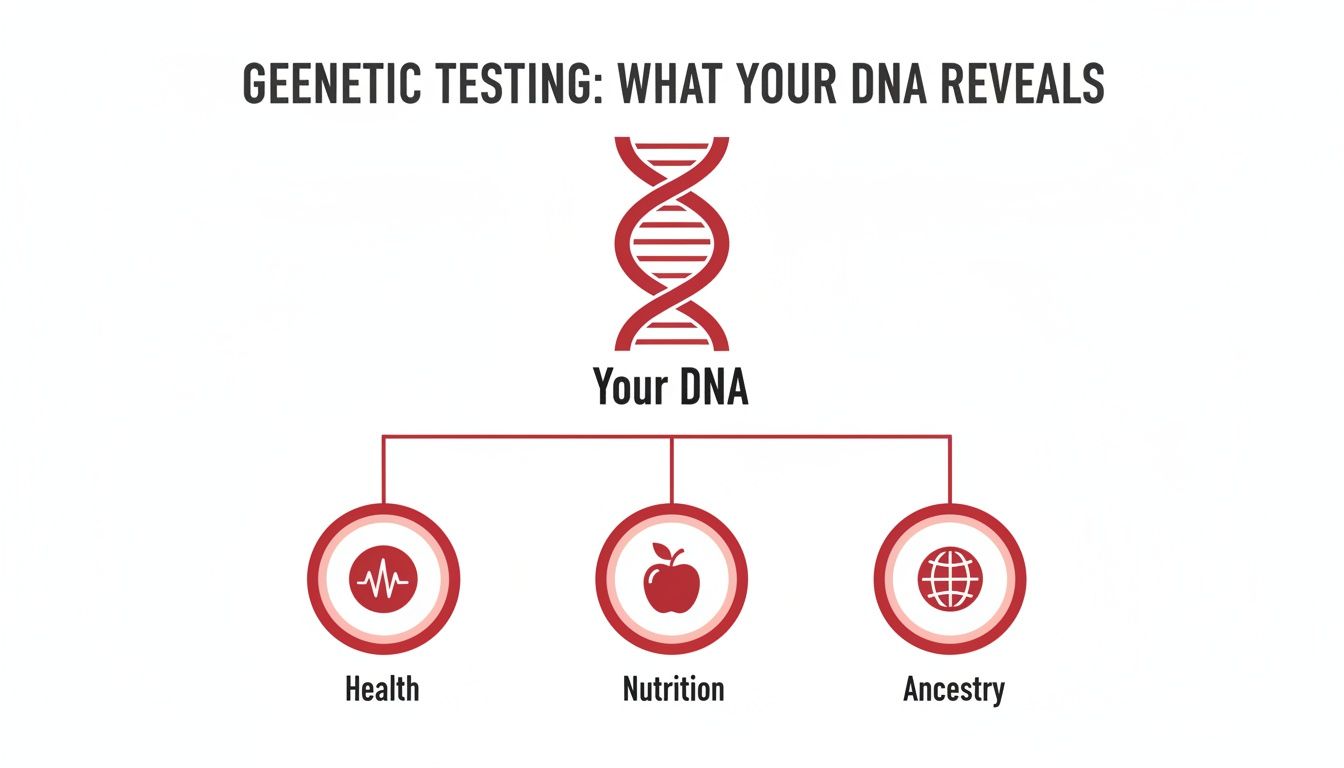
This image perfectly illustrates how your DNA blueprint can be a source of practical, actionable information for managing your health and lifestyle from the ground up.
To help you get a clearer picture, this table breaks down the main types of genetic tests, what they're for, and who might benefit from them.
| Test Type | Primary Purpose | Who It's For | Example of a Finding & Action |
|---|---|---|---|
| Predictive/Wellness | To identify genetic risks and guide proactive health choices. | Healthy individuals wanting to optimise their lifestyle and prevent future issues. | A marker for high cholesterol risk, prompting a Cholesterol and Lipids Blood Test to check current levels. |
| Diagnostic | To confirm or rule out a specific genetic condition causing symptoms. | Patients with symptoms that suggest a particular genetic disorder. | A specific mutation in the CFTR gene, confirming a diagnosis of cystic fibrosis. |
| Carrier Screening | To see if you carry a gene for a condition you could pass to a child. | Individuals or couples planning a family, especially with a family history of genetic disorders. | Finding you are a carrier for sickle cell anaemia, leading to a discussion with a genetic counsellor. |
| Prenatal | To screen a foetus for common genetic conditions during pregnancy. | Expectant parents who want to understand the genetic health of their developing baby. | A high probability of Down's syndrome, prompting further discussion and testing options. |
| Pharmacogenomic (PGx) | To determine how your genes affect your response to medications. | Anyone starting a new medication or experiencing side effects with a current one. | A gene variant that causes you to metabolise a certain antidepressant too quickly, leading a doctor to adjust the dose. |
Each test provides a different piece of the puzzle. Choosing the right one is about asking the right questions from the start.
This is the starting point for most people exploring their DNA. Predictive and wellness tests are not about diagnosing a disease you have now. Instead, they scan your genes for variants that might increase your risk for certain conditions or influence how your body handles things like diet and exercise.
For instance, you might discover you have a genetic tendency towards lower Vitamin B12 levels. This isn’t a diagnosis of a deficiency, but it’s a powerful, actionable insight. It gives you a clear and simple next step: use a Vitamin or Hormone tests to check your current B12 levels and discuss adjustments to your diet with a professional if needed. It’s all about being proactive.
These tests, like those offered by Repose Healthcare, give you a personalised roadmap to manage your health before problems arise. They empower you to shift from reacting to health issues to actively preventing them.
Predictive and wellness tests are perfect for anyone wanting to:
A doctor will turn to diagnostic testing when they suspect a specific genetic condition based on your symptoms or a strong family history. Its job is to provide a definite 'yes' or 'no' answer to confirm or rule out a diagnosis, giving you and your healthcare team clarity.
For example, if a child shows symptoms of muscular dystrophy, a doctor may order a diagnostic genetic test to look for mutations in the DMD gene to confirm the diagnosis. It’s an essential medical tool but worlds away from the proactive wellness insights you get from at-home tests.
If you're thinking about starting or growing your family, carrier screening is an incredibly valuable test. It’s designed to check if you or your partner "carry" a genetic variant for a recessive condition, like sickle cell anaemia or Tay-Sachs disease, that you could pass on to your children.
Most people who are carriers are perfectly healthy and have no idea they even have the gene variant. The issue arises when both partners are carriers for the same condition. In that situation, there is a 25% chance with each pregnancy that their child will be born with the condition. The actionable insight here is powerful: this knowledge allows you to speak with a genetic counsellor and make informed decisions about family planning.
Once you’re pregnant, prenatal genetic tests offer a window into the health of your developing baby. A very popular and safe option is Non-Invasive Prenatal Testing (NIPT), which works by analysing tiny fragments of the foetus’s DNA that naturally circulate in the mother’s bloodstream.
NIPT can screen for the risk of common chromosomal conditions like Down's syndrome (Trisomy 21), Edwards' syndrome (Trisomy 18), and Patau's syndrome (Trisomy 13). It gives an early risk estimate with a very high degree of accuracy—you can read more about the accuracy of NIPT tests to understand the details. A high-risk result provides an actionable insight, prompting parents and doctors to plan for further diagnostic tests and any necessary medical care upon birth.
Ever wondered why a particular medication works wonders for one person but does nothing for another? The answer often lies in our genes, and that’s what pharmacogenomic (PGx) testing explores. This test looks at how your unique genetic makeup influences your body's response to different drugs.
A PGx test might reveal, for example, that you’re a "rapid metaboliser" of a certain antidepressant, meaning your body breaks it down too quickly. This is an actionable insight for your doctor, who might then prescribe a higher dose for it to be effective. This helps avoid the frustrating and sometimes risky process of trial and error.

Getting your genetic report is an exciting moment, but it can also feel a bit like trying to read a foreign language. The good news is, understanding what your genetic test shows is more straightforward than it first appears. It’s all about decoding the key terms so you can turn the scientific data into practical health choices.
A really helpful way to think about your results is to use a simple traffic light analogy. This system helps you quickly grasp what different genetic variants—the small differences in your DNA that make you unique—actually mean for you. At Repose Healthcare, we present your information in a secure, easy-to-use dashboard designed to make this whole process clear and empowering.
Think of your genetic variants as signals on your personal health roadmap. Some signals tell you to pay closer attention, while others simply confirm you’re on a clear path.
Green Light (Benign): This is the most common result you’ll see. A ‘benign’ variant is just a harmless difference in your DNA that isn’t known to increase your risk of disease. Essentially, it’s a green light, signalling that for this specific gene, everything looks clear.
Red Light (Pathogenic/Likely Pathogenic): This is your ‘red light’ warning. This type of variant is known to be linked with a higher risk for a particular health condition. ‘Pathogenic’ means that the scientific evidence establishing this link is very strong. This is the result you’ll want to pay the most attention to.
Amber Light (Variant of Uncertain Significance or VUS): This is like an amber light at a crossing. It means a genetic variation was found, but science doesn’t yet have enough evidence to say for sure whether it’s harmful or harmless. A VUS isn't a reason to panic; it just means ‘we don’t know yet,’ and researchers are constantly working to classify them.
This framework simplifies what your genetic test shows, but for a more detailed walkthrough, you can learn more about how to effectively interpret your genetic test results.
This is probably the single most important thing to remember. Finding a ‘pathogenic’ (red light) variant does not mean you have a disease or will definitely get one. It simply means your genetic makeup gives you a higher predisposition or risk compared to someone without that variant.
Your genetic report is not a crystal ball predicting your future. Instead, it’s a personalised guidebook that reveals where you might need to build a stronger fence or check the foundations more regularly. It gives you the power to act.
For instance, your Repose Healthcare report might show you have a genetic predisposition for lower Vitamin D levels. This isn't a diagnosis of a deficiency. It's an actionable piece of insight that prompts a logical next step: use our Vitamin D Blood Test to check your current levels.
If the test shows they are low, you can make simple but effective lifestyle changes, like adjusting your diet or taking supplements, to bring them back up. Just like that, you’ve used your genetic blueprint to make a proactive, evidence-based health decision.
Genetic information becomes truly powerful when it’s placed in the wider context of your health. Early detection is becoming a huge focus in UK healthcare. For example, the UK National Screening Committee recently recommended adding tyrosinaemia type 1 to newborn screening programmes, a move that could save lives. This highlights a national shift towards using genetic insights proactively—a sentiment echoed by 90% of UK adults who support using pharmacogenomics to personalise medicines.
Your genetic test is a powerful starting point, but it's not the end of the story. If a significant risk is flagged, the next step should always be to discuss it with your GP or a genetic counsellor. They can help you understand what the result means for you, taking into account your overall health, family history, and lifestyle.
For example, a genetic risk for high cholesterol becomes truly actionable when paired with a Cholesterol and Lipids Blood Test. This combination gives your GP the full picture needed to guide you on diet, exercise, or other preventive measures.

It’s one thing to talk about DNA in theory, but what happens when you get your own results back? The real value of genetic testing isn't just in the report itself; it’s in how you use that information to take control of your health.
These insights aren't just interesting facts. They’re the starting point for making proactive, meaningful changes. The stories below show how people use at-home genetic tests to move from simply knowing to actively doing. This is where a simple saliva sample can spark a powerful shift in your well-being.
David, a busy professional in his late 40s, had always thought of himself as reasonably healthy. He knew heart problems ran in his family but figured it was a concern for the distant future. Out of curiosity, he decided to take a predictive health test with Repose Healthcare.
His results flagged a genetic variant linked to a higher-than-average risk for high cholesterol and heart disease. This wasn't a diagnosis, but it was the nudge he needed. It completely changed his outlook, motivating him to get ahead of the problem.
Genetic information provides the 'why' behind taking action. For David, seeing his genetic risk in black and white was the motivation he needed to prioritise his long-term cardiovascular health.
Armed with this knowledge, David knew exactly what to do next:
David's story is a perfect example of how genetic risk information can bridge the gap between awareness and action, empowering you to manage your health long before any symptoms appear.
For months, Chloe, a 32-year-old marketing professional, felt drained by constant fatigue and brain fog. She'd tried sleeping more and drinking endless cups of coffee, but nothing made a difference. Suspecting her diet might be involved, she decided to try a nutrition genetics test.
The results were a revelation. Chloe discovered she had a genetic tendency that made it more difficult for her body to absorb and use iron from food. This suggested she was more prone to iron deficiency, a very common cause of unexplained tiredness.
This insight gave her a specific, testable theory for her symptoms. Instead of more guesswork, she finally had a clear direction to follow.
Chloe’s genetic report was the starting point, not the final answer. It prompted her to connect the dots between her genetic 'blueprint' and her body's current status.
Within weeks, Chloe’s energy returned, and the brain fog began to clear. Her experience shows how what genetic testing shows can solve a frustrating health mystery. It provided the missing piece of the puzzle, allowing her to stop guessing and start tackling the root cause of her fatigue.
Knowledge is power, but that includes knowing a tool’s limits. While genetic testing can offer incredible insights, it’s vital to approach it with realistic expectations. Part of understanding what a test can show you is knowing what it can't.
One of the most important things to grasp is that a genetic risk is not a guarantee. Think of your DNA not as your destiny, but as a guide to your potential health paths.
A key idea here is something called incomplete penetrance. It’s a scientific term that simply means that even if you have a gene variant strongly linked to a condition, there's no certainty you will develop it. It’s a bit like inheriting a predisposition for being tall—it definitely increases the odds, but your final height is also shaped by nutrition and other factors during your life.
For example, finding a variant linked to a higher risk of type 2 diabetes doesn't mean a diagnosis is inevitable. It’s a powerful call to action, giving you the knowledge to focus on diet, exercise, and regular check-ups—factors you can actually control. The actionable insight is to use this knowledge to be proactive, rather than seeing it as a fixed outcome.
A genetic report gives you a risk assessment based on your DNA. It doesn’t see your lifestyle, your environment, or other health factors that play a huge role in your overall well-being. It is a piece of the puzzle, not the whole picture.
Understandably, the privacy of your most personal data is a major consideration. When you decide to look into your genetic blueprint, you need to have complete confidence that your information is secure.
At Repose Healthcare, we take this responsibility incredibly seriously. We use a robust, GDPR-compliant system to make sure your genetic data is protected with the highest standards of security and confidentiality. Your data is yours, and keeping it safe is our priority.
A common worry is whether genetic test results could affect getting insurance. In the UK, there are strong protections in place to prevent this. The Code on Genetic Testing and Insurance is a voluntary agreement between the government and the Association of British Insurers (ABI) that offers significant peace of mind.
What this means for you:
This protective framework is a key reason why more people feel comfortable exploring their genetics. In fact, reported tests have climbed from 3,246 in 2010 to 8,281 in 2024. This steady rise shows a growing public trust, backed by a system designed to protect you. You can find out more about the Code's upcoming 2025 review on the UK government's official publication.

So, your genetic report has arrived. What now? It’s natural to feel a mix of curiosity and perhaps a little uncertainty. Think of your results not as the final word on your health, but as the start of a much more informed chapter. The real value comes from what you do with this new knowledge.
The single most important first step for any significant finding is to talk it over with a healthcare professional. Your GP or a genetic counsellor can help fit the pieces of the puzzle together, looking at your results alongside your lifestyle, family history, and overall health to see the complete picture.
A Repose Healthcare genetic test gives you a foundational blueprint of your health predispositions. It shines a light on areas that might need more of your attention and provides the perfect starting point for building a personalised health strategy.
Let's say your report flags a potential predisposition for hormonal imbalances. This isn't a diagnosis, but it’s a very clear signal to investigate further. It’s a clue you can act on right away.
Your genetic report is the question, not the final answer. The actionable next step is to get the current, real-time data that shows what’s happening in your body right now.
This is where your genetic blueprint meets your current biology. By using our at-home Hormone Blood Tests, for example, you can measure your actual hormone levels as they are today. Combining your genetic likelihood with this real-time data gives you and your doctor the solid evidence needed to make confident choices about lifestyle adjustments or potential treatments.
Getting to grips with what your DNA can reveal is key, but so is understanding the practicalities. To learn more, have a look at our guide on the cost of genetic testing in the UK. This will help you make a fully informed decision, empowering you to use your unique genetic map to your advantage.
When it comes to genetics, it's natural for a lot of questions to pop up. As you think about what a genetic test can show you, having straightforward answers is key. Here, we tackle some of the most common queries to give you confidence and clarity on your health journey.
That really depends on the kind of test you’re taking. A diagnostic genetic test, which is almost always ordered by a doctor, is used to confirm a diagnosis when you’re already showing symptoms of a specific genetic condition. Its job is to provide a clear answer to a current health problem.
On the other hand, most at-home tests from providers like Repose Healthcare are what we call 'predictive' or 'wellness' tests. They aren’t designed to diagnose a disease but to show your genetic likelihood of developing one. A high-risk result is an actionable insight—it’s an opportunity to talk about prevention and monitoring with your doctor, not a final verdict on your future health.
Reputable at-home tests are extremely accurate from a technical point of view. This is known as analytical validity, and it means the test correctly spots the specific genetic variants it’s looking for. To maintain this high standard, Repose Healthcare uses fully UK-accredited laboratories to process every single sample.
The other side of the coin is clinical validity—which is about how strongly a particular gene is scientifically linked to a health condition. For well-researched genes, this connection is very strong, giving you reliable insights. We are always transparent about the scientific evidence behind our reports so you can feel confident in the results you get.
A quality test brings together precise lab work and solid scientific evidence. The aim is to give you insights that are both technically correct and genuinely meaningful, helping you make proactive decisions about your health.
This is a very common worry, but thankfully, the UK has strong protections in place. The Code on Genetic Testing and Insurance is a formal agreement that protects you as a consumer. For most policies, including life insurance up to £500,000, you do not have to disclose the results of predictive genetic tests.
This crucial protection means you can explore your genetic health with peace of mind. You can use the insights from our at-home health and genetic tests to be proactive about your wellbeing without the fear that it will negatively affect your ability to get insured.
Genetic tests and blood tests are fantastic partners in managing your health, but they do very different jobs. A genetic test reads your DNA—your body’s lifelong ‘blueprint’—to reveal inherited predispositions that generally don’t change over time.
A standard blood test, like our Vitamin or Hormone tests, offers a ‘snapshot’ of what’s happening in your body right now. For example, your genetic report might flag a risk for high cholesterol, and our Cholesterol and Lipids Blood Test can then check your actual cholesterol levels to see if your diet and lifestyle changes are having an effect. They work together to give you a complete and actionable picture of your health.
At Repose Healthcare, we believe that understanding your unique genetic makeup is the first step toward a more personalised and proactive approach to your health. Explore our range of at-home health and genetic tests to start your journey today.