
How long are MRSA results valid?
Test results are usually valid for 4 to 6 weeks, unless you’ve been exposed to MRSA again or have new symptoms. It’s a good idea to check with your hospital or care team if you’re not sure what they need.
MRSA is a skin infection that can affect children and should always be managed and treated by a doctor or paediatric team. Some children are carriers of MRSA (colonised), where they don’t have an active infection. In MRSA in children, when an infection is active, symptoms such as red, swollen, painful bumps and feeling generally unwell occur. Treating MRSA in kids usually involves topical decolonisation treatments (such as antiseptic skin wash and nasal ointments)
Diagnosing and treating paediatric MRSA skin infections always takes place in a healthcare setting where doctors take swabs from the nose, groin, or infected skin before using topical treatments of antibiotics. In some cases, drainage of abscesses and antibiotics are also necessary for a deeper infection.
Properly treating MRSA in kids is important. Never try to squeeze or drain MRSA lesions at home – this can make things worse and spread infection. If your child is feeling unwell with MRSA, such as having spreading redness, high fever, or pain, it’s important to see your GP or dial NHS 111 so you can arrange hospital treatment.
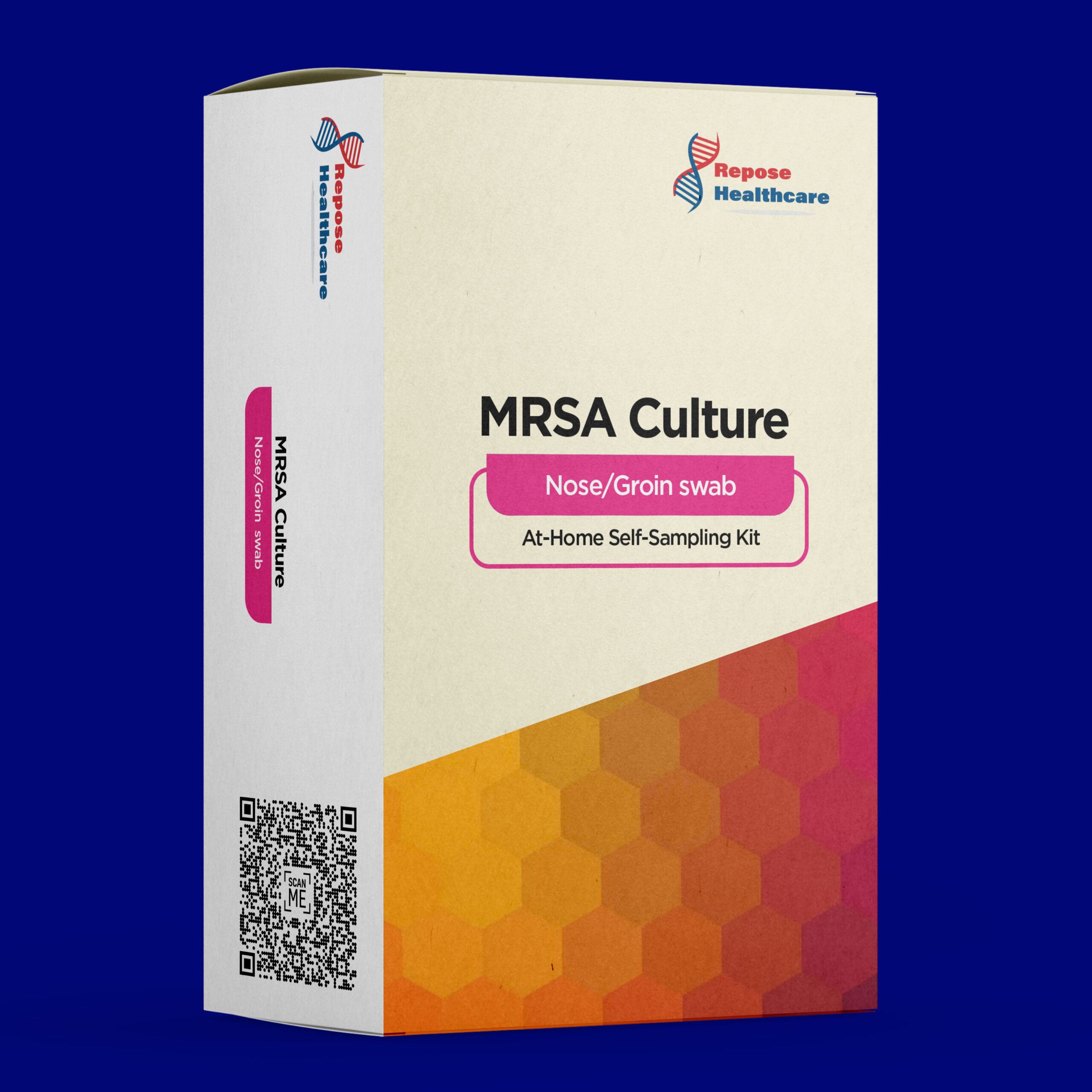
When it comes to MRSA screening UK, MRSA is always diagnosed and treated in a hospital setting. However, you can get MRSA screening UK tests for home from Repose. These pre-operative MRSA screenings include nose and groin swabs for MRSA (similar to what doctors do). However, these at-home MRSA nose and groin swab tests are predominantly for adults – they should only ever be used after discussing with a doctor, and you should always discuss results with your GP or paediatrician.
Either get tested in a medical setting or choose a home MRSA test kit.
You can order the MRSA home test kit UK online (with free tracked UK delivery and returns) that includes a self-collect MRSA swab kit. After taking the sample, you return it to a UKAS-accredited lab (ISO 15189). There is no GP referral needed.
Alternatively, get screened in an NHS hospital, where they perform a swab test and later send to labs to check for MRSA.
Some people need regular MRSA screenings, including healthcare workers, people with a history of MRSA, those living with vulnerable individuals, and people preparing for elective surgery.
There are certain MRSA risk factors, also known as the 5 C’s of MRSA.
Crowding: crowding and skin-to-skin contact go hand in hand.
Skin-to-skin contact: touching skin can easily spread MRSA.
Compromised skin: this includes cuts, grazes, rashes, or wounds.
Contamination: such as contaminated towels or shared equipment.
Cleanliness problems: a lack of cleanliness and hygiene.
MRSA is commonly spread in areas like gyms, changing rooms, prisons, schools, and nurseries. To prevent MRSA skin infections, simple habits like regular handwashing, covering wounds, and avoiding sharing towels and razors can help.
So, what does MRSA look like? The truth is that MRSA skin bumps look like a lot of other skin infections, and you cannot reliably tell what it is from appearance alone. Generally, though, they look like red, swollen, painful boils or abscesses with a strong resemblance to spider-bite-like bumps. The area feels like warm skin, similar to cellulitis, and they sometimes produce pus-filled lesions. Also, people may have a fever or feel generally unwell.
Do not pick or squeeze at MRSA bumps; instead, keep the area covered and clean and seek medical advice. You can also use one of Repose’s MRSA culture tests to check for colonisation status between hospital appointments (if you get MRSA regularly).
It’s also important to note that MRSA infections generally occur in healthcare settings, and this is known as HA-MRSA. Community-associated MRSA is known as CA-MRSA.
It’s normal to wonder: where do you catch MRSA?
Community: This includes the five C’s of gyms, sports clubs, prisons, shared accommodation, schools, and households where people share towels or razors.
Healthcare Settings: MRSA in hospitals is common. It is called healthcare-associated MRSA (HA-MRSA) and happens in surgical wards, ICUs, and nursing homes. It’s particularly common there because individuals have weakened immune systems and surgical wounds or are using catheters.
So, can you buy an MRSA test online? While there is no instant MRSA self test strip that gives instant results at home, there is the Repose home MRSA Nose & Groin test that targets the two most common colonisation sites. Be aware that a positive MRSA result means you’re carrying the infection, and you should discuss it with a medical professional. Repose will always guide you on the next steps and can refer you to trusted private GP partners or advise you to see your own GP if your results need clinical attention.
Yes – MRSA is a strain of Staphylococcus aureus, so an MRSA eye infection is possible. Styes are usually caused by staph bacteria infecting the oil glands in the eyelid. Some signs of a hordeolum (style) include:
Most cases of a style can easily be managed with warm compresses, but in some cases, doctors may check for an MRSA eye infection or a Staphylococcus aureus eyelid infection. They will typically do this if there are recurrent styles, repeated infections, or a history of MRSA skin infections.
An at-home MRSA test like the one from Repose does not test the eye area. Instead, it shows whether you are carrying MRSA in the nose or groin area, which may be useful if you experience repeated infections. If you have severe eye pain, vision changes, spreading redness, or feel very unwell, it’s important to seek urgent medical attention rather than relying on a home test kit!
Our home testing kits are designed to be simple, reliable, and easy to use. After placing your order, your kit will be delivered to your address with clear instructions for collecting your sample (e.g., blood, saliva, or urine or swab). Once collected, return your sample to our UKAS-accredited laboratory using the prepaid packaging. Your secure digital results will be available within 1–3 working days of the lab receiving your sample.
Yes. All tests offered by Repose Healthcare use clinically validated methods and are processed by fully accredited UK laboratories. The results are as accurate as those provided through traditional GP or private clinic services.
No. Our tests are available without the need for a prescription. They are intended for individuals who wish to proactively monitor their health in a private and convenient way.
Your results will be delivered through a secure online portal or an encrypted email, with a password sent separately to you, accompanied by easy-to-understand explanations and clear reference ranges. If any result requires clinical attention, we will guide you on appropriate next steps.
At Repose Healthcare, we prioritise your safety and peace of mind. If your results fall significantly outside the normal range, the following steps will be taken:
Our kits are suitable for adults who wish to monitor key health markers, including cholesterol, vitamin and hormone levels, blood sugar, infections, STIs, and genetic risk factors. Some tests may have age or gender-specific guidance, which will be clearly outlined on the product page.
Orders placed before 2:00pm are dispatched the same day. Kits are sent via tracked Royal Mail 24-hour service and typically arrive within 1–2 working days.
You may cancel your order for a full refund if the kit has not yet been dispatched. Once a kit has been shipped or used, we are unable to offer a refund for hygiene and regulatory reasons. If your kit arrives damaged or incomplete, please contact our customer care team within 14 days, and we will arrange a replacement at no cost.
Absolutely. Our partner laboratories are UKAS-accredited and operate under strict quality control protocols. These labs are used by both NHS and private healthcare providers, ensuring your results are handled with the highest standards.
Yes. Repose Healthcare takes data protection very seriously. We comply fully with the UK General Data Protection Regulation (UK GDPR) and all relevant data privacy laws. Your personal and medical data is encrypted, stored securely, and never shared with third parties without your explicit consent.
You can view our full Terms & Conditions, Privacy Policy, and Cookie Policy at the bottom of our website. These documents outline your rights, our responsibilities, and how we handle your data, orders, and any communications with you.