Getting your head around your pregnancy scan dates is a huge part of the antenatal journey. In the UK, you'll be offered at least two routine ultrasound scans on the NHS as standard: a dating scan around 10–14 weeks and an anomaly scan around 18–21 weeks. These dates aren't just picked at random; they are specifically timed to monitor your baby's health and development at crucial stages, giving you actionable insights for your pregnancy care.
When you're pregnant, there are so many new appointments and milestones to track. Figuring out your scan timeline is one of the very first things you'll do. It's best to think of these scans as a roadmap for your baby's development, giving you and your healthcare team vital information at just the right moments.
Of course, the main point of these appointments is to check that everything is progressing as it should. But they're also unforgettable moments—the first time you see your baby on screen or hear that tiny, racing heartbeat. This guide will walk you through the standard UK scan schedule and explain exactly why the timing of each one is so important, so you know exactly what to do and when.
Let's break down the typical timeline for antenatal scans provided by the NHS. This visual guide gives you a clear picture of the journey, from your first scan to later checks.
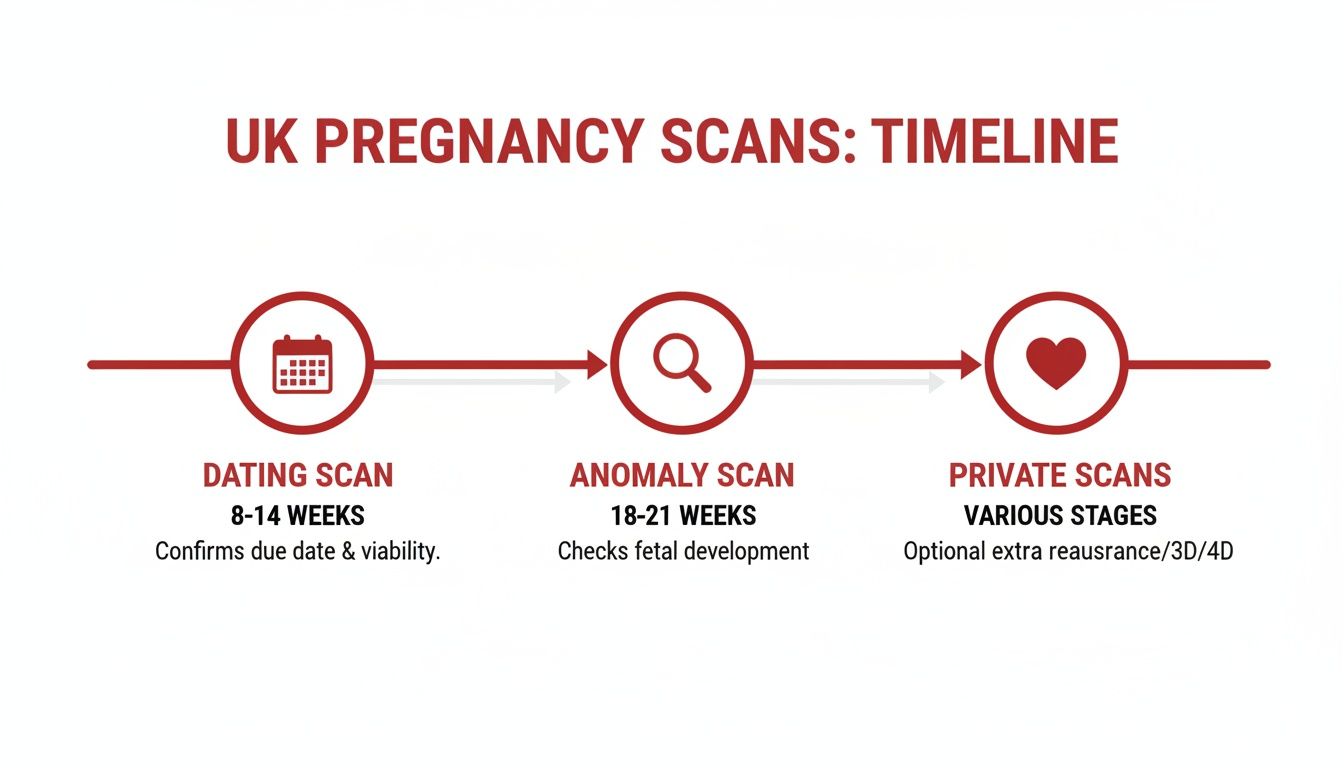
As you can see, the two core NHS scans are the dating and anomaly scans. The timeline also shows where optional private scans can fit in if you’re looking for extra reassurance along the way.
To make it even clearer, here’s a quick overview of the standard NHS scans.
| Scan Type | Typical Timing (Weeks) | Primary Purpose |
|---|---|---|
| Dating Scan | 10–14 | To determine your due date, check the number of babies, and see the heartbeat. |
| Anomaly Scan | 18–21 | A detailed check of your baby’s physical development, looking at bones, organs, and the placenta. |
This table covers the essentials, but we'll dive into what each scan involves in more detail in the following sections.
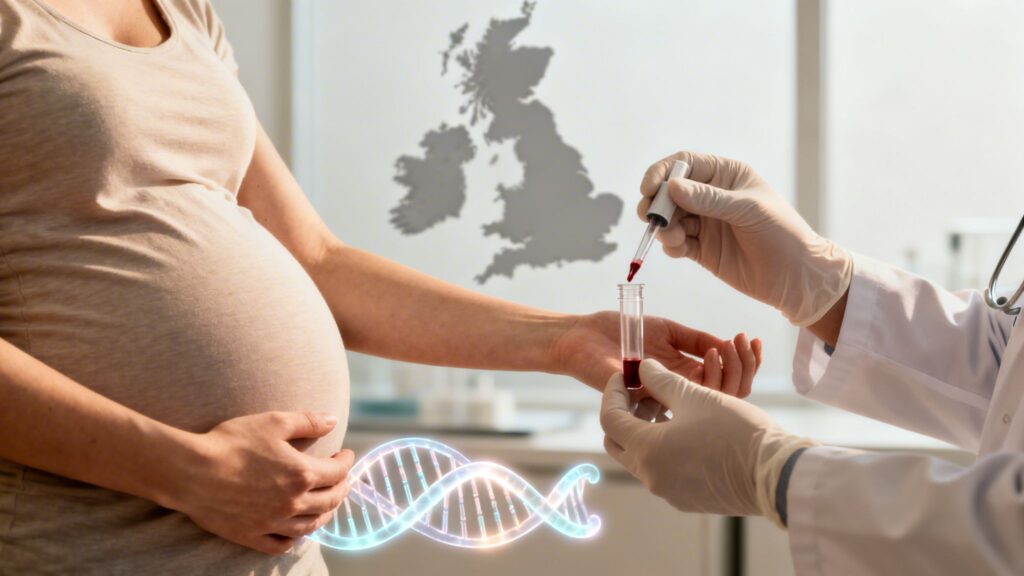
Beyond the standard pathway, some parents-to-be choose to explore extra screening for more detailed genetic information. For example, if you want more insight than the standard combined screening, a private NIPT test can offer deeper insights into your baby's health much earlier in your pregnancy, from just 10 weeks.
Actionable Insight: Only about 5% of babies are born on their actual due date. The date you're given at your scan is a brilliant, scientifically-backed estimate, but it helps to think of it more like an "estimated due window." Use this date to plan, but be prepared for baby to arrive a week or two on either side.
Getting a handle on your scan dates is just one piece of the puzzle. A good preparing for baby arrival checklist can help you feel calm and organised as you get ready to welcome your newborn. Knowing what to expect with your scans is a great first step towards feeling ready for the big day.
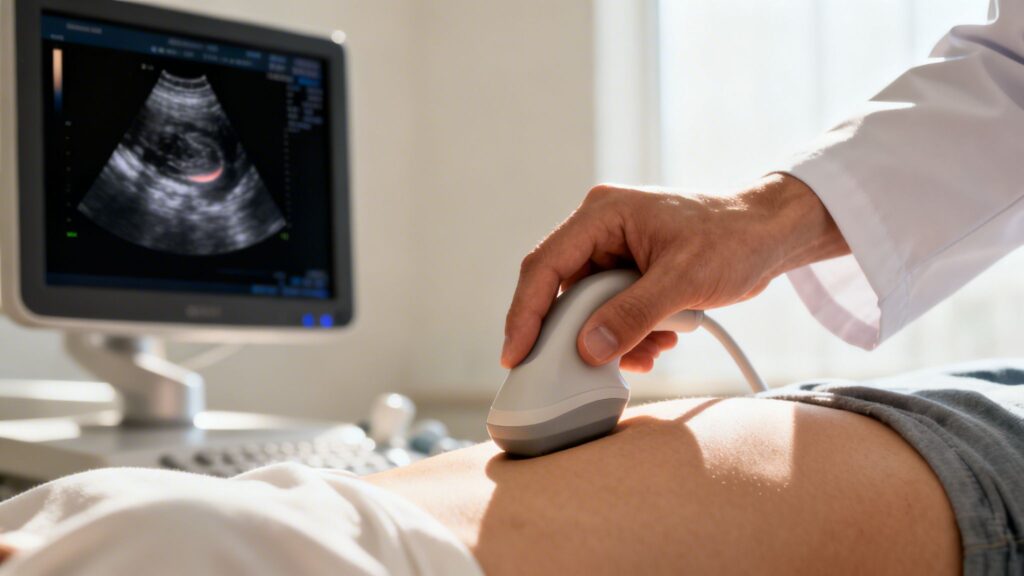
That first official ultrasound, often called the dating scan, is one of the most exciting and nerve-wracking moments of early pregnancy. It’s usually scheduled somewhere between 6 and 14 weeks, and for most parents-to-be, it's the moment everything suddenly feels incredibly real. Seeing that tiny, flickering heartbeat on the screen for the first time is a memory you won't forget.

The main job of this scan is to give you a reliable Estimated Due Date (EDD). While your midwife will have given you a rough date based on your last menstrual period (LMP), that method isn't always accurate, especially if you have irregular cycles. Instead, the sonographer will take a very precise measurement of your baby from the top of their head to their bottom—what's known as the Crown-Rump Length (CRL).
This measurement is the most accurate way to date a pregnancy in the first trimester. In fact, for scans done between 11-14 weeks, 68% of women give birth within ±11 days of the date predicted. That’s a lot more precise than LMP dates, which can be off by two weeks or more in a staggering 40% of pregnancies. Getting this date right is crucial for planning all your future antenatal care.
Depending on how far along you are, the scan can be done in two ways. The most common is a transabdominal scan, where warm gel is put on your tummy and a probe is gently moved over your skin. If it's very early on (usually before 10 weeks), you might need a transvaginal scan to get a clearer picture. This involves a small, lubricated probe being carefully inserted into the vagina, which sounds a bit daunting but isn't usually uncomfortable.
During this key appointment, the sonographer will check a few important things:
Actionable Insight: It's worth remembering that this dating scan sets the timetable for everything that follows. Crucial tests, like the combined screening for Down's, Edwards', and Patau's syndromes, have to be done within a very specific window, so the accuracy of this first scan is vital. This is also when other tests are planned, so it can be helpful to read up on what to expect from pregnancy blood tests and their result times.
If waiting for your first NHS scan feels too long, especially if you're feeling anxious due to previous losses or fertility treatment, you can book a private early reassurance scan. These can be done from as early as 6 weeks and can offer some much-needed peace of mind.
Often called the ‘20-week scan’, this is one of the most detailed and comprehensive checks you’ll have during your entire pregnancy. It usually takes place between 18 and 21 weeks, and it goes far beyond just confirming your due date.
This appointment provides a thorough, top-to-toe examination of your baby’s physical development. Think of it as the first detailed survey of your baby's anatomy, checking that everything is growing as it should be before the final trimester.

You can expect this scan to be longer and more involved than your dating scan, often lasting around 30 minutes. The sonographer will meticulously work through a checklist, looking at your baby’s bones, heart, brain, spinal cord, face, kidneys, and abdomen.
The main goal of the anomaly scan is to check for 11 specific rare conditions, including things like spina bifida and serious cardiac abnormalities. It gives you an incredible amount of information, with the sonographer paying close attention to several key areas.
This comprehensive check is a standard part of antenatal care in the UK and Ireland and is designed to identify potential issues early on. Sometimes, what's seen on the scan can lead to conversations about further diagnostic options. For example, if your anomaly scan shows a "soft marker" that slightly increases the chance of a chromosomal condition, you might decide to proceed with a private NIPT test for a more definitive answer without the risks of an invasive test. You can learn more by reading about NIPT test accuracy and what the statistics mean.
The anomaly scan can detect around 9 out of 10 babies with spina bifida. It’s important to remember, though, that some conditions may not be visible on a scan. A 'normal' result doesn't guarantee the absence of all issues.
To get ready for the scan, just wear comfortable, loose-fitting clothing. Unlike the dating scan, you usually don’t need a full bladder for this appointment, which is a relief for many! Actionable Tip: Write down any questions you have beforehand so you don’t forget in the moment.
For most parents-to-be, this scan is a hugely reassuring and exciting experience. Sometimes, however, the sonographer might spot something unexpected or simply can't get a clear view of a particular area. If this happens, they will tell you on the day, but it absolutely does not automatically mean something is wrong.
You might be asked to come back for another scan a week or two later. This is often just because the baby was in an awkward position, making it hard to see everything clearly. If a potential health condition is suspected, you'll be referred to a specialist fetal medicine team for further scans and support. This can be a very anxious time, but the NHS has clear pathways to ensure you get expert care and counselling to help you understand all your options.
As you head into the final stretch of your pregnancy, your midwife or doctor might mention you need an extra ultrasound. This is often called a growth scan. Hearing you need an extra check can feel a bit unsettling, but it’s almost always just a way for your care team to get a better look at how your baby is doing.
These scans aren’t part of the standard NHS schedule for every pregnancy. Instead, think of them as an extra check-in, recommended for specific reasons to make sure your baby is thriving as you get closer to your due date.
There are a few common reasons your midwife or doctor might suggest a growth scan. It’s all about being proactive and gathering more information, not a sign that something is definitely wrong.
Some of the usual triggers include:
During a growth scan, the sonographer takes a few key measurements to estimate your baby’s size and current weight. This information is then plotted on a growth chart, which shows how your baby is tracking along their own personal growth curve (or centile line).
Actionable Insight: A growth scan is like a progress report for your baby. It’s not a test to pass or fail, but simply a tool that gives you and your care team more information to work with. For example, if the scan shows the baby's growth is slowing, your team might suggest increased monitoring or even an earlier delivery to ensure the best outcome.
The main things they measure are:
These scans are particularly important if there have been any difficulties with dating the pregnancy. UK guidelines are very clear that the first-trimester scan is the most accurate way to establish a due date, as dating becomes much less precise after 20 weeks. Getting the dates wrong can complicate decisions later on, especially for the nearly 700,000 pregnancies each year, making this third-trimester monitoring even more valuable. You can learn more about how dating accuracy impacts pregnancy care in the UK by reading this overview on dating guidelines.
Ultimately, a growth scan is an incredibly useful tool. It can offer brilliant reassurance that everything is on track, or it can flag any issues early, allowing your team to step in with the right support to ensure the best possible outcome for you and your baby.
It’s a classic point of confusion for many newly pregnant women. Your period-tracking app confidently gives you one due date, but after your first ultrasound, your midwife gives you a completely different one. So, which one should you trust?
While tracking your cycle is a brilliant way to understand your body, healthcare professionals in the UK and Ireland will almost always go by the date from your pregnancy scan. And for very good reason.
The traditional way of guessing a due date relies on the first day of your Last Menstrual Period (LMP). This method works on the assumption of a perfect 28-day cycle where ovulation happens like clockwork on day 14. But for so many of us, our bodies don't follow a textbook script. This makes the LMP calculation more of a well-intentioned guess than a precise measurement.
Even if you’re a meticulous tracker, pinpointing the exact moment of conception is incredibly tricky. A few common factors can easily throw off an LMP-based due date:
Before you have your first scan, a home pregnancy test is usually the first confirmation you'll get. Getting your head around understanding pregnancy tests and what the results really mean can give you a great head start for your first chat with the midwife.
An early pregnancy scan, especially one in the first trimester, gives us a direct window into your baby’s development. Instead of relying on assumptions about your cycle, a sonographer measures your baby’s Crown-Rump Length (CRL).
This measurement gives us a precise, biological timestamp that is incredibly consistent across all healthy pregnancies in the first 14 weeks.
Actionable Insight: Think of an early ultrasound as a developmental clock. It measures the baby’s actual size to work out its gestational age, completely bypassing the guesswork of LMP calculations. Your actionable step is simple: update your calendar, apps, and diary with the Estimated Due Date (EDD) from your dating scan. Use this date for all future planning.
There's a reason this method became the gold standard. The use of ultrasound for dating pregnancies in the UK goes all the way back to the work of Professor Ian Donald in 1958. By the 1970s, the data was clear: while 24% of women had uncertain due dates using their period, an amazing 95% delivered within 12 days of an ultrasound-predicted date. This was a huge leap forward, leading to its widespread adoption by the NHS. You can discover more about the historical impact of ultrasound on due date accuracy.
So, when your scan date is different from your app’s prediction, trust the scan. It gives you the most reliable timeline for your antenatal care, making sure all your future checks and screenings happen at exactly the right time for you and your baby.
Even with a timeline in hand, it’s completely normal to have more questions swirling around. This is an exciting, and let's be honest, sometimes overwhelming time. We get it. Here are some straightforward answers to the questions we hear most often from expectant parents.
This is probably the most common question we get asked! Yes, it’s often possible to find out your baby’s sex during the big 20-week anomaly scan. But it's good to remember that this isn't the main reason for the appointment. The sonographer's top priority is carrying out a detailed health check of your baby from head to toe.
Whether they can tell you depends on a couple of key things:
Actionable Tip: If you’re keen to know, your best bet is to mention it to the sonographer right at the start of your scan. That way, they can keep an eye out for a good opportunity. For those who want a more definite answer, many people opt for a private gender reveal scan, which you can usually book from around 16 weeks.
Thankfully, preparing for your scans is pretty simple. For your first scan (the dating scan), you’ll usually be asked to come with a full bladder. Drinking about a pint of water an hour or so before you go in helps to lift your uterus up, giving the sonographer a much clearer picture of your baby.
For the 20-week anomaly scan, a full bladder isn't usually necessary.
Actionable Tip: Wear comfortable, two-piece clothing, like a top and trousers or a skirt. It’s a small thing, but it makes life so much easier when you only need to lift your top and lower your waistband for the gel, rather than wrestling with a dress.
Always pop your maternity notes in your bag for every appointment. It's also a great idea to jot down any questions you have on your phone or in a notebook beforehand, so you don’t forget them in the moment.
NHS and private scans are best thought of as serving two different, but equally valid, purposes.
NHS scans are purely diagnostic. They follow strict clinical guidelines and their sole focus is on monitoring your baby’s health and development. They provide the essential medical information needed for your antenatal care pathway.
Private scans, on the other hand, are generally about reassurance and bonding. They offer things the NHS can't, like more flexible appointment times, longer slots, and the chance for more family members to be in the room with you.
Popular private scans include:
If you do go down the private route, it’s crucial to make sure the clinic is regulated by the Care Quality Commission (CQC). And remember, a private scan is an addition to your NHS care, never a replacement for it. A practical example is using a private NIPT test for early screening, then continuing with your standard NHS anomaly scan at 20 weeks.
At Repose Healthcare, we believe in giving you the tools to feel empowered and informed. Navigating your pregnancy journey is just one part of looking after your overall health. Our at-home testing kits offer a private, convenient way to keep an eye on everything from hormone levels to key health markers, right from your own home. Take a look at our range of tests at https://reposehealthcare.co.uk and feel more in control of your health journey.