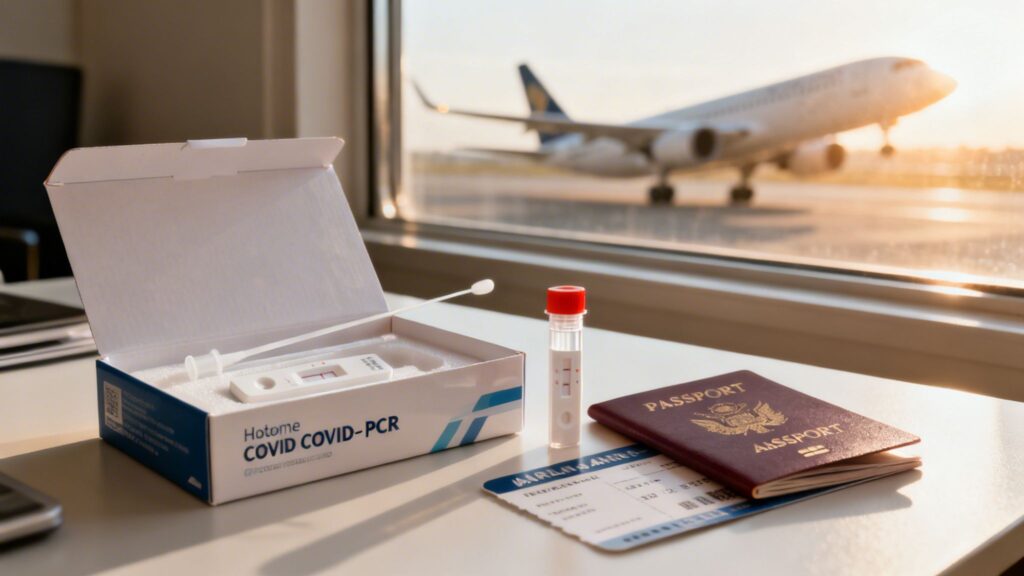
Think of a fit to fly certificate as your health passport for air travel. It's an official document signed off by a healthcare professional, confirming you're well enough to fly without risking your own health or the health of others. For example, if you're travelling soon after recovering from a respiratory illness, this certificate proves to the airline that you're no longer contagious and can safely handle the flight. It’s an actionable step to ensure a smooth boarding process.

A fit to fly certificate has become a crucial part of modern international travel, and it’s about more than just COVID-19. Its main job is to verify that a passenger’s health won’t be put at risk by the stresses of flying, like the changes in cabin air pressure and lower oxygen levels.
It also serves to protect your fellow passengers and the crew from any contagious illnesses. This is exactly why so many airlines and destination countries now insist on seeing proof of fit to fly testing before you can even get on the plane. A practical example is a passenger with a severe heart condition who needs a doctor's note to confirm flying is safe, or a traveller heading to a destination with strict infectious disease screening.
| Aspect | Description | Actionable Insight |
|---|---|---|
| Purpose | A medical document confirming you are healthy enough for air travel. | Action: Always check your destination and airline's rules before your trip to see if a certificate is required. |
| Who Needs One? | Travellers post-illness, with chronic conditions, or going to specific destinations. | Action: If you have a chronic illness, speak to your GP about getting a fit to fly letter well in advance of your travel date. |
| Test Type | Usually a PCR or supervised Antigen test to check for active infections like COVID-19. | Action: Verify the exact test type (e.g., PCR, Antigen) required. Booking the wrong one will invalidate your certificate. |
| Timing | Tests must be taken within a tight window before travel (e.g., 24-72 hours). | Action: Calculate your testing window by counting back from your flight's departure time. Set a calendar reminder. |
| Documentation | A formal certificate with your details, test result, date, and lab/clinic info. | Action: Once you receive your certificate, immediately check that all details match your passport. Save a digital and print a physical copy. |
This table neatly summarises what’s involved, but let's dive into the specifics of when you'll actually be asked for one.
You might be surprised how often a certificate is needed, and it's not just during a global pandemic. Here are a few real-world situations where you could be asked for proof of health:
Even now, health surveillance shows why these checks are still in place. For instance, UKHSA data from early 2026 showed persistent virus circulation, with SARS-CoV-2 positivity at 7%, flu at 2%, and RSV at 3%. With nearly a third of UK consumers planning to fly more, the Civil Aviation Authority (CAA) makes it clear that health professionals must assess a traveller's stability, which often means this paperwork is non-negotiable. You can read the official guidance for health professionals on the CAA website.
Actionable Insight: If you need to prove you're free from an infectious disease for travel, getting a certificate is your most direct course of action. It provides documented proof that you’ve been medically assessed and are safe to travel, giving you, the airline, and immigration officials confidence for a smooth journey.
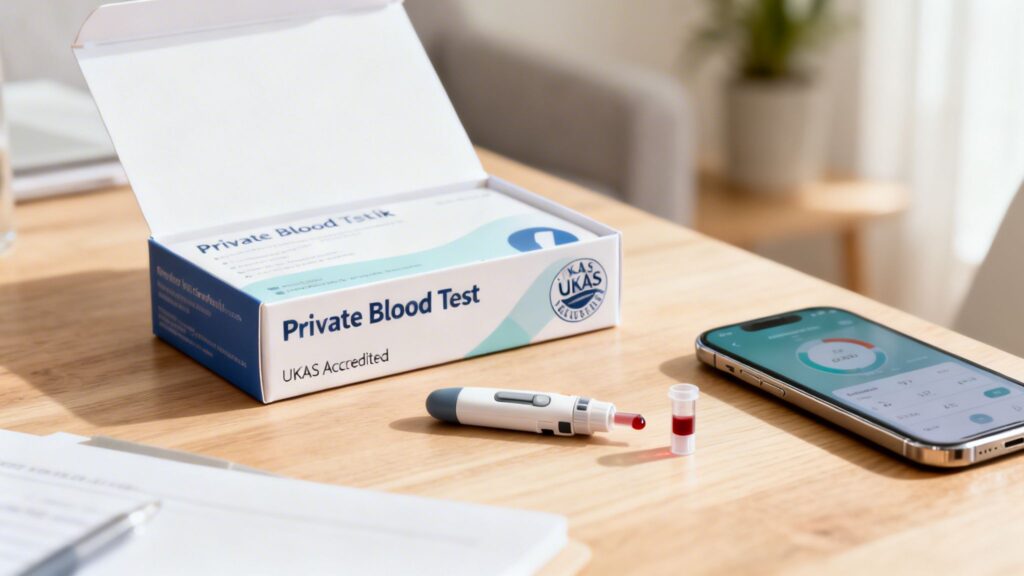
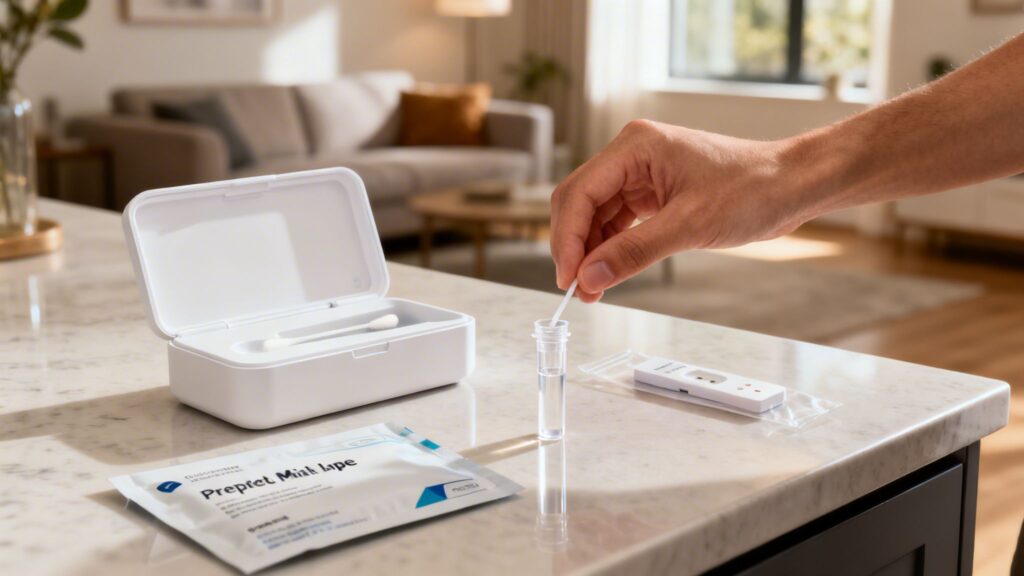
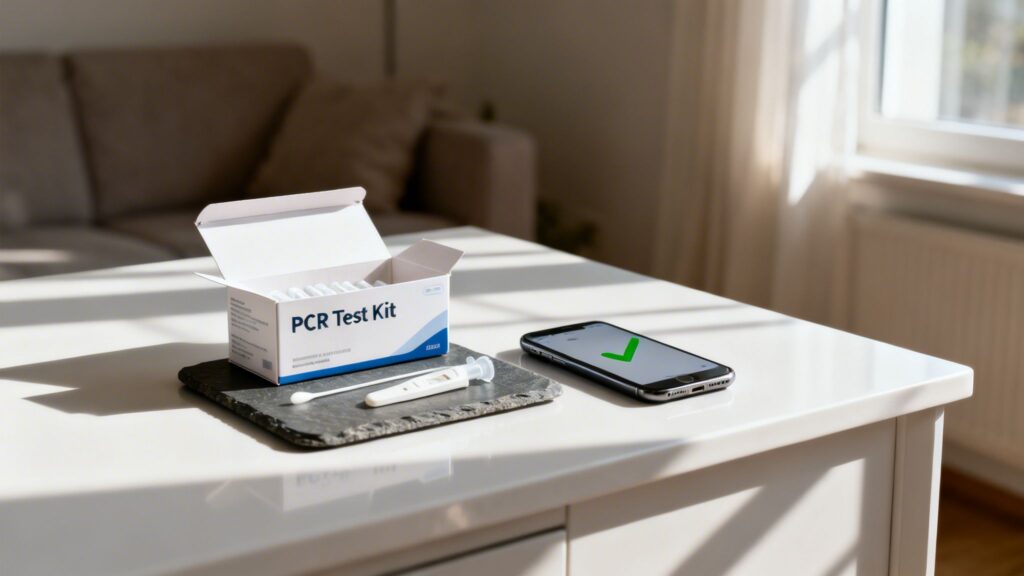
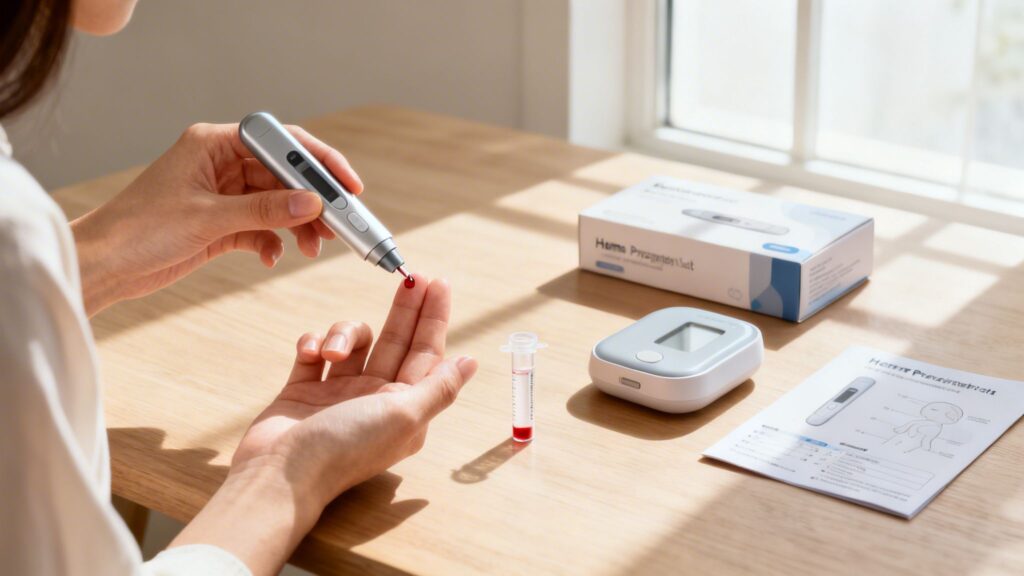
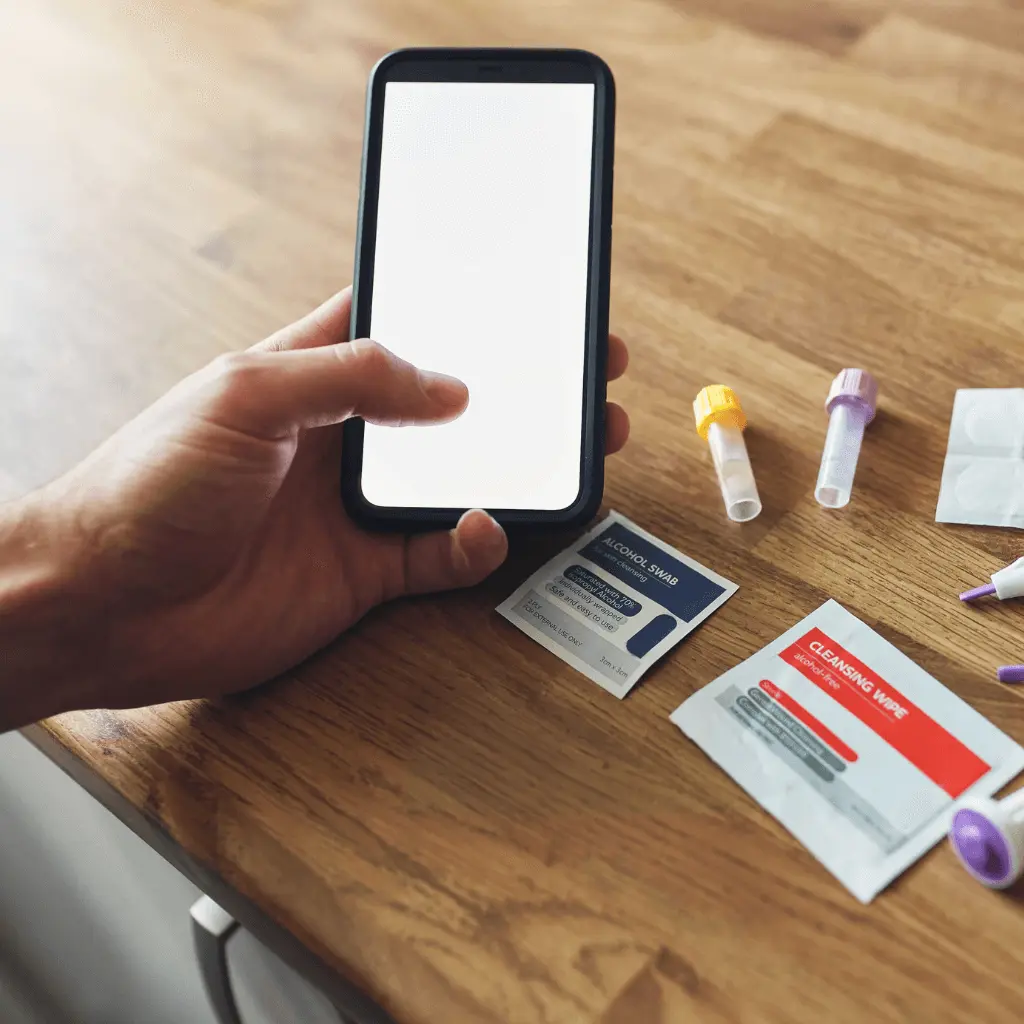
Thankfully, getting this vital document no longer means a trip to a clinic. You can order one of our convenient At-Home PCR Test Kits, collect a sample in the comfort of your home, and receive a certified travel document without the usual hassle.
When you're getting ready for a trip, figuring out which fit to fly test you need can be a bit of a headache. Most of the time, it comes down to two main choices: a PCR test or a Lateral Flow (Antigen) test. The actionable first step is to check your destination's official government travel advisory website—this will state exactly which test is accepted.
Let’s break it down. Think of a PCR (Polymerase Chain Reaction) test as a high-tech forensic investigation. It meticulously scans a sample to find even the smallest traces of a virus's genetic material (RNA). This makes it incredibly sensitive and the certified gold standard for accuracy.
On the other hand, an Antigen test, which you might know as a lateral flow test, is more like a quick security check. It doesn't look for genetic code; instead, it searches for specific proteins (antigens) that sit on the virus's surface. It’s a much faster process but, as a trade-off, it's a bit less sensitive than a PCR.
The superb accuracy of PCR tests is exactly why so many countries with strict health rules insist on them. Because they can spot a virus very early on in an infection—sometimes even before you feel any symptoms—they offer the highest level of confidence for both airlines and border officials.
Actionable Insight: If your destination requires a PCR test, you must plan ahead. Order your test kit in advance and schedule your sample collection to allow for lab processing time. Our At-Home PCR Test Kits are designed for this, with results typically available 1-3 business days after the lab receives your sample.
The number one benefit of an Antigen test is its speed. You can often have your result in just 15-30 minutes. This convenience makes it a great option for destinations with more relaxed entry rules or for travellers who find themselves needing a last-minute certificate.
So, how do you pick the right one? The simple truth is: your airline and destination choose for you. It is absolutely vital to check the official travel requirements for the country you're flying to and the airline you're using. Some might be happy with a rapid Antigen test, while others will only let you in with a certificate from a PCR test.
For example, a business trip to Japan, known for its stringent entry protocols, will almost certainly require a PCR test. In contrast, a short holiday to a European destination might only require an Antigen test.
Actionable Insight: Before you buy any test, create a simple checklist: 1. Google "[Destination Country] entry requirements". 2. Check your airline's travel advisory page. 3. Confirm the required test type (PCR or Antigen) and the timing window (e.g., 72 hours). This simple action prevents you from wasting money on the wrong test.
For those situations where you need that gold-standard accuracy and a certificate from a UK-accredited lab, our straightforward and reliable At-Home PCR Test Kits are designed to meet international travel standards.
When it comes to fit to fly testing, timing is everything. One of the most common and costly mistakes travellers make is getting the test validity window wrong. Crucially, this period starts from the moment your sample is collected, not from when you get your result.
Getting this wrong can have some pretty serious consequences, like being turned away at the check-in desk with an invalid certificate. To avoid this travel nightmare, you absolutely must understand your destination’s rules and plan backwards.
Let's walk through a real-world example to make this crystal clear. Say you have a flight to Dubai leaving at 8 PM on a Friday. The rules for Dubai state you need a test taken within 72 hours of departure.
Here's your actionable plan:
Actionable Insight: A simple miscalculation can invalidate your entire effort. Use a time-and-date calculator online to double-check your window. Always build in a buffer for lab processing and potential postage delays to avoid any last-minute panic.
Even as we've settled into a new normal for travel, pre-departure health checks are still very much a part of the picture. With common viruses still circulating, timely testing remains a key part of travelling responsibly. For instance, recent UKHSA data for the 2025-2026 season shows influenza positivity at 12.2% and SARS-CoV-2 at 5.1%, with the highest rates affecting children. This just goes to show why vigilance is still so important, especially when travelling as a family. You can find more details in the national flu and COVID-19 surveillance report.
The type of test you choose—PCR or Antigen—has a big impact on your timeline. The infographic below breaks down the key differences.

As you can see, while Antigen tests give you speed, PCR tests offer the highest accuracy. This trade-off is something you'll need to factor into your schedule, especially considering lab processing times.
Juggling the test validity window with result turnaround times can be a stressful balancing act. This is where a reliable at-home testing service can be a real game-changer. At Repose Healthcare, we've designed our entire process around convenience and giving you peace of mind.
Here’s a practical example of how our service helps you nail your timeline for a PCR test:
This dependable process removes the guesswork, letting you manage your travel prep confidently and focus on the exciting part—packing for your trip.

Getting a fit to fly certificate from home is far easier than you might think. We've designed the whole process to be as convenient as possible, letting you skip the clinic queues and handle your travel health checks on your own time. With Repose Healthcare, you get a simple, direct path to the official documents you need.
It all starts with ordering the right test. For example, if you need to test for a range of respiratory viruses, you can visit our website and choose the Respiratory PCR Test. We’ll send a complete kit straight to your door with tracked delivery, so you’ll know exactly when to expect it.
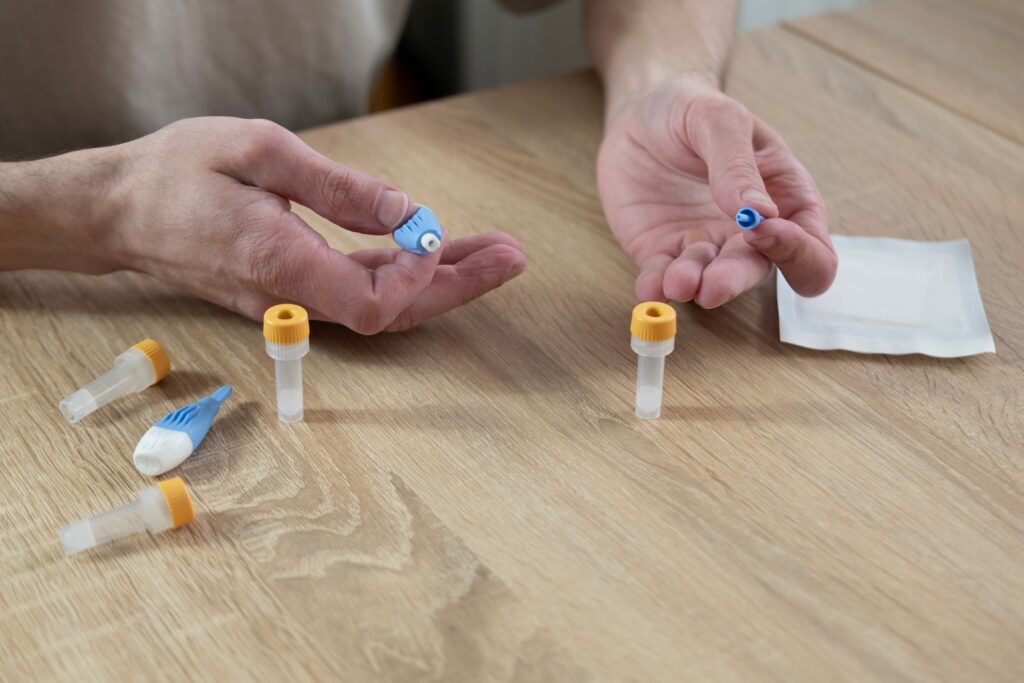
When your kit arrives, you’ll find the process is refreshingly straightforward. We’ve boiled it down into a few simple, actionable steps to make sure you get a high-quality sample – that’s the key to getting accurate results and a valid fit to fly certificate.
This at-home approach puts you firmly in control. You can manage your fit to fly testing without having to shuffle your schedule for a clinic appointment, which makes your travel prep that much smoother.
After you post your sample, it travels directly to one of our UK-accredited partner laboratories. These facilities use clinically robust methods to process every sample, guaranteeing the results are of the highest standard and recognised by airlines and authorities across the globe. It's this validation that makes your final certificate a trusted travel document.
At-home fit to fly testing really became a cornerstone of UK air travel safety during the pandemic. As travel has bounced back, with UK airspace seeing a record 2,536,156 flights in 2025, the demand for convenient, reliable testing has only grown. You can explore the government's official surveillance reports to see just how health monitoring continues to shape the way we travel.
Actionable Insight: We know that when a trip is on the line, speed is everything. Our partner labs typically process samples and return results within 1-3 business days of receiving your sample. To ensure the fastest turnaround, post your sample from Monday to Thursday.
The moment your result is ready, we’ll notify you. Your official Fit to Fly certificate will be uploaded to your secure online dashboard, all ready for you to download and print. It contains all the necessary details to ensure you have a seamless experience at the airport.
If your travel plans require a certified PCR test, you can get started by ordering our popular Respiratory PCR Test today.
Your fit to fly certificate is your golden ticket for boarding the plane, so spending a few moments confirming that every detail is correct is one of the most important pre-travel checks you can make. It’s a simple action that provides complete peace of mind.
Even a small error, like a mistyped name, can cause significant delays or even result in being denied boarding. Think of it like double-checking your passport and flight details before you leave for the airport – your fit to fly testing certificate needs the same level of care to ensure a smooth journey.
Before you file it away, it's crucial to pull up your certificate and check it against your passport and booking confirmation. Airline staff are trained to look for discrepancies, and making sure everything matches perfectly is non-negotiable.
Here's a practical checklist to help you verify your certificate has all the essential information.
| Information Field | Example | Actionable Check |
|---|---|---|
| Your Full Name | John Michael Smith | Does it match your passport exactly? No nicknames or abbreviations. |
| Your Date of Birth | 15/04/1985 | Is the format correct and does it match your travel documents? |
| Your Passport Number | X12345678 | Have you cross-referenced every single digit and letter? |
| The Test Type | RT-PCR | Does this match the specific test required by your destination? |
| Sample Collection Date & Time | 22/10/2024 at 09:30 | Is this within the valid time window for your flight? |
| Lab & Accreditation Details | Repose Health Labs (UKAS No. 12345) | Does it show an official, accredited lab? This proves its legitimacy. |
Every certificate issued by Repose Healthcare is specifically designed to meet strict international travel standards. Once you’ve ticked off all these points, you can be confident your document is ready for inspection.
The next step is making sure you can actually access your certificate when you need it. Our guide to how our service works explains how your certificate is delivered straight to your secure online dashboard, making this next part easy.
While we live in a digital world, technology isn’t always reliable, especially when you're on the move. That’s why the smartest, most actionable strategy is to have a backup for your backup.
Your Action Plan:
Having both versions means you are fully prepared, allowing you to approach check-in with total confidence.
Navigating the rules for fit to fly testing can feel like a minefield, but getting it right is the key to a stress-free journey. We get a lot of questions from travellers trying to make sense of the process. This section tackles the most common queries we see, with clear, actionable answers.
Getting your head around these points early on can save you a world of time and anxiety as you get ready for your trip. It's about making sure you tick all the boxes in the smartest way possible.
Getting a positive test result is never good news, especially when you have a trip on the horizon. The most important thing is to act fast and do the right thing for your health and for everyone around you. Your travel plans will have to be put on hold.
Here’s your immediate action plan:
Actionable Insight: A positive result means you are not fit to fly. Trying to travel would risk your own health and that of your fellow passengers and crew. Postponing your trip is the only responsible action to take. This is where having purchased comprehensive travel insurance becomes invaluable.
This question comes up all the time, and the answer is a firm no. NHS tests are there for people with symptoms or those who've been told to test by a healthcare professional. They are a core part of our public health system, not a travel concierge service.
Actionable Insight: Airlines and border officials need an official travel certificate that lists specific information, like your passport number, the exact time the sample was taken, and verifiable lab details. An NHS test result—whether it's a text or an email—simply doesn't have this level of detail and will be rejected. You must use a private provider whose service is designed for travel, like our At-Home PCR Test Kits, to get a valid certificate.
The rules for children are often one of the most confusing parts of planning a trip. There's no single, universal rule; it all comes down to your destination, the airline you're flying with, and your child's age.
Practical Example: A family flying to one destination might find their 6-year-old needs a PCR test. On the very same day, another family travelling to a different country might discover their 6-year-old is completely exempt.
Actionable Insight: Before booking anything, visit the official government travel advisory for your destination and check your airline's specific policy for children. This is the only way to get a definitive answer and avoid unnecessary tests or being denied boarding.
For a completely seamless experience, we always suggest ordering your fit to fly testing kit about a week before your testing window even opens. This gives you plenty of breathing room and builds a nice buffer into your travel prep.
Actionable Insight: Let's say your flight is on a Saturday and you need to test within the 72 hours prior (from Wednesday onwards). A smart, actionable timeline would be to order your At-Home PCR Test Kit on the Friday before. This ensures it arrives well before you need to take your sample, removing any stress about delivery times.
At Repose Healthcare, we aim to take the guesswork out of your travel health. Our at-home testing kits are designed to be simple, reliable, and accepted by airlines and authorities across the globe. Secure your travel-ready certificate with confidence by exploring our full range of at-home health tests at https://reposehealthcare.co.uk.