
Explore what causes low vitamin d levels and how to boost them

If you find yourself feeling constantly drained, especially during the UK’s long, grey winters, you’re certainly not alone. That persistent fatigue might be more than just the "winter blues." Often, the real culprit is a lack of vitamin D, and a key reason for this is simply our geography.
Here’s why: from around October to early March, the sun sits too low in the sky for its UVB rays—the specific type we need to make vitamin D—to reach us. Think of your skin as a solar-powered factory; if the right kind of sunlight isn’t hitting it, production shuts down completely. This makes understanding your personal levels the first practical step you can take.
Why Do So Many People in the UK Have Low Vitamin D?
That lingering tiredness and low mood that creeps in as the nights draw in could well be a sign of low vitamin D, a problem affecting a huge number of people across the UK and Ireland. It’s a simple environmental reality that puts us at a disadvantage for almost half the year.
But it’s not just about the winter months. Our modern, indoor lives play a massive role, too. Even in summer, spending most of the day in an office, at school, or at home means we miss the peak hours for sun exposure. When you add that to a diet that is typically low in vitamin D, you have the perfect storm for deficiency.
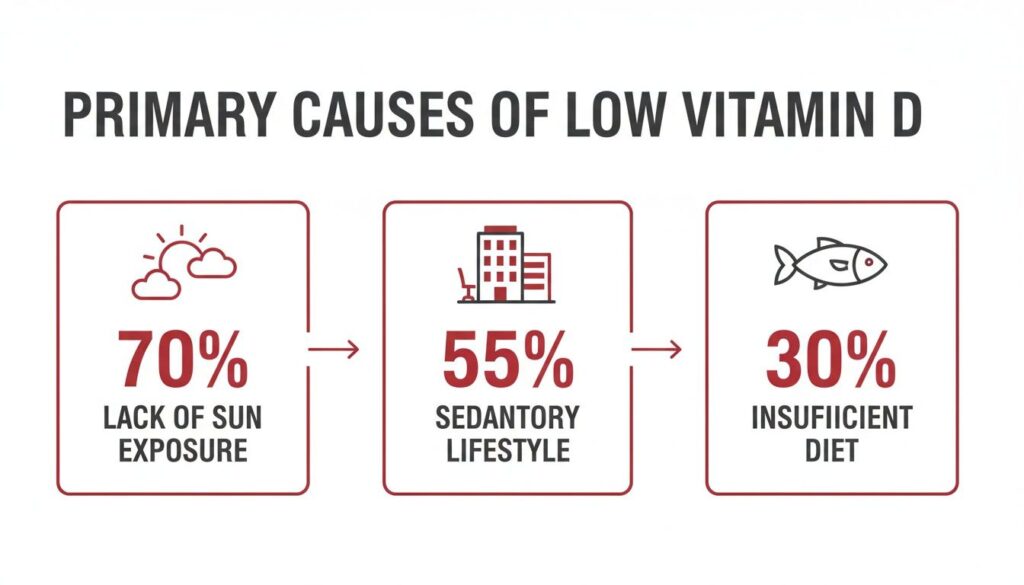
The Main Causes at a Glance
The infographic above neatly summarises the three big factors: not enough sun, our indoor lifestyles, and a diet lacking in vitamin D-rich foods. To give you a clearer picture, let’s break down exactly what this means in practice.
The table below summarises these key causes, why they happen, and who is most likely to be affected.
Primary Causes of Low Vitamin D at a Glance
| Cause | Why It Happens | Who Is Most Affected |
|---|---|---|
| Lack of Sunlight | In the UK & ROI, the sun isn’t strong enough for vitamin D production from October to March. | Everyone living in the UK/ROI, especially during winter months. |
| Indoor Lifestyle | Spending most daylight hours indoors (office work, at home) reduces sun exposure, even in summer. | Office workers, people who are housebound, and those who cover their skin for cultural or personal reasons. |
| Insufficient Diet | Very few foods are naturally rich in vitamin D, and fortified foods may not be enough to meet daily needs. | Vegans, vegetarians, and individuals with a limited diet or poor nutrient absorption. |
| Skin Pigmentation | Melanin in darker skin tones acts as a natural sunblock, meaning more sun exposure is needed to produce the same amount of vitamin D. | Individuals with naturally dark skin, including those of African, Afro-Caribbean, or South Asian descent. |
| Age and Health | The skin’s ability to produce vitamin D declines with age. Certain health conditions (e.g., Crohn’s, coeliac disease) can also impair absorption. | Older adults (over 65), people with obesity, and those with gut malabsorption issues. |
As you can see, a wide range of factors can put you at risk, many of which are completely beyond your control.
The seasonal impact is no small thing, either. Data from the UK Biobank study paints a stark picture. In an analysis of over 91,000 people, 23.1% were found to be deficient in winter, a massive jump from just 7.6% in autumn.
Actionable Insight: Because the symptoms of low vitamin D—like fatigue, back pain, and frequent colds—are so common, they are often dismissed. This makes testing the only definitive way to know your status and take control.
Understanding what causes low vitamin D is the first step. The next is to find out where you stand. A simple at-home diagnostic like our Vitamin D Test can give you the clarity you need to take action.
The UK’s Sunlight Problem and Your Lifestyle
When we try to figure out what causes low vitamin D, one massive factor looms over everyone in the UK and Ireland: where we live. Our northern spot on the globe creates a real environmental challenge for our health, especially between October and March.
Think of the sun’s UVB rays like a phone signal. For your skin to start making vitamin D, it needs a strong, direct signal. But during the UK’s autumn and winter, the sun hangs so low in the sky that its rays hit us at a really weak angle. The "signal" just isn’t powerful enough to connect with our skin and kick-start the vitamin D production line.
It doesn’t matter if you spend hours outside on a crisp, sunny winter’s day; your body simply cannot make any vitamin D from that weak sunlight. This six-month stretch is often called the "Vitamin D Winter", a time when your body has to rely entirely on the stores you hopefully built up over the summer.
How Modern Life Makes It Worse
This geographical handicap is made even worse by our modern lifestyles. Even during the brighter summer months when the sun’s signal is strong enough, most of us spend the best part of the day indoors.
- Office Jobs: A practical example is working 9-to-5 in an office. By the time you commute home, the peak sun has gone.
- Indoor Activities: We spend far more of our free time inside than previous generations, cutting down our chances for sun exposure even more.
- Commuting: Our travel to and from work usually happens in the early morning or evening when the sun’s rays are at their weakest.
It all adds up to a year-round problem. In winter, we can’t make vitamin D. In summer, we often don’t get the opportunity. This is a major reason why deficiency is so widespread.
Then there’s the perfectly sensible use of sunscreen. While it’s absolutely essential for protecting our skin from cancer, high-SPF sunscreens are designed to block UVB radiation—the exact rays we need to synthesise vitamin D. This leaves us in a tricky spot: protecting our skin from damage can accidentally lead to low vitamin D levels.
Actionable Insight: "Just get more sun" isn’t practical advice for most of the year in the UK. The most sensible first step is to understand your personal vitamin D status by getting tested. Once you have a clear picture of your levels, you can take the right steps for you.
An at-home diagnostic like our Vitamin D Test gives you the precise information you need to start managing your health effectively.
Why Your Diet Alone Is Not the Answer
Many of us think we can fix low vitamin D by simply eating healthier. It seems logical, but it’s a common mistake. While certain foods can give you a bit of a boost, they’re almost never enough to correct a proper deficiency on their own.
The truth is, the list of foods naturally packed with vitamin D is incredibly short. Your best bet is oily fish like salmon and mackerel. You’ll find smaller amounts in red meat and egg yolks, and some fortified foods like breakfast cereals, certain yoghurts, and plant-based milks also contribute. But the levels in these foods are often just a drop in the ocean compared to what your body actually needs.

The Numbers Behind the Foods
Let’s get practical. A 100g piece of farmed Atlantic salmon gives you around 13 micrograms (µg) of vitamin D. That’s a decent amount, just over the UK’s recommended daily intake of 10µg. But wild salmon has much less, and eating a big portion of oily fish every single day just isn’t realistic for most people.
What about other foods?
- Egg Yolks: You’d have to get through several large eggs every day to make a real difference.
- Fortified Milk: One glass might only give you 2-3µg, which is just a fraction of your daily target.
- Mushrooms: Only specific types that have been exposed to UV light contain any meaningful vitamin D.
This gap between what we eat and what we need is a huge problem across the UK. Studies have confirmed that a low dietary intake, paired with not taking supplements, is a key reason for vitamin D shortages. With so few food sources and our heavy reliance on sunshine, it’s no surprise that a staggering 98-100% of us don’t get the recommended 10µg a day from diet alone. Even when supplements are factored in, the picture only improves slightly. You can read more about these findings on the impact of diet and supplements on UK vitamin D levels.
Actionable Insight: This gap between what your diet provides and what your body needs is precisely why testing is so important. You can’t assume a healthy diet is keeping your levels optimal.
Ultimately, while food can be a helpful supporting player, it can’t take the lead in fixing low vitamin D levels. This is why it’s so vital to know your actual numbers. A simple at-home diagnostic like our Vitamin D Test shows you exactly where you stand, so you know if your lifestyle is enough or if it’s time to consider a more direct approach like supplementation.
How Your Body and Health Affect Vitamin D Levels
It’s not just about the sun in the sky or the food on your plate. Your own unique biology has a huge say in what causes low vitamin D levels. In fact, two people with the exact same lifestyle can have completely different vitamin D readings, all down to their personal health and genetics.
Your skin tone is one of the biggest biological factors. The pigment that gives skin its colour, melanin, works like a natural sunblock. For anyone of African, Afro-Caribbean, or South Asian descent, this means your skin needs a lot more time in the sun to produce the same amount of vitamin D as someone with paler skin. It’s a major reason why these communities face a higher risk of deficiency here in the UK.
The Role of Age and Weight
As we get older, our bodies just aren’t as good at making vitamin D. An older person’s skin simply won’t produce as much vitamin D from the same amount of sun exposure as a younger person’s does. This natural decline puts people over 65 at a much greater risk of falling short.
Your body weight also has a surprising effect. Vitamin D is a fat-soluble vitamin, which means it gets stored away in body fat. If you have a higher body mass index (BMI), more of your vitamin D can become trapped in fat tissue, leaving less of it available for your body to actually use. It’s not that you aren’t making or absorbing it; it’s just that it’s being locked away where it can’t do its job.
How Gut Health Affects Absorption
Even if you’re getting plenty of sun and eating all the right foods, your vitamin D levels can still plummet if your body can’t absorb it properly. Certain health conditions can seriously get in the way of this process.
- Coeliac Disease: This autoimmune disorder causes damage to the small intestine, which then struggles to absorb many nutrients, including vitamin D.
- Crohn’s Disease: The inflammation that comes with Crohn’s can also put a limit on how well your gut absorbs fat-soluble vitamins.
- Other Digestive Issues: A whole range of problems, from previous weight-loss surgery to conditions like leaky gut, can interfere with your body’s ability to take in essential nutrients.
If your digestive system isn’t working at its best, it creates a huge barrier to keeping your vitamin D levels healthy. You can find out more about supporting your digestive system in our guide on how to improve gut health.
The impact of ethnic background is particularly stark in the UK. Research using UK Biobank data showed that profound deficiency was found in 9% of Asians and severe deficiency in 47%, with similarly high rates in Black ethnicities. These figures are drastically higher than those seen in White populations. You can read more about these findings to understand the profound vitamin D deficiency risk in the UK Biobank.
Actionable Insight: These factors prove that vitamin D status is highly personal. A one-size-fits-all approach just doesn’t cut it, which is why a personalised approach, starting with an at-home diagnostic like our Vitamin D Test, is so effective for understanding your own unique needs.
How to Know for Sure: Symptoms and Testing
After looking at the causes of low vitamin D, it’s pretty clear that many of the risk factors are just a normal part of life here in the UK and Ireland. But how do you go from suspecting you have a deficiency to actually knowing for sure?
The problem is, the signs of low vitamin D are often frustratingly vague. They can easily be mistaken for the general wear and tear of a busy life.
Things like persistent fatigue, a nagging ache in your lower back, a low mood you just can’t seem to shift, or catching every single cold doing the rounds are all classic signs. But they’re so common it’s easy to write them off as just being a bit run-down. This is exactly why symptoms alone are an unreliable guide. The only way to know your status for certain is with a blood test.
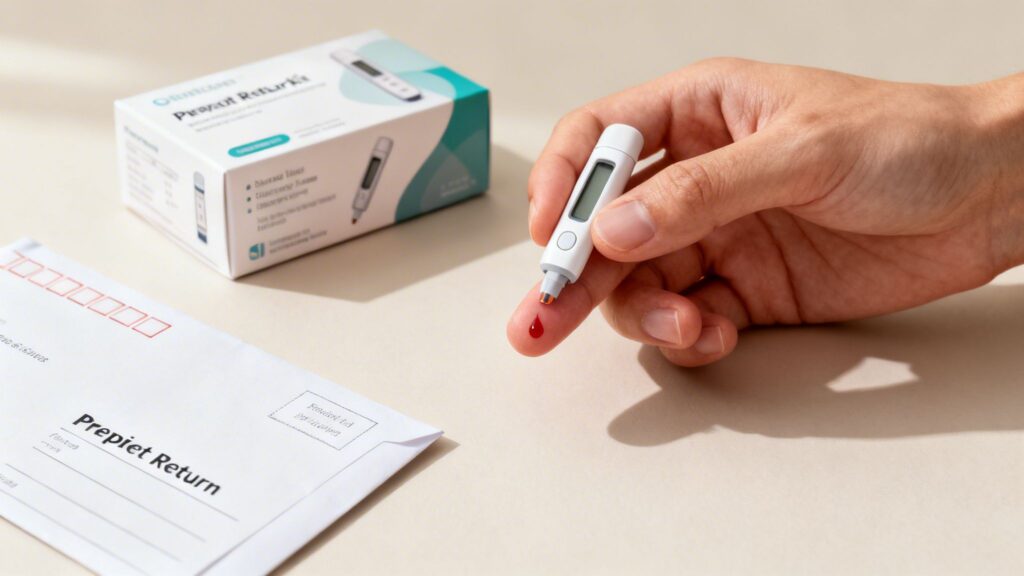
Why At-Home Testing Is the Practical Answer
Traditionally, getting a blood test meant booking a GP appointment, taking time off work, and then waiting for the results to come back. While this is still a perfectly valid route, life today often calls for a more direct and convenient approach. An at-home blood test is a simple, no-nonsense way to get the answers you need without all the hassle.
The Repose Healthcare Vitamin D Blood Test is designed to fit right into your life. It puts you back in control, letting you check your levels from your own home, on your own schedule. No waiting for an appointment or travelling to a clinic needed.
It’s a practical and efficient solution for modern life. You can explore the different methods in our guide on how to check for a vitamin deficiency.
Actionable Insight: Guessing isn’t a strategy. The symptoms of low vitamin D are far too common to rely on. A simple test provides the concrete data you need to take targeted, effective action for your health.
This straightforward process removes the barriers to getting clarity. It’s a clear path from uncertainty to empowerment, giving you the specific information you need to tackle your health concerns head-on.
How the Repose Healthcare Test Works
We’ve made the whole process as simple as possible. Here’s a practical look at how you can get your confidential results in just a few steps:
- Order Online: Your Vitamin D Test kit is delivered directly to your door in discreet packaging.
- Collect Your Sample: Follow the simple, clear instructions to collect a small finger-prick blood sample. Everything you need is right there in the kit.
- Post It Back: Pop your sample in the prepaid postage envelope provided and send it off to our accredited UK laboratory.
- Receive Your Results: In just a few days, you’ll get a notification that your confidential results are ready to view on your secure online dashboard.
Your results will clearly show your vitamin D level and explain what it means, giving you the power to have a really informed conversation with your doctor about what to do next. It’s the most practical way to find out if low vitamin D is the real reason you’re not feeling your best.
Actionable Steps to Boost Your Vitamin D Levels
So, you’ve got your vitamin D results. Knowing where you stand is the first step, but the real work starts now. If your Repose Healthcare test shows your levels are on the low side, don’t panic. There’s a straightforward, three-pronged approach to getting them back up to a healthy range: smart supplementation, sensible sun exposure, and a few dietary tweaks.
Instead of just guessing what to do, your results give you the hard data you need to build a plan that’s actually right for you.
Smart Supplementation Is Key
For most of us here in the UK, supplements are the most reliable way to keep our vitamin D levels topped up, especially during the long, grey "Vitamin D Winter." The UK government even recommends that all adults consider taking a daily supplement with 10 micrograms (400 IU) of vitamin D between October and March.
But here’s the thing: if your test shows you’re already deficient, that standard maintenance dose probably won’t be enough to fix the problem. This is where your test results become so important. They give you the information you need to have a proper conversation with your doctor about a higher, more effective dose to safely bring your levels back into the optimal range.
Actionable Insight: Think of your test results from Repose Healthcare as your personal roadmap. They let you move past the generic advice and create a strategy that’s based on your body’s specific needs, turning numbers on a page into clear, confident action.
As you start thinking about supplements, it helps to know how to choose from the best vitamin D supplements on the market.
Sensible Sun and Dietary Support
While supplements are the heavy lifters, they work best when you support them with other healthy habits. Here are some practical examples:
- Sensible Sun Exposure: When the sun finally shows its face in the UK summer (usually from April to September), try to get short, regular bursts of midday sun without sunscreen. For example, roll up your sleeves during your lunch break for 10-15 minutes. The key word here is sensible—be very careful never to let your skin start to redden or burn.
- Dietary Adjustments: You can also give your levels a little boost by eating more vitamin D-rich foods. Think oily fish like salmon and mackerel, red meat, and egg yolks. A practical tip is to add a portion of grilled salmon to your evening meal twice a week. Don’t forget fortified foods like breakfast cereals and plant-based milks, which also play a helpful supporting role.
By combining these strategies—guided by your own personal data—you have a powerful plan to tackle low vitamin D. Your test results are the key to unlocking this personalised approach, and you can explore our full range of online lab tests in the UK to keep an eye on your progress over time.
Your Vitamin D Questions, Answered
Still have a few questions floating around? It’s completely normal. Let’s tackle some of the most common queries we hear about getting vitamin D levels back on track.
How Long Does It Take to Correct a Vitamin D Deficiency?
This really depends on how low your starting levels are and the treatment plan you follow with your GP. The good news is that with a consistent approach – usually involving supplements – most people start to feel a noticeable improvement within a few weeks to a couple of months.
Regular monitoring is the key to tracking your progress. It ensures you reach an optimal level safely, without accidentally over-supplementing, which can have its own health risks.
Are Sunbeds a Safe Way to Get Vitamin D?
In a word, no. While it’s true that sunbeds emit the UVB rays that trigger vitamin D production in your skin, their use is strongly and clearly linked to an increased risk of skin cancer.
For this reason, health authorities across the UK and Ireland strongly advise against using them for any purpose. The safest ways to boost your levels will always be sensible, short periods of sun exposure in the summer, dietary changes, and appropriate, targeted supplementation.
What Is a Normal Vitamin D Level in the UK?
Understanding your test results is the first step to taking control of your health. It gives you and your doctor a clear benchmark to aim for.
In the UK, a blood level above 50 nmol/L is generally considered sufficient for good health. Levels between 25-50 nmol/L are classed as insufficient, while anything below 25 nmol/L indicates a deficiency that needs addressing.
Your lab report will clearly show your number and explain what this means for you, empowering you to create a plan with your GP’s guidance.
Ready to move from uncertainty to clear, actionable insight? The Repose Healthcare at-home Vitamin D Test provides the accurate, confidential results you need to understand your levels and take the next step towards better health. Order yours today.
You Might Also Like
STI Test Kit at Home: How It Works and What to Expect
You've had condomless sex with a new partner, feel completely well, and are now deciding [...]
Fertility Blood Test Day 3: What to Expect
You've booked your first fertility appointment, but one phrase on the instructions keeps bothering you: [...]
Home Liver Function Test: What Results Mean
You've opened the results from a home liver function test and found a mildly raised [...]
Glucose Tolerance Test at Home: What You Need to Know
A true diagnostic oral glucose tolerance test in the UK is usually a supervised clinic [...]
At Home PSA Test: Accuracy, Process, and UK Guidelines
You notice that you're urinating more often, your stream seems weaker, or you want a [...]
A1C Blood Test UK: What It Measures and How to Get One
You've just opened a private or at-home A1C blood test UK result and found two [...]
STI Screening for Men: What to Test and When
You've recently ended a relationship, ordered an STI test kit online, and now you're staring [...]
Fertility Testing Before Trying to Get Pregnant: Key Info
You and your partner may have chosen a rough timeline, checked your finances and started [...]
Nutrition Testing Kit: What It Measures and Why It Matters
You're doing the sensible thing, eating reasonably, trying to sleep, and still feeling flat. That's [...]
Private Coeliac Testing UK: A Practical Patient Guide
You've been bloated after pasta for months. You've searched “coeliac symptoms”, noticed the fatigue and [...]
STI Test Kit Price Guide for UK Home Testing
Private STI test kits in the UK usually start at about £29 to £30 for [...]
Sexual Health Screening: Your Guide to 2026
You're often here for a very ordinary reason that suddenly feels loaded. A new partner. [...]
Pregnancy Screening Tests Private: Your UK Guide
You've had a positive pregnancy test, the NHS booking appointment is still ahead, and your [...]
What Is Glucose Tolerance Test and How It Works
A glucose tolerance test is a two-hour challenge test: after an overnight fast, your fasting [...]
Blood Test for Night Sweats What to Check and When
You wake in the early hours with damp nightwear, wet sheets and a racing mind. [...]
The 2026 Cost of Hepatitis Vaccination in the UK
You're usually looking up the cost of hepatitis vaccination for a practical reason. A trip [...]
Hormone Blood Test London: Find Your Perfect Test
Some London health questions start subtly. Your cycle changes a little. You feel wired at [...]
Peanut Allergy Test Kit: A Practical UK User’s Guide
A peanut reaction often starts with uncertainty, not clarity. You eat a biscuit, satay sauce, [...]
NIPT Test Edinburgh: Your 2026 Guide
If you're searching nipt test edinburgh, you're probably already in that familiar stage of pregnancy [...]
Peripheral Artery Disease UK: Peripheral Artery Disease UK:
You might be reading this because walking has started to feel different. Perhaps your calf [...]
NIPT Test Cardiff: Clinic, Home & NHS Pathways 2026
If you're in Cardiff, newly pregnant, and staring at screening options that all seem to [...]
Gender Scan Difference UK: Accuracy, Timing & Cost Compared
You've probably already done the same search most parents do. One tab shows the NHS [...]
NIPT Test Cambridge: Guide to Options & Booking 2026
You're in Cambridge, you've had the first rush of finding out you're pregnant, and then [...]
Home COVID Test Results: A Practical UK & Ireland Guide
You've done the swab, mixed the sample, added the drops, and now you're staring at [...]
DVT Test Squeeze Calf: Homan’s Sign & Beyond
You notice one calf is sore, a little swollen, and not behaving like an ordinary [...]
Your Guide to Every Travel Clinic Leicester Offers in 2026
Flights are booked. The hotel is sorted. Your passport is still in date. Then one [...]
13 Week Gender Scan: Accuracy, NIPT & What to Expect
By the time you reach 13 weeks, pregnancy often starts to feel more real in [...]
Your Pregnancy Scan London: Guide to Options & Costs
A positive test can make London feel suddenly very small and very complicated. You might [...]
Your Nuchal Dating Scan Explained: A 2026 UK Guide
That appointment message has landed in your phone or come through the post, and suddenly [...]
Normal Cortisol Levels UK: Get Clarity
Some people search for normal cortisol levels uk after weeks of feeling unlike themselves. They’re [...]