 Skip to content
How does genetic testing work: A clear guide to your health

Genetic testing works by analysing your DNA to uncover clues about your health, unique traits, and even your ancestry. The whole process starts with a simple biological sample, usually saliva, which you send off to a lab. There, technicians carefully extract your DNA and "read" its unique code.
This reading process is all about spotting specific genetic variations—tiny differences in your DNA—that can influence everything from your risk for certain health conditions to how your body processes nutrients. Ready to explore your personalised insights? Discover the right test for you.
Your At-Home Genetic Testing Journey Explained
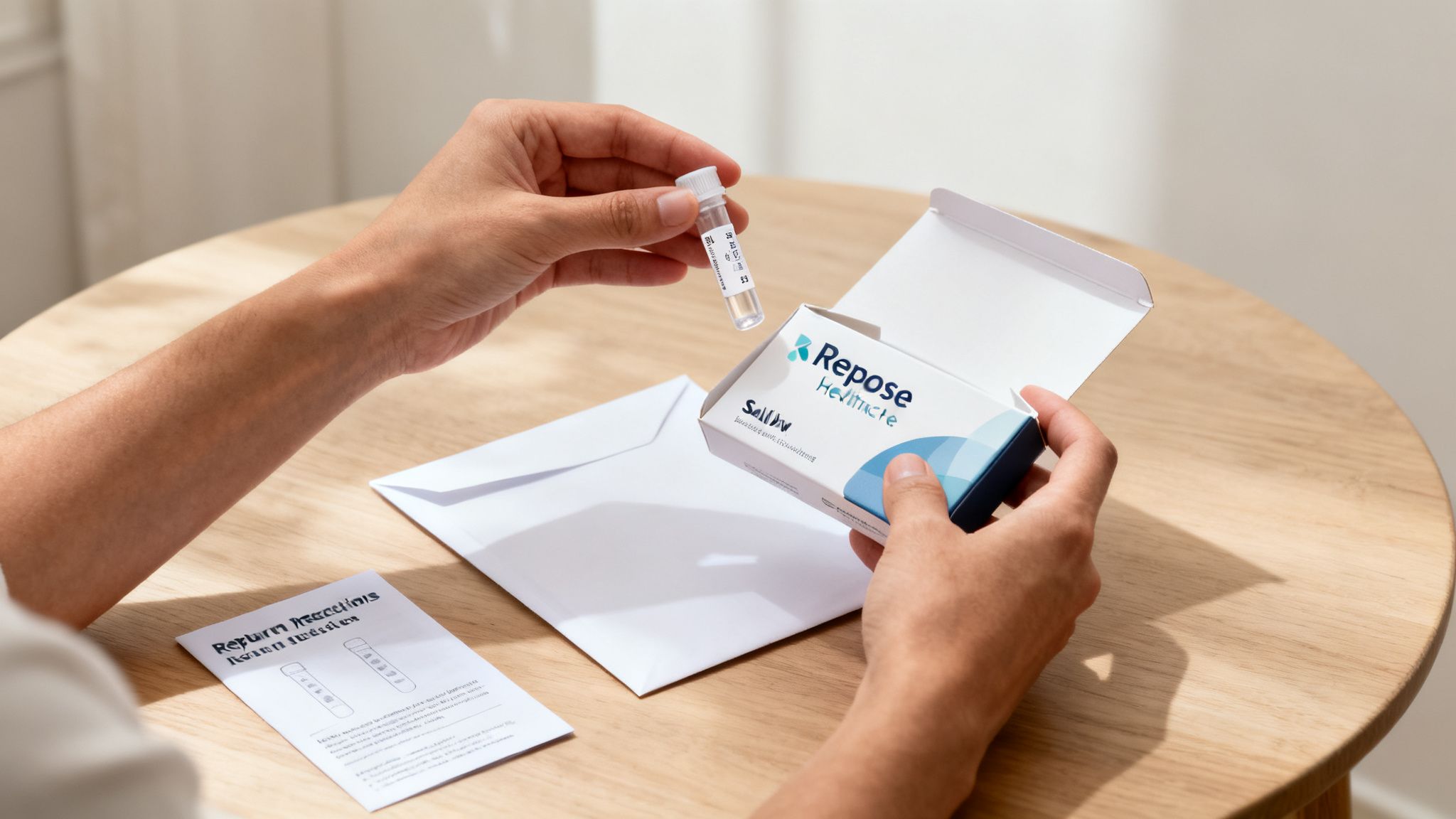
The idea of DNA testing might bring to mind complex labs and white coats, but the journey to understanding your genetic blueprint is surprisingly straightforward. Think of your DNA as your body’s personal instruction manual; a genetic test is simply a way to read the chapters most relevant to your well-being.
The entire process is designed to be as convenient as possible, putting you in control right from the comfort of your own home. It all starts when you order a kit online and ends with practical health insights delivered securely to you. You can begin with our Wellness Panels for comprehensive nutrition and lifestyle insights.
The Core Steps of At-Home Testing
Getting a genetic test from home involves just a few simple, clear stages. Each step is designed to be easy and put you firmly in charge of your health discovery.
- Order and Collect: First, you choose and order a testing kit online from a provider like Repose Healthcare. Once it arrives, you just follow the simple instructions to collect a saliva sample.
- Post Your Sample: Using the prepaid packaging that comes with the kit, you pop your sample in the post and send it directly to a certified laboratory for analysis.
- Receive Your Results: In just a few working days, you’ll get an alert letting you know your results are ready to view on a secure online dashboard. The reports are laid out to be clear and easy to understand.
For example, if you choose our Nutrition Panel, you can use your results to adjust your supplement routine within days, turning data into immediate, actionable steps.
This simple approach takes the mystery out of genetic science and makes it accessible to everyone. In the UK, at-home testing works on this exact model: a saliva sample is sent to an accredited lab where advanced technology like next-generation sequencing (NGS) is used to analyse it. This method, which held 40.62% of the European market share, allows for a rapid and cost-effective scan of your DNA for important variations.
By breaking the journey down into these manageable steps, you can confidently start exploring your personalised health. The focus is on empowering you with information, not overwhelming you with jargon.
Let’s take a closer look at what this journey looks like from start to finish.
The At-Home Genetic Testing Journey at a Glance
This table breaks down the simple, step-by-step process of getting a genetic test from home with a provider like Repose Healthcare.
| Step | What You Do | What Happens Next |
|---|---|---|
| 1. Order Your Kit | Select the test you need and order it online. | The kit is dispatched and delivered discreetly to your door. |
| 2. Collect Your Sample | Follow the clear, simple instructions to provide a saliva sample. | Your DNA is now ready for the lab. |
| 3. Post it Back | Place the sample vial in the prepaid return packaging. | The package is sent directly to a UK-accredited lab for analysis. |
| 4. Lab Analysis | Nothing for you to do here! | Lab technicians extract and analyse your DNA using advanced tech. |
| 5. View Your Results | You’ll receive an email notification in a few days. | Log in to your secure online dashboard to see your results. |
| 6. Take Action | Review your insights and consider the next steps. | Share your results with your GP or a specialist for further guidance. |
As you can see, the process is designed to be as seamless as possible, giving you powerful health information without the hassle.
Understanding how it all works is the first step towards unlocking these valuable insights. Our guide on the Repose Healthcare testing process gives you even more detail on what to expect every step of the way. If you’re eager for actionable recommendations, our Wellness Panels provide clear next steps.
What a Genetic Test Can Reveal About You
Think of a genetic test as a way to peek at your body’s unique instruction manual. Different tests look at different chapters, each revealing a distinct part of your health story, from your risk for certain conditions to how you might react to a particular medication. Understanding what these tests can tell you is the key to picking one that actually matches your health goals.
The information you get back isn’t just a dry list of genes; it’s practical insight that can help you make smarter decisions about your diet, lifestyle, and even family planning. It’s about moving from reacting to health problems to proactively managing your well-being. Our Wellness Panels and Fertility Tests bring these insights to life with personalised recommendations.
Four Key Areas of Genetic Insight
We can group genetic tests based on the kind of information they provide. Some are designed to find answers to existing health questions, while others help you look ahead.
- Diagnostic Testing: This is used to confirm or rule out a specific genetic condition if you’re already showing symptoms. Your doctor might use this to pinpoint the exact genetic cause behind a medical issue.
- Predictive Testing: This type of test scans for genetic variations that increase your risk of developing certain health conditions in the future, like some forms of heart disease or cancer, long before any symptoms show up.
- Carrier Screening: Perfect for individuals or couples thinking about starting a family. This test checks if you carry a genetic variant for a condition that could be passed on to your children, even if you have no symptoms yourself.
- Pharmacogenetics: This reveals how your unique genetic makeup influences your body’s response to specific drugs. It helps predict which medications might work best for you or which could cause side effects.
Looking for quick decision-making tools? Our Fertility Tests deliver carrier screening results in just 1–3 days, so you can plan with confidence.
The real power of a genetic test isn’t just in the data it gives you. It’s about what you do with that information. Whether that means adjusting your lifestyle or having a more informed chat with your GP, these insights are the first step towards truly personalised health.
Practical Examples of Genetic Information
To see how this works in the real world, let’s consider a couple of scenarios. Imagine you want to get your nutrition right. Our Wellness Panels can analyse genes linked to how your body processes things like Vitamin D or caffeine, giving you clear, actionable insights to tailor your diet for better results. For instance, if your Wellness Panels indicate a slow Vitamin D metabolism, you can start a targeted 1000 IU supplement regimen right away.
Or, if you’re planning to start a family, our Fertility Tests provide crucial information through carrier screening. This is a significant area of genetic testing in the UK, holding a 26.5% market share. It often uses a lab technique called PCR to identify risks for conditions like sickle cell, where an estimated 1 in 10 people of African-Caribbean descent in the UK are carriers. These tests deliver results quickly, usually within 1–3 days, to a secure online portal, helping you make informed decisions. You can find more insights on the UK genetic testing market and its applications.
Choosing the Right Genetic Test for Your Health Goals
With so many different types of information available, it’s vital to choose a test that answers your specific questions. The table below breaks down the most common types of genetic tests, what they’re used for, and when you might consider each one.
| Test Type | Main Purpose | Example Scenario |
|---|---|---|
| Predictive | To assess future health risks before symptoms appear. | You have a family history of heart disease and want to understand your own genetic predisposition to proactively manage your health. |
| Carrier Screening | To check if you carry a genetic variant for a condition you could pass to a child. | You and your partner are planning to have a baby and want to understand any potential inherited risks. |
| Pharmacogenetic | To understand how your body may react to certain medications. | You are about to start a new long-term medication and want to know if it’s the most effective choice for your genetic profile. |
Ultimately, the more you understand about how genetic testing works, the better equipped you are to choose a path that gives you the clarity you need for your health journey. To compare all options, Discover the right test for you.
Following Your DNA Sample Through The Lab
Once you post your sample, its journey is only just beginning. It travels to a highly specialised, UK-accredited laboratory where some seriously clever science transforms your saliva into actionable health insights. This behind-the-scenes process is precise, methodical, and ensures the results you receive from Repose Healthcare are both accurate and reliable.
The whole thing can be broken down into three key stages, each one building on the last to carefully decode your genetic information. It’s a meticulous journey from a simple sample to a detailed report.
Step 1: DNA Extraction
First things first, the lab needs to isolate your DNA from everything else in your saliva sample, like proteins and other cells. Think of it like carefully pulling a single golden thread out of a complex tapestry.
Lab technicians use specialised chemical solutions to break open the cells, which releases the DNA held inside. The DNA is then carefully separated and purified, leaving a clean, concentrated sample ready for the next stage. This pure DNA is the raw material for the entire analysis.
Step 2: DNA Amplification
There’s actually only a tiny amount of DNA in your original sample – not nearly enough to analyse directly. This is where amplification comes in. The most common technique used for this is called Polymerase Chain Reaction (PCR).
Imagine you have a single page of a book you need to study, but it’s too faint to read. PCR acts like a biological photocopier, making millions or even billions of copies of specific segments of your DNA. This creates a much larger, more robust sample, making it possible for the laboratory instruments to read your genetic code accurately.
Step 3: Genetic Analysis
This is the moment of truth, where your genetic code is finally read and interpreted. The journey through the lab involves advanced techniques such as nanopore sequencing technology, bioinformatics, and applications to make sense of your unique genetic blueprint.
One of the most powerful technologies used is Next-Generation Sequencing (NGS). These incredible machines can read millions of small DNA fragments all at once, piecing them together like a massive jigsaw puzzle to reveal your unique genetic sequence. This allows scientists to spot the tiny variations that are linked to different health traits and predispositions.
The UK’s approach to genetic testing has been hugely shaped by initiatives like the landmark 100,000 Genomes Project. This ambitious project successfully sequenced 100,000 genomes from NHS patients, leading to a new diagnosis for an incredible 25% of participants with a rare condition.
This streamlined pipeline—from at-home sample collection to advanced lab analysis using NGS and PCR—is central to how genetic testing works in the UK today. While our kits typically use saliva, you can explore our guide on how other collection methods work in our article on finger-prick blood tests at home. No matter your choice, results guide clear next steps—just like our Wellness Panels do.
This infographic provides a simple visual guide to the main types of genetic tests.
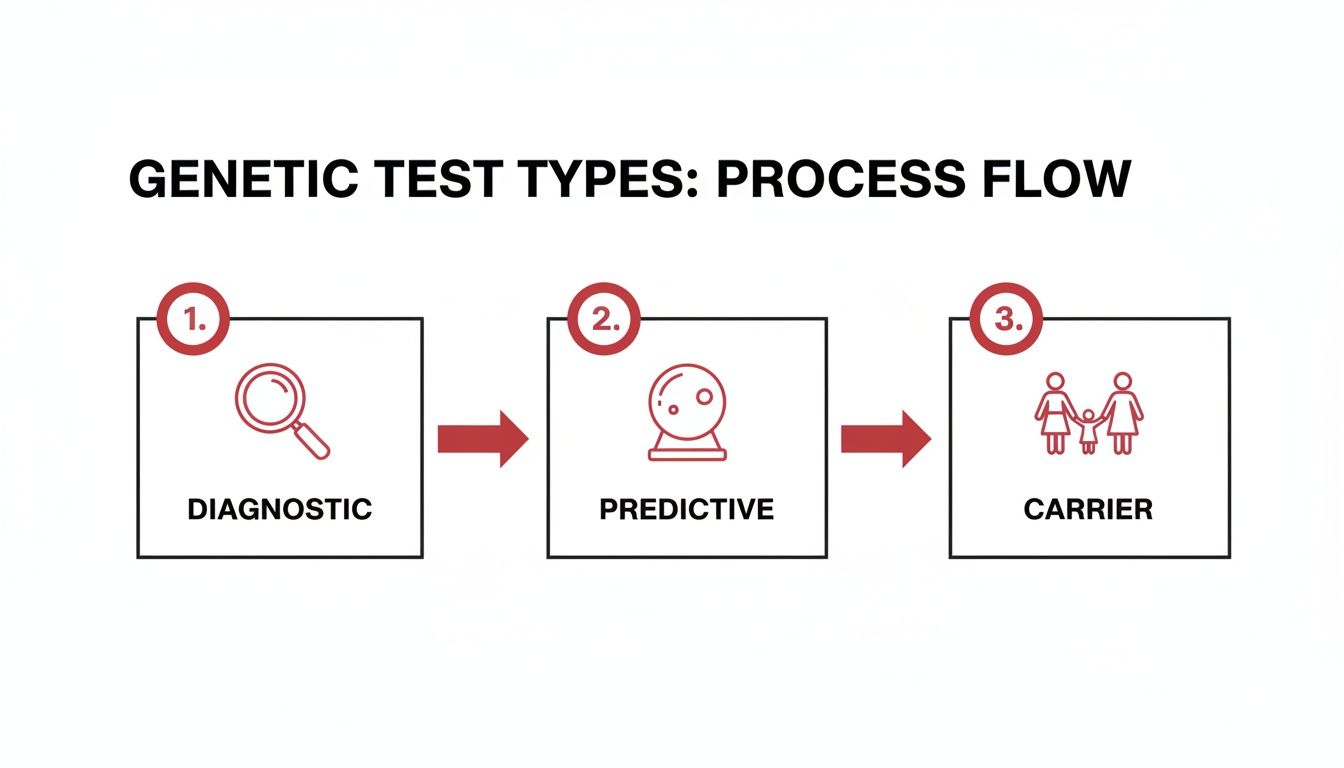
The flow highlights how each test type addresses a different question, from diagnosing current symptoms to helping you plan for the future.
Making Sense of Your Genetic Report

Getting your genetic results back is an exciting moment, but let’s be honest—the report can look a bit intimidating, full of complex scientific terms. This section is designed to help you cut through the noise and understand your results without needing a degree in genetics. We’ll break down what the findings mean in plain English, helping you turn powerful insights into confident, practical action.
Think of your report not as raw data, but as a personalised map to your unique genetic makeup. It will point out specific gene variants, give you an idea of your wellness traits, and provide information on potential health risks. This is where Repose Healthcare really makes a difference, by presenting this complex information in a clear, expert-reviewed format that makes sense.
Understanding Key Terms in Your Report
When you first open your results, you’ll probably come across a few key phrases. Getting to grips with these is the first step in understanding what your genetic test is really telling you.
- Positive Result: This means a specific gene variant the test was designed to find was found. For instance, a positive result for a variant linked to slow caffeine metabolism suggests your body might not process that morning coffee as efficiently as others.
- Negative Result: This simply means the specific variant was not found. While this is often reassuring, it doesn’t completely rule out your risk for a condition, as other genes or lifestyle choices still play a big part.
- Variant of Uncertain Significance (VUS): This is when a gene variation was spotted, but medical science doesn’t yet have enough solid evidence to say whether it affects your health. As research moves forward, the meaning of a VUS can become clearer.
For actionable guidance, our reports from Wellness Panels include straightforward lifestyle recommendations.
It’s absolutely crucial to remember that your genetics are just one piece of the health puzzle. A result showing a higher genetic predisposition for something is not a diagnosis. It’s information to empower you.
From Report to Real-World Action
Ultimately, the goal of any genetic report is to give you knowledge you can actually use. Our reports at Repose Healthcare are built to do just that—deliver clear, actionable recommendations that can help you and your GP make properly informed decisions.
A great example is our detailed Wellness Panels, which might uncover a genetic marker linked to lower Vitamin D levels. This single piece of information gives you a perfect starting point for a focused chat with your doctor about your diet, sun exposure, or whether supplements might be a good idea. It turns a complex bit of data into a simple, practical next step for your health.
Accuracy, Privacy, and Choosing Your Test Wisely
When you’re exploring your own health information, trust is everything. Naturally, two of the biggest questions on anyone’s mind are about accuracy and privacy. It’s vital to understand the high standards that reputable providers meet, but also to be realistic about the limitations of any single test.
Professional at-home genetic tests processed in UK-accredited laboratories, like those we use at Repose Healthcare, are highly accurate. For the specific genetic markers they are designed to find, these tests typically hit an accuracy rate of over 99%. You can count on over 99% precision in detecting targeted markers, so you get reliable data to act on. This precision comes down to the rigorous scientific methods we’ve already touched on, like PCR and Next-Generation Sequencing.
Understanding Test Accuracy and Its Limits
It’s important to remember, however, that no test is perfect. A negative result doesn’t give you a completely clean bill of health, as your lifestyle and other genetic factors still have a huge part to play. In the same way, a positive result for a risk variant is not a diagnosis—it’s just an indicator that you might have a predisposition. To get a better handle on this, you can learn more about the accuracy of at-home health tests in our detailed guide.
Your genetic data provides a powerful piece of the puzzle, not the complete picture. The goal is to give you information to make proactive choices, not to provide a definitive medical diagnosis.
Your Privacy Is Paramount
Your genetic data is some of the most personal information you own, and keeping it safe is our absolute highest priority. At Repose Healthcare, we strictly follow the UK General Data Protection Regulation (UK GDPR), which sets a very high legal bar for data security and confidentiality. Your information is anonymised, encrypted, and is never shared without your explicit consent.
Transparency is key—review our privacy practices alongside examples when understanding privacy policies from different providers. We are completely committed to keeping your data secure.
At-Home Wellness vs. Clinical Diagnostic Tests
Finally, it’s crucial to choose the right tool for the job. The at-home tests we provide are designed for wellness and proactive insight, helping you optimise your lifestyle or understand certain predispositions. They are not the same as the diagnostic tests ordered by the NHS.
- Repose Healthcare At-Home Tests: Think of these as screening and wellness tools. They provide actionable information about your genetic traits, carrier status, or predispositions to help inform your personal health choices. For example, our Wellness Panels might highlight a genetic marker for a vitamin deficiency, giving you a reason to start a conversation with your GP.
- NHS Diagnostic Tests: These are used by doctors to confirm a suspected medical condition when you are already showing symptoms. They are a critical part of the diagnostic process within a clinical setting, not for general wellness screening.
Explore wellness tools like our Wellness Test or dig deeper with clinical diagnostics. Choosing wisely means understanding this difference.
Turning Your Genetic Insights Into Action
So, you’ve got your genetic report. What now? The real magic of genetic testing isn’t just knowing the information; it’s about what you do with it. Think of your report not as an endpoint, but as a starting line for taking charge of your health in a smarter way. It’s about turning powerful data into simple, everyday decisions that actually support your well-being.
Your genetic insights basically hand you a personalised roadmap to your own body. For instance, finding out you have a genetic marker that means you metabolise caffeine slowly can finally explain why that 3 pm coffee messes with your sleep. Suddenly, the decision to switch to decaf isn’t just a random guess—it’s an informed choice that makes a real difference.
Building a Personalised Health Plan
The whole point is to use this information to build a health plan that’s genuinely tailored to you. This is exactly where Repose Healthcare’s tests come in, giving you specific, actionable data to work with.
- Our Nutrition Panel might show you have a genetic tendency for lower Vitamin D levels. That single piece of information gives you a solid reason to get more sunlight, tweak your diet, or chat with your GP about supplements.
- The wider Wellness Test can flag traits related to your fitness, stress response, or sleep patterns. It equips you with the knowledge to fine-tune your lifestyle in ways that are specifically suited to your body’s unique wiring.
Your genetic report helps you move beyond generic health advice and start taking targeted action. It’s about finally understanding what your body needs, so you can take confident, proactive steps towards better health.
Visit our Nutrition Panel or Wellness Test to pick your starting point.
Still Have Questions About Genetic Testing?
It’s completely normal to have a few questions, even when you understand the basics. Here are some clear, straightforward answers to the queries we hear most often.
Is an At-Home Genetic Test as Accurate as One From My Doctor?
This is a great question, and one we get a lot. The simple answer is yes – for what they are designed to do. At-home tests from accredited labs, like those used by Repose Healthcare, are incredibly accurate for the specific genetic markers they analyse, typically over 99%.
The key difference is their purpose. Our at-home wellness tests are designed to give you proactive insights to help you manage your well-being. A test from your doctor, on the other hand, is usually diagnostic – it’s used to confirm a specific medical condition after symptoms have already appeared.
How Long Until I Get My Genetic Test Results?
We know you’ll be keen to see your results. Once our UK-accredited lab receives your sample, you can expect your secure, expert-reviewed report to be ready on your online dashboard within just 1–3 working days.
Could My Genetic Data Affect My UK Insurance?
In the UK, you’re protected by the Code on Genetic Testing and Insurance. This is a solid agreement between the government and the insurance industry.
It prevents insurers from using predictive genetic test results for most policies, including life insurance up to £500,000. This should give you peace of mind that your data will be handled responsibly and won’t be used against you.
What’s the Real Difference Between an Ancestry and a Health DNA Test?
While both analyse your DNA, they are looking for completely different stories in your genetic code. An ancestry test scans for markers linked to different global populations to trace your ethnic origins and connect you with distant relatives.
A health DNA test, like our Wellness Panels, is much more focused. It zeroes in on specific genes linked to your physical traits, how you metabolise nutrients, and your predispositions to certain health characteristics, giving you actionable insights for your well-being.
Ready to take the next step in your health journey? Explore our full range of at-home genetic and wellness tests at Repose Healthcare and start turning personalised insights into confident action. Discover the right test for you

You Might Also Like
STI Test Kit at Home: How It Works and What to Expect
You've had condomless sex with a new partner, feel completely well, and are now deciding [...]
Fertility Blood Test Day 3: What to Expect
You've booked your first fertility appointment, but one phrase on the instructions keeps bothering you: [...]
Home Liver Function Test: What Results Mean
You've opened the results from a home liver function test and found a mildly raised [...]
Glucose Tolerance Test at Home: What You Need to Know
A true diagnostic oral glucose tolerance test in the UK is usually a supervised clinic [...]
At Home PSA Test: Accuracy, Process, and UK Guidelines
You notice that you're urinating more often, your stream seems weaker, or you want a [...]
A1C Blood Test UK: What It Measures and How to Get One
You've just opened a private or at-home A1C blood test UK result and found two [...]
STI Screening for Men: What to Test and When
You've recently ended a relationship, ordered an STI test kit online, and now you're staring [...]
Fertility Testing Before Trying to Get Pregnant: Key Info
You and your partner may have chosen a rough timeline, checked your finances and started [...]
Nutrition Testing Kit: What It Measures and Why It Matters
You're doing the sensible thing, eating reasonably, trying to sleep, and still feeling flat. That's [...]
Private Coeliac Testing UK: A Practical Patient Guide
You've been bloated after pasta for months. You've searched “coeliac symptoms”, noticed the fatigue and [...]
STI Test Kit Price Guide for UK Home Testing
Private STI test kits in the UK usually start at about £29 to £30 for [...]
Sexual Health Screening: Your Guide to 2026
You're often here for a very ordinary reason that suddenly feels loaded. A new partner. [...]
Pregnancy Screening Tests Private: Your UK Guide
You've had a positive pregnancy test, the NHS booking appointment is still ahead, and your [...]
What Is Glucose Tolerance Test and How It Works
A glucose tolerance test is a two-hour challenge test: after an overnight fast, your fasting [...]
Blood Test for Night Sweats What to Check and When
You wake in the early hours with damp nightwear, wet sheets and a racing mind. [...]
The 2026 Cost of Hepatitis Vaccination in the UK
You're usually looking up the cost of hepatitis vaccination for a practical reason. A trip [...]
Hormone Blood Test London: Find Your Perfect Test
Some London health questions start subtly. Your cycle changes a little. You feel wired at [...]
Peanut Allergy Test Kit: A Practical UK User’s Guide
A peanut reaction often starts with uncertainty, not clarity. You eat a biscuit, satay sauce, [...]
NIPT Test Edinburgh: Your 2026 Guide
If you're searching nipt test edinburgh, you're probably already in that familiar stage of pregnancy [...]
Peripheral Artery Disease UK: Peripheral Artery Disease UK:
You might be reading this because walking has started to feel different. Perhaps your calf [...]
NIPT Test Cardiff: Clinic, Home & NHS Pathways 2026
If you're in Cardiff, newly pregnant, and staring at screening options that all seem to [...]
Gender Scan Difference UK: Accuracy, Timing & Cost Compared
You've probably already done the same search most parents do. One tab shows the NHS [...]
NIPT Test Cambridge: Guide to Options & Booking 2026
You're in Cambridge, you've had the first rush of finding out you're pregnant, and then [...]
Home COVID Test Results: A Practical UK & Ireland Guide
You've done the swab, mixed the sample, added the drops, and now you're staring at [...]
DVT Test Squeeze Calf: Homan’s Sign & Beyond
You notice one calf is sore, a little swollen, and not behaving like an ordinary [...]
Your Guide to Every Travel Clinic Leicester Offers in 2026
Flights are booked. The hotel is sorted. Your passport is still in date. Then one [...]
13 Week Gender Scan: Accuracy, NIPT & What to Expect
By the time you reach 13 weeks, pregnancy often starts to feel more real in [...]
Your Pregnancy Scan London: Guide to Options & Costs
A positive test can make London feel suddenly very small and very complicated. You might [...]
Your Nuchal Dating Scan Explained: A 2026 UK Guide
That appointment message has landed in your phone or come through the post, and suddenly [...]
Normal Cortisol Levels UK: Get Clarity
Some people search for normal cortisol levels uk after weeks of feeling unlike themselves. They’re [...]