
Ferritin Blood Test UK: Your Guide to At-Home Testing and Results
Are you constantly battling fatigue, noticing more hair than usual in your brush, or struggling with a persistent brain fog? The culprit might not be your hectic schedule, but something hidden away in your body’s iron reserves. A simple ferritin blood test in the UK can measure these stores, giving you a vital snapshot of your health long before a serious issue like anaemia takes hold. Our Ferritin Blood Test provides a clear, actionable number, helping you understand what’s really going on.
Why Your Ferritin Level Is a Critical Health Marker
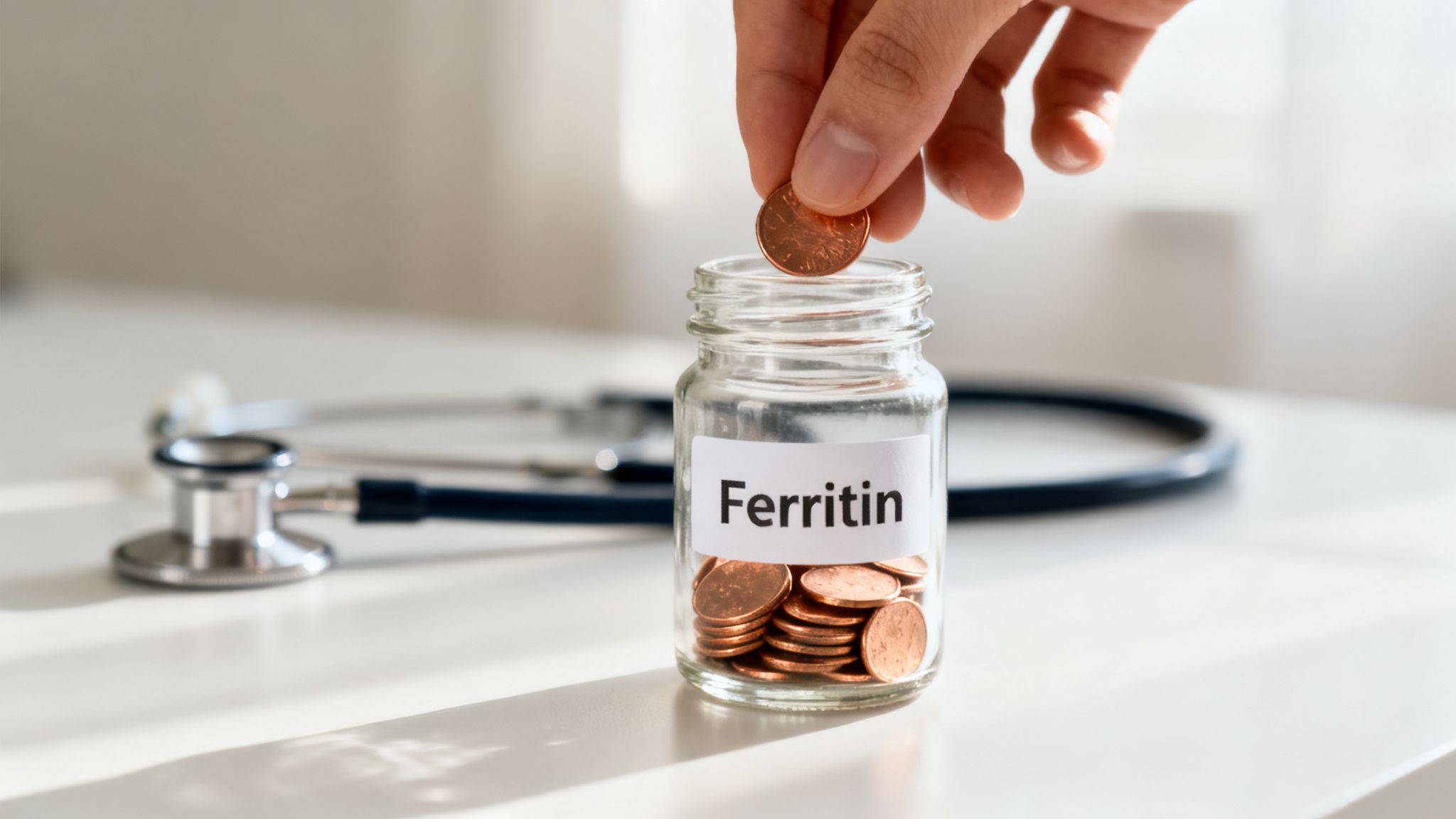
It’s a common misconception that a standard iron test reveals the full picture. It often doesn’t. Think of the iron moving through your blood as the cash in your wallet—ready for immediate spending. Ferritin, on the other hand, is your savings account. It’s a protein that safely stores iron, releasing it whenever your body needs it for essential tasks.
This distinction is crucial. You can have perfectly normal levels of circulating iron (cash) while your savings account—your ferritin—is quietly running on empty. This is the very first stage of iron deficiency, and it can trigger all sorts of frustrating symptoms even when a routine full blood count looks completely fine.
The Hidden Impact of Low Iron Stores
Low ferritin is a huge issue in the UK, especially for women, yet its effects are often dismissed as just the result of a busy lifestyle. When your iron reserves get low, your body struggles to produce energy and transport oxygen effectively.
This can bubble up to the surface as a collection of symptoms that get in the way of your daily life:
- Persistent fatigue that no amount of rest seems to fix.
- Brain fog or finding it hard to concentrate.
- Unexplained hair shedding or thinning.
- Feeling breathless after minor efforts, like climbing a flight of stairs.
Actionable Insight: By measuring your ferritin level, you get a direct and early insight into your body’s iron status. It’s a proactive step that moves beyond guesswork, providing a clear data point to understand the root cause of your symptoms.
Keeping an eye on this one number can be a genuine game-changer for your well-being. An at-home Ferritin Blood Test from Repose Healthcare offers a convenient and private way to get the answers you’re looking for, empowering you to take back control of your health from the comfort of home.
Understanding Ferritin Versus Iron in Your Body

When people talk about iron deficiency, it’s easy to mix up two related but very different things: iron and ferritin. Getting your head around the distinction is the first step to figuring out why you might feel unwell, even when other tests come back looking perfectly normal.
Let’s use a practical example: think of your body’s iron like your personal finances.
The iron that’s actively circulating in your blood, often measured as serum iron, is like the cash in your wallet. It’s right there, ready for your body to ‘spend’ on its daily needs.
Ferritin, on the other hand, is your savings account. It’s a protein that safely stores iron, keeping it tucked away until your body needs to make a withdrawal. This stored iron is your essential backup supply.
A standard blood test might show you have enough ‘cash’ in your wallet for today, but it won’t tell you if your savings are about to run out. A ferritin blood test is different. It directly measures your reserves, giving a much earlier and more accurate picture of your true iron status.
The Role of Iron: Your Body’s Hardest Worker
Iron isn’t just some mineral on the periodic table; it’s a non-stop worker involved in hundreds of processes that keep you healthy and energised. Its main job is to help create haemoglobin, the protein in your red blood cells that ferries oxygen from your lungs to every single cell, from your brain to your biceps.
When iron levels are low, these critical systems grind to a halt. It’s like a factory trying to run with a skeleton crew—production plummets, and everything becomes sluggish. This is exactly why low iron can cause such a wide and seemingly unrelated range of symptoms.
Here are just a few of iron’s most important jobs:
- Energy Production: It’s vital for the chemical reactions that turn food into fuel.
- Brain Function: Iron helps produce neurotransmitters that affect your focus, mood, and mental sharpness.
- Immune Support: Your immune cells rely on iron to mature and effectively fight off infections.
- Oxygen Transport: Its most famous role is carrying life-giving oxygen to all your tissues.
Why Ferritin is the First Warning Sign
Your body is incredibly resourceful. When it isn’t getting enough iron from your diet, it doesn’t just let your ‘wallet’ run dry straight away. Instead, it starts quietly dipping into your ferritin ‘savings account’ to keep daily operations running.
This is what makes ferritin such a powerful health marker. A drop in your ferritin level is the very first sign that your iron stores are being used up. You can have low ferritin for months, or even years, before your circulating iron and haemoglobin levels fall far enough to be flagged as full-blown anaemia.
Actionable Insight: Checking your ferritin gives you a proactive advantage. It allows you to spot a developing iron deficiency and take action before your reserves are completely gone and more severe symptoms kick in. For example, if your result is low, you can immediately focus on iron-rich foods and discuss supplementation with your doctor.
This isn’t a niche problem. Iron deficiency is a major public health issue in the United Kingdom, and testing ferritin is the key to identifying those at risk. While anaemia affects around 4.1% of people in England, iron deficiency without anaemia is far more common, affecting up to 17% of the UK population. The numbers are even more stark for women aged 18 to 49, where rates can climb past 35%.
Practical Tip: Boosting your iron intake through diet can make a real difference. For anyone looking to increase their levels, especially through plant-based options, there’s a great variety of iron-rich plant-based foods to explore. By keeping an eye on your "iron savings" with a simple ferritin blood test in the UK, you can get to the root cause of your symptoms and safeguard your long-term health.
Recognising the Symptoms of Low and High Ferritin
It’s all too easy to brush off symptoms of wonky ferritin levels as just the result of a busy, modern life. But learning to connect the dots between how you feel and what your body’s iron stores are doing is the first step to taking back control. Your body is pretty good at sending out signals when its iron savings account is either running on empty or overflowing.
When most people think of low iron, they immediately jump to extreme tiredness, but the full picture is far more nuanced. The signs of dwindling ferritin can be subtle at first, creeping into your daily life in ways you might not connect to iron at all. Learning to spot these patterns is the key to knowing when it’s time to get tested.
The Subtle Signs of Low Ferritin
When your ferritin levels start to drop, it means your body is dipping into its emergency reserves. This can impact everything from your energy levels to your appearance. Yes, fatigue is a classic hallmark, but the depletion of your iron stores shows up in other important ways, too.
A practical example: you might notice you’re shedding more hair than usual—not just in your hairbrush, but on your pillow or in the shower drain. This isn’t your imagination. It happens because your body, trying to conserve resources, starts diverting oxygen and vital nutrients away from non-essential functions like hair growth to support your vital organs instead.
Here are a few other common, yet often overlooked, symptoms of low ferritin:
- Restless Legs at Night: That infuriating, almost uncontrollable urge to move your legs, especially when you’re trying to relax or fall asleep. It’s a well-known neurological symptom of iron deficiency.
- Brittle Nails: If your nails have become concave (spoon-shaped), weak, or seem to break just by looking at them, it could be a sign your body doesn’t have the iron it needs for healthy keratin production.
- Breathlessness from Minor Exertion: Getting winded after climbing a single flight of stairs or carrying the shopping in? That can mean your blood isn’t carrying enough oxygen—a direct result of low iron.
- Unusual Cravings (Pica): This one is less common, but a persistent craving to eat non-food items like ice, dirt, or even paper can be linked to severe iron deficiency.
If you’re fed up with feeling drained and suspect your symptoms might be connected, our guide on blood tests for constant tiredness could be really helpful.
Actionable Insight: The crucial thing to remember is that these symptoms often show up long before you’d be formally diagnosed with full-blown anaemia. Our Ferritin Blood Test is your chance to catch the issue at its earliest stage, putting you in a position to act before your iron reserves are completely gone.
When Ferritin Levels Are Too High
While it’s less common than deficiency, having too much stored iron—a condition known as iron overload—comes with its own distinct set of problems. This is sometimes caused by a genetic disorder called haemochromatosis, and it can lead to iron accumulating in your organs, causing serious damage over time.
Think of it like an overstuffed bank vault that’s starting to strain at the seams. Your body simply has nowhere to put the excess iron, so it gets deposited in critical places like your liver, heart, and pancreas.
The symptoms of high ferritin can be quite vague and often overlap with other conditions, which is why a definitive blood test is so essential for a clear answer.
Key indicators that might point to iron overload include:
- Persistent Joint Pain: This often shows up in the knuckles of the first two fingers and is frequently mistaken for arthritis.
- Chronic Fatigue and Weakness: Unlike the fatigue from low iron, this is often coupled with a general feeling of being unwell or run down.
- Stomach and Abdominal Discomfort: A nagging pain over the liver area (the upper right side of your abdomen) can be a significant red flag.
- Loss of Libido: Both men and women can experience a noticeable drop in their sex drive.
Symptoms of Imbalanced Ferritin Levels
To make it clearer, here’s a quick comparison of the common symptoms you might experience depending on whether your ferritin is too low or too high.
| Symptom | Associated with Low Ferritin | Associated with High Ferritin |
|---|---|---|
| Fatigue & Weakness | ✔️ (Very Common) | ✔️ |
| Breathlessness | ✔️ | |
| Hair Loss & Brittle Nails | ✔️ | |
| Restless Legs | ✔️ | |
| Joint Pain | ✔️ | |
| Abdominal Pain | ✔️ | |
| Loss of Libido | ✔️ | |
| Pale Skin | ✔️ | |
| Headaches & Dizziness | ✔️ |
Seeing your symptoms laid out like this can often help clarify what might be going on, but it’s no substitute for a proper test.
Ultimately, whether your ferritin is dipping too low or climbing too high, the symptoms can have a major impact on your quality of life. A simple ferritin blood test from Repose Healthcare gives you a clear, definitive number. It replaces guesswork with actionable insight, empowering you to have the right conversation with your doctor.
Who Should Get a Ferritin Blood Test in the UK?
While anyone can find their iron stores running low, some of us are at a much higher risk than others. Figuring out if you fall into one of these groups is the first step towards getting on top of your health. A ferritin blood test in the UK isn’t just for people with obvious symptoms; it’s a vital screening tool for anyone whose body has a higher-than-average demand for iron.
Understanding your personal risk factors helps you move from just guessing to actually knowing. A practical example: it can explain why you feel completely drained despite getting a full night’s sleep, or why you’re suddenly noticing more hair in the shower. For many, the answer is hidden in their unique physiology or lifestyle.
Women Throughout Different Life Stages
Women are particularly prone to iron deficiency, mainly due to regular blood loss and the huge physiological demands of pregnancy and menopause. Your body’s need for iron can swing dramatically throughout your life, which makes regular monitoring a really smart move.
Key groups who should think about regular testing include:
- Women with Heavy Periods: This is one of the most common reasons for depleted iron. If you consistently lose a lot of blood each month, your body can struggle to keep up with iron replacement, leading to a slow but steady drain on your ferritin stores.
- Pregnant or Postpartum Women: During pregnancy, your iron needs go through the roof to support your baby’s development and your own increased blood volume. After birth, recovery and breastfeeding continue to place huge demands on your iron reserves, making this a critical time to get tested.
- Perimenopausal Women: The hormonal shifts during perimenopause can throw menstrual patterns into chaos, often leading to heavier or more frequent periods. This unexpected increase in blood loss can quickly drain ferritin levels that were previously perfectly stable.
Individuals with Specific Dietary Choices
What you eat has a direct line to your iron levels. While plant-based diets can be incredibly healthy, they do make it a bit trickier to absorb enough of this vital mineral.
- Vegetarians and Vegans: Plants contain a type of iron called non-haem iron, which our bodies find harder to absorb compared to the haem iron found in animal products. Without careful meal planning to include iron-rich plant sources and vitamin C (which boosts absorption), it’s easy for ferritin levels to drop.
Those with Gut Health Conditions
Your iron status isn’t just about what goes in; it’s about what your body can actually absorb. Certain digestive and autoimmune conditions can seriously get in the way of your gut’s ability to pull nutrients from your food, including iron.
Practical Example: If you have a condition like coeliac disease, Crohn’s disease, or ulcerative colitis, the chronic inflammation in your digestive tract can interfere with iron absorption. In these cases, even a perfectly iron-rich diet might not be enough to keep your ferritin levels where they should be, making a blood test a crucial part of managing your overall health.
This isn’t a minor issue. Iron deficiency without anaemia is a significant but often overlooked problem in the UK. A 14-year study of over 4,400 English adults revealed that 8.8% had low ferritin despite not being anaemic. For women, this figure jumped to 10.9%. Worryingly, those with this hidden deficiency had a 58% higher mortality rate over the study period. You can read more about the public health impact of iron deficiency.
Endurance Athletes and Fitness Enthusiasts
Regular, intense exercise ramps up your body’s demand for iron. It’s essential for transporting oxygen to your muscles and for energy production—both of which are pushed to the max during endurance activities. Athletes also lose iron through sweat and minor damage to red blood cells, sometimes called "foot-strike haemolysis." This double whammy of increased demand and increased loss puts athletes squarely in a high-risk group.
If you recognise yourself in any of these categories, a simple test can give you the clarity you need. The sheer convenience of an at-home Ferritin Blood Test from Repose Healthcare makes it easy to check in on your levels and take control of your well-being, all without a trip to a clinic.
Comparing NHS and Private At-Home Ferritin Tests
When you decide it’s time to check your ferritin levels, you have two main routes to go down in the UK: through the National Health Service (NHS) or by opting for a private, at-home test. Knowing the key differences between these two pathways can help you choose the one that best fits your needs, your timeline, and how hands-on you want to be with your health.
The traditional route involves booking an appointment with your GP. This is the bedrock of UK healthcare and, of course, an essential service. But getting a specific test like ferritin isn’t always straightforward. You usually need to have clear clinical symptoms that justify the test, and even then, whether you get one can depend on local guidelines and your GP’s discretion.
The NHS Pathway Explained
Going through your GP is a familiar process. You book an appointment, chat about your symptoms, and if your doctor agrees a ferritin test is clinically necessary, they’ll arrange for you to have your blood drawn at a local clinic or hospital. While this is a well-trodden path, it can sometimes mean long waiting times, both for the initial appointment and for the test itself.
Ferritin testing is a critical part of primary care diagnostics in the UK. Data from England shows that GPs order the vast majority of these tests (74.1%). However, studies also show there are gaps in the process. For instance, only about half of patients presenting with anaemia had their ferritin levels checked, which suggests that the initial investigation isn’t always as thorough as it could be. Discover more about the role of ferritin testing in UK primary care on jamanetwork.com. This highlights that while the NHS is an invaluable resource, its capacity constraints can sometimes create hurdles for people looking for quick, specific answers.
The Modern Alternative: An At-Home Test
For anyone who wants to bypass the waits and take direct control of their health information, a private at-home test offers a modern alternative. This route puts the power squarely in your hands, letting you get the data you need without having to justify your symptoms to a gatekeeper.
The process with Repose Healthcare is designed for convenience and speed:
- Order Online: You can purchase your Ferritin Blood Test directly from our website in just a few minutes.
- Collect Your Sample: The kit arrives at your door with everything you need. You collect a small blood sample using a simple, virtually painless finger-prick method at a time that works for you. For more detail, you can read our guide explaining how our finger-prick blood tests work at home.
- Post Your Sample: You then pop your sample into the pre-paid envelope and send it off to our accredited UK laboratory—the very same labs used by the NHS.
- Receive Your Results: Within a few days, you’ll get a notification that your secure, confidential results are ready to view on your personal dashboard.
Actionable Insight: This private approach is built around empowerment, privacy, and speed. It’s for anyone who wants to proactively monitor their health on their own terms, track their levels over time, or simply get a fast, definitive answer without delay.
NHS vs Repose Healthcare: A Quick Comparison
To make the choice clearer, here’s a straightforward breakdown of the two options:
| Feature | NHS Pathway | Repose Healthcare At-Home Test |
|---|---|---|
| Access | Requires GP appointment and clinical justification. | Order online anytime, no referral needed. |
| Waiting Time | Can involve waits for appointments and testing slots. | Kit arrives in days; results typically within 1-3 working days of lab receipt. |
| Convenience | Requires travel to a clinic for a blood draw. | Collect your sample from the comfort of your own home. |
| Privacy | Results are part of your NHS medical record. | Secure, confidential results delivered to your private online dashboard. |
| Cost | Free at the point of service. | A one-off fee for the test kit and lab analysis. |
When exploring private at-home ferritin tests, it’s useful to understand how to use a regulated online pharmacy in the UK. Choosing a reputable provider like Repose Healthcare ensures your test is processed with the highest clinical standards. Ultimately, the right choice depends on your personal circumstances. If you value speed, convenience, and direct access to your health data, a private at-home ferritin test is an excellent and reliable option.
How to Interpret Your Ferritin Test Results
Getting your results back is the first step, but what do those numbers actually mean for your health? When it comes to understanding your ferritin blood test in the UK, it’s not just about seeing if you’re inside the standard laboratory range. It’s about figuring out the difference between what’s considered "normal" and what’s truly "optimal" for feeling your best.
The numbers on your report will be measured in micrograms per litre (μg/L). While every lab has slightly different reference ranges, a common lower limit for a "normal" result in the UK is somewhere around 15-30 μg/L. The problem is, falling just above this line doesn’t automatically mean your iron stores are in a good place.
Why Normal Is Not Always Optimal
Many health experts and functional medicine practitioners will tell you that the standard ranges are designed to catch severe deficiency, not to promote ideal health. A ferritin level of 25 μg/L might be flagged as normal on paper, but it can still be low enough to cause very real symptoms like chronic fatigue, brain fog, and even hair shedding.
For many people, particularly women, those nagging symptoms of low iron just won’t budge until their ferritin levels are pushed much higher.
Actionable Insight: Many experts now suggest that for optimal wellbeing, ferritin levels should be maintained above 50-70 μg/L. If your result from our Ferritin Blood Test is below this, it gives you a clear target to discuss with your doctor, allowing you to create a specific plan involving diet or supplementation.
This decision pathway visualises the journey from noticing symptoms to getting tested, whether you go through your GP or use an at-home kit.
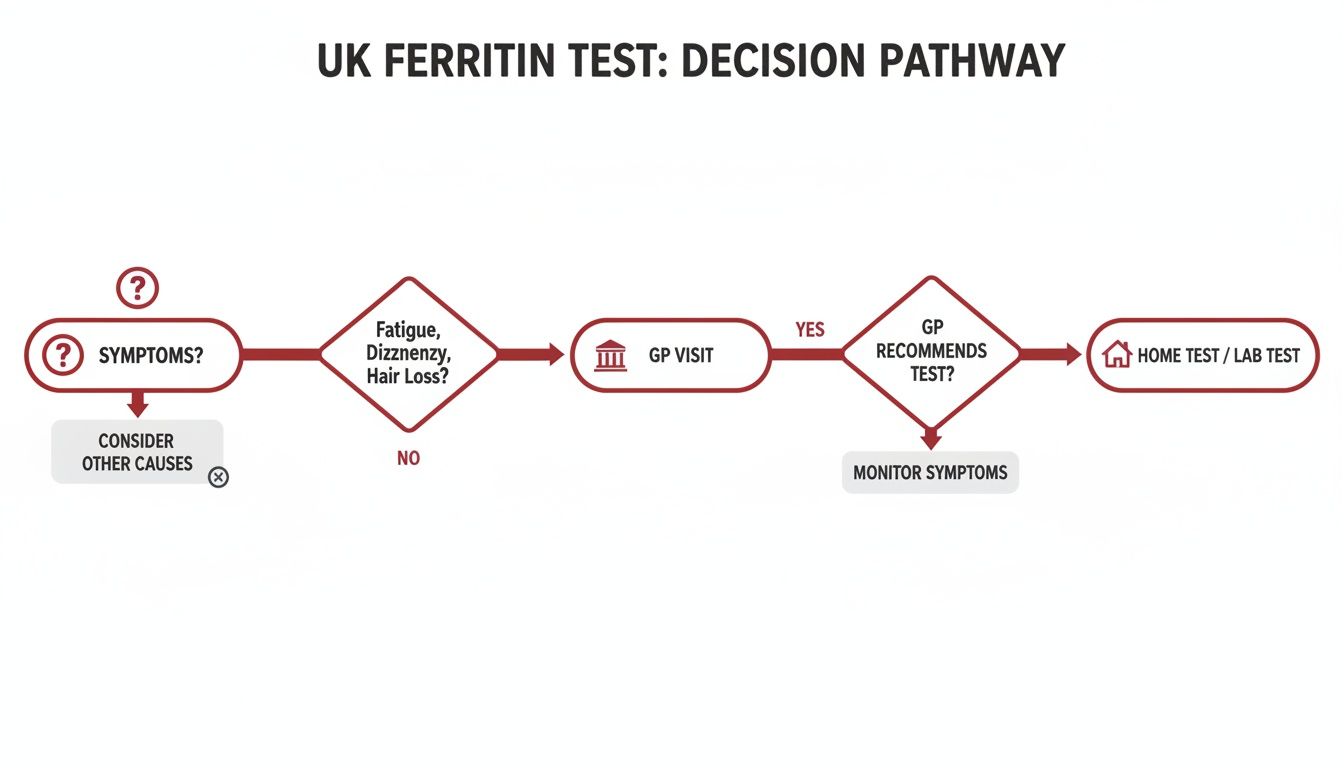
As you can see, both the NHS route and private at-home tests are valid ways to get the answers you need.
The Inflammation Factor: A Crucial Detail
Here’s something absolutely critical to understand when looking at your ferritin results: ferritin is also an acute-phase reactant. In simple terms, this means its levels can shoot up in response to inflammation, infection, or chronic illness.
This can create a very misleading picture. For example, you could have genuinely low iron stores, but if you’re also dealing with an underlying inflammatory condition (like an autoimmune disease or even just a recent bug), your ferritin level might look falsely high or "normal." This can completely mask a true iron deficiency, stopping you from getting the right diagnosis and treatment.
Practical Tip: If your result seems high but you still feel unwell, it’s vital to consider inflammation as a possible culprit. Having an open conversation about this, along with any other health conditions you have, with your healthcare provider is a crucial next step.
It’s also important to trust the testing method you’ve used. To learn more, you can read our detailed guide on whether at-home blood tests are accurate, which explains how our lab-certified tests deliver reliable results. Armed with this knowledge, you can have a much more productive and informed conversation with your doctor about what to do next for your health.
Got Questions About Ferritin Testing?
When you’re looking into something like a ferritin blood test in the UK, it’s natural to have a few practical questions. Here are some straightforward answers to the queries we hear most often, so you can feel clear and confident about taking the next step.
How Often Should I Check My Ferritin?
This really comes down to your personal situation. If you’ve just had a low result and you’re actively trying to raise your levels through diet or supplements, it’s a good idea to re-test every 3-6 months. That gives you enough time to see if what you’re doing is actually making a difference.
On the other hand, if you have ongoing risk factors – like heavy periods or a plant-based diet – a yearly check-in is a smart way to keep an eye on things. It helps you spot any dips early before they become a bigger problem.
Is a Finger-Prick Test As Good As a Full Blood Draw?
Yes, absolutely. For a stable marker like ferritin, a finger-prick (or capillary) blood test is spot-on for accuracy. The real key is what happens after the sample is taken. Our at-home test kits are sent to the very same UK-accredited labs the NHS trusts for their analysis.
So, you get all the convenience of taking your sample at home, without ever having to compromise on the quality or reliability of your results.
Can I Just Fix Low Ferritin with My Diet?
For some people, dietary changes can be enough to get things moving in the right direction. A practical first step is to load up on iron-rich foods like red meat, poultry, lentils, and spinach. The crucial trick is to pair these foods with a source of vitamin C—think citrus fruits or bell peppers—as this massively boosts how much iron your body can absorb.
However, if your levels are seriously low, diet alone might not be enough to replenish your iron stores quickly. In that case, your test results provide the data needed for a doctor to recommend supplements to give your levels a more significant and timely boost.
How Does Hormonal Contraception Affect Ferritin?
This is a really important point that often gets missed. Hormonal contraception that reduces or stops periods altogether, like the hormonal IUD or certain contraceptive pills, can have a hugely positive effect on ferritin levels.
Practical Example: If you start a new form of contraception and your fatigue lifts, it could be because the reduced blood loss is allowing your iron stores to rebuild. This is a vital piece of the puzzle when you’re trying to understand your results and overall health.
Ready to get a clear picture of your iron stores? Take control of your health from the comfort of your own home with a simple, accurate ferritin test from Repose Healthcare. Order your Ferritin Blood Test today.
You Might Also Like
STI Test Kit at Home: How It Works and What to Expect
You've had condomless sex with a new partner, feel completely well, and are now deciding [...]
Fertility Blood Test Day 3: What to Expect
You've booked your first fertility appointment, but one phrase on the instructions keeps bothering you: [...]
Home Liver Function Test: What Results Mean
You've opened the results from a home liver function test and found a mildly raised [...]
Glucose Tolerance Test at Home: What You Need to Know
A true diagnostic oral glucose tolerance test in the UK is usually a supervised clinic [...]
At Home PSA Test: Accuracy, Process, and UK Guidelines
You notice that you're urinating more often, your stream seems weaker, or you want a [...]
A1C Blood Test UK: What It Measures and How to Get One
You've just opened a private or at-home A1C blood test UK result and found two [...]
STI Screening for Men: What to Test and When
You've recently ended a relationship, ordered an STI test kit online, and now you're staring [...]
Fertility Testing Before Trying to Get Pregnant: Key Info
You and your partner may have chosen a rough timeline, checked your finances and started [...]
Nutrition Testing Kit: What It Measures and Why It Matters
You're doing the sensible thing, eating reasonably, trying to sleep, and still feeling flat. That's [...]
Private Coeliac Testing UK: A Practical Patient Guide
You've been bloated after pasta for months. You've searched “coeliac symptoms”, noticed the fatigue and [...]
STI Test Kit Price Guide for UK Home Testing
Private STI test kits in the UK usually start at about £29 to £30 for [...]
Sexual Health Screening: Your Guide to 2026
You're often here for a very ordinary reason that suddenly feels loaded. A new partner. [...]
Pregnancy Screening Tests Private: Your UK Guide
You've had a positive pregnancy test, the NHS booking appointment is still ahead, and your [...]
What Is Glucose Tolerance Test and How It Works
A glucose tolerance test is a two-hour challenge test: after an overnight fast, your fasting [...]
Blood Test for Night Sweats What to Check and When
You wake in the early hours with damp nightwear, wet sheets and a racing mind. [...]
The 2026 Cost of Hepatitis Vaccination in the UK
You're usually looking up the cost of hepatitis vaccination for a practical reason. A trip [...]
Hormone Blood Test London: Find Your Perfect Test
Some London health questions start subtly. Your cycle changes a little. You feel wired at [...]
Peanut Allergy Test Kit: A Practical UK User’s Guide
A peanut reaction often starts with uncertainty, not clarity. You eat a biscuit, satay sauce, [...]
NIPT Test Edinburgh: Your 2026 Guide
If you're searching nipt test edinburgh, you're probably already in that familiar stage of pregnancy [...]
Peripheral Artery Disease UK: Peripheral Artery Disease UK:
You might be reading this because walking has started to feel different. Perhaps your calf [...]
NIPT Test Cardiff: Clinic, Home & NHS Pathways 2026
If you're in Cardiff, newly pregnant, and staring at screening options that all seem to [...]
Gender Scan Difference UK: Accuracy, Timing & Cost Compared
You've probably already done the same search most parents do. One tab shows the NHS [...]
NIPT Test Cambridge: Guide to Options & Booking 2026
You're in Cambridge, you've had the first rush of finding out you're pregnant, and then [...]
Home COVID Test Results: A Practical UK & Ireland Guide
You've done the swab, mixed the sample, added the drops, and now you're staring at [...]
DVT Test Squeeze Calf: Homan’s Sign & Beyond
You notice one calf is sore, a little swollen, and not behaving like an ordinary [...]
Your Guide to Every Travel Clinic Leicester Offers in 2026
Flights are booked. The hotel is sorted. Your passport is still in date. Then one [...]
13 Week Gender Scan: Accuracy, NIPT & What to Expect
By the time you reach 13 weeks, pregnancy often starts to feel more real in [...]
Your Pregnancy Scan London: Guide to Options & Costs
A positive test can make London feel suddenly very small and very complicated. You might [...]
Your Nuchal Dating Scan Explained: A 2026 UK Guide
That appointment message has landed in your phone or come through the post, and suddenly [...]
Normal Cortisol Levels UK: Get Clarity
Some people search for normal cortisol levels uk after weeks of feeling unlike themselves. They’re [...]